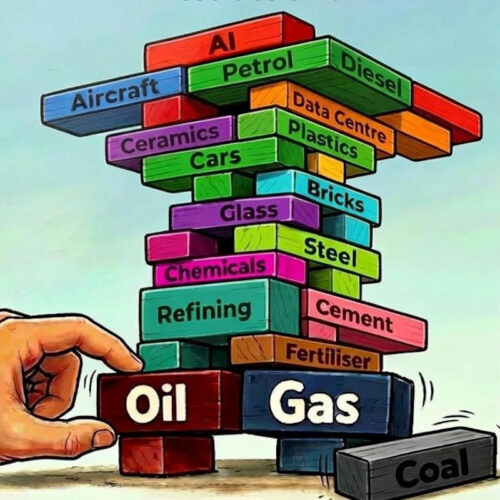

TOGETHER with David Turver and Brian Monteith, I recently published a paper – Premeditated industrial destruction; How the UK destroyed its industry and a plan to reverse this. It is a detailed debunking of all that is wrong with the UK’s Net Zero policy – with 116 pages packed full of examples, statistics and arguments of how the policy needs to be reversed.
To summarise, here are the 21 most important lessons from the paper:
-
- Despite all the talk about electricity and renewables, almost 80 per cent of UK Energy consumption comes from oil, gas and coal. Gas alone is 40 per cent of total UK energy consumption. Yet we are deliberately replacing secure domestic production with expensive imports due to high taxes, reduced allowances, high carbon charges, and restrictions on finding and developing new oil and gas fields.
- Gas security remains a real and immediate threat to the UK economy. The currentconflict in the Persian Gulf, a recent cyclone in North Western Australia, and this summer’s scheduled maintenance of Norway’s pipelines and processing facilities will restrict supply and push gas prices higher, increasing the UK’s trade deficit unless UK production is increased.
- Oil and gas aren’t just fuel – they’re essential feedstocksfor chemicals, plastics, pharmaceuticals, and fertilisers. High costs and green dogma are shutting down refineries and downstream industries.
- Industrial heat for cement, glass, ceramics, aluminium, and steel comes from gas and coal (plus metallurgical coal for steel production). Carbon taxes and sky-high energy prices aredriving up construction costs—making homes, infrastructure, data centres, and even wind turbines more expensive.
- Scrap the taxes and regulations that limit UK oil and gas production, such as the Energy Profits Levy (windfall tax), the Oil and Gas Price Mechanism, the Carbon Price Support tax, and the restrictions on fracking, exploration and development of new fields. They are not part of the UK’s Paris Agreement commitments; removing them would reduce costs, revive industries, and boost domestic supply.
- The UK government shouldcopy Norway: encourage exploration and invest in offshore and onshore fields such as Lincolnshire’s Gainsborough Trough. The Norwegian government owns 67 per cent of Equinor, the oil and gas major, it encourages exploration in the North Sea, and companies continue to find new oil and gas fields.
- Coal remains the world’s #1 energy source. The UK has high-quality anthracite and thermal coal—mine it, export it, and build modern, clean coal plants for fast, firm power. Old mine waste holds rare earths and critical minerals—extract them.
- Extractive industries: oil, gas and coal, as well as their downstream industries: oil refining, chemicals, plastics, and pharmaceuticals, have very high productivity – output per worker. Forcing these industries to close due to high corporate and carbon taxes on their production and necessary inputs has lowers total UK productivity and GVA, and devastates regional employment.
- Britain’s top exports—fuels, chemicals, pharmaceuticals, vehicles, aircraft parts—rely on imported raw materials. Reducing the supply of North Sea oil and gas, taxing energy, and taxing imported raw materials makes UK goods less competitive in international markets, lowers UK exports and increases the UK’s trade deficit.
- The UK’s largest goods export sector: vehicles and aircraft parts, relies on large amounts of aluminium, which is produced using electricity and gas. But UK carbon taxes, high industrial electricity costs and environmental regulations have driven 95 per cent of UK primary aluminium production out of the country.
- UN emissions accounting treats a 30-year aircraft wing the same as a disposable drinks can. This absurd equivalence punishes durable, high-value manufacturing.
- The UK cannot achieve Net Zero with the current technology – and the international accounting system for CO2 emissions excludes imported goods. Meanwhile, the UK imported goods with 180 million tonnes of CO2 emissions in 2024, making a nonsense of the UK’s claims to have cut its emissions by 300 million tonnes.
- Imported goods may have higher emissions than UK-made equivalents, but are not counted as UK emissions under the UN system. As a result, shortsighted UK politicians focus only on territorial CO2 emissions and favour imports over domestically produced goods, ignoring employment, tax revenue, and export income.
- Joining the European Union’s Carbon Border Adjustment Mechanism (CBAM)will increase the costs of inputs for the UK’s complex goods, such as chemicals, plastics, pharmaceuticals, glass, ceramics, and vehicle and aircraft manufacturing. The EU’s CBAM only covers simple input products: iron and steel, aluminium, fertilisers, cement, hydrogen, and electricity. The UK is reliant on imported supplies of all of them.
- There is no single global oil price. Oil prices vary by grade, delivery cost, and insurance. North Sea Brent Crude is highly valuedbecause it is a light, sweet oil, particularly suited to the production of petrol, diesel, jet fuel, and chemicals. We should not be leaving it under the North Sea.
- Natural gas prices vary with its composition, location and transport costs. North Sea gas fields connected to the UK via pipeline ensure dependable supplies. Converting gas to a liquid and transporting it is expensive, energy-intensive, and requires specialist plant. The UK does not have any specialist LNG plants but we do have our own untapped gas fields.
- Scrap the ZEV mandate, EV subsidies and fines imposed on car manufacturersfor selling people the ICE cars they want to buy. Stop the time-consuming task of enforcing EV sales, focus on supplying urban chargers and let the market decide.
- Both major parties havedeindustrialised Britain through energy taxes and environmental red tape. Reversing this may require exiting the Paris Agreement, the ECHR, and similar agreements. The US is moving that way—the UK should too.
- Financial and insurance rules should focus on real risk/reward—not hypothetical 100-year climate scenarios—unless the investment literally lasts 100 years. Company reports should focus on company results, not on Net Zero commitments.
- Award government and council contracts on ability to deliver—not Net Zero virtue-signalling. Scrap the requirementsdemanding contractors produce carbon reduction plans, Net Zero commitments, and low-carbon specifications.
- Hydrocarbons are not going away. Data centres and AI will drive UK gas demand for dispatchable power from ~8 TWh to 26 TWh by 2030(Oxford Economics). Cement and steel needed to build data centres will explode too—both require gas and coal. Leaving these resources buried is a self-inflicted economic disaster.
That’s just a summary, but there’s so much more to read – find the link here.
Established in 2006 and celebrating twenty years, ThinkScotland is not for profit relying on donations to publish our wide range of opinions. You can subscribe to our FREE newsletter here – share and follow us on ‘X’ here – like and comment on facebook here and make a donation here. Every contribution helps to meet our overheads.