
POLITICALLY, the UK has been moving toward the dismantling of its hydrocarbon extractive industries for many decades. Almost all post-war UK governments, including those of Harold Wilson and Margaret Thatcher, either closed down, increased regulations, or increased taxes on the industry as a whole or on parts of it. The only exception was the brief government of Liz Truss, which proposed lifting the fracking moratorium, but Rishi Sunak ousted Truss before it could take effect.
Compiled for the GBBC paper: Premeditated industrial destruction; How the UK destroyed its industry and a plan to reverse this the following fifty policy decisions map out the steps taken to move the UK to Net Zero. What is noticeable is how each party has sought over the years to outdo the other in their zeal for kneeling before the altar of Net Zero. Occasionally there has been a delay announced but inevitably even those have been rescinded and UK governments have doubled down (eg fracking moratoria, oil & gas licences and ICE vehicles being replaced by EVs.)
Here’s the UK’s Top Fifty hit parade…
- Ironically, being the only scientist we have had as a prime minister, Margaret Thatcher may have inadvertently started the UK’s pursuit of Net Zero when she warned the UN in 1990: ‘The danger of global warming is as yet unseen, but real enough for us to make changes and sacrifices.’ In her 2003 memoir, Thatcher expressed regret for the ‘apocalyptic hyperbole’ she had unleashed and lamented how the climate-change narrative had ossified into a ‘dogma’. In 1990 Thatcher established the Hadley Centre for Climate Prediction and Research, which to this day produces the primary datasets for the Intergovernmental Panel on Climate Change (IPCC).
- The ‘dash for gas’, which took off in earnest in the early 1990s, was already reducing UK CO2 emissions, at no cost to consumers and long before the Climate Change Act.
- The UK Major Government signed the UN’s 1992 Rio Declaration, which consisted of 27 principles intended to guide countries in future sustainable development.
- The Blair government signed the 1997 Kyoto Protocol, committing the UK to reducing emissions. John Prescott was the UK representative at the 1997 Kyoto Protocol meeting and played a prominent role in negotiating the UK’s commitments within the EU framework.
- The EU introduced its Emission Trading System (ETS) in 2005. This was the world’s first large-scale international carbon market. The ETS requires power generators, heavy industry and intra-EEA aviation to buy allowances for every tonne of CO2 they emit. It also caps total emissions by limiting the number of allowances sold, with zero allowances sold by 2039.
- The Labour Government under Gordon Brown signed the Climate Change Act in 2008. Both the Conservative and the Liberal Democrat opposition parties claimed the target reduction was too low. Only five MPs voted against the bill in its second reading, and only three MPs, Christopher Chope, Peter Lilley and Andrew Tyrie, opposed it in its third reading. The Climate Change Act 2008 required the government to:
– reduce greenhouse gas emissions by 80 per cent below 1990 levels by 2050
– reduce carbon dioxide emissions by 26 per cent by 2020
– set out a series of five-year carbon budgets to establish the pathway to 2050
– prepare policies to keep emissions within these budgets
– Introduce emissions trading schemes by secondary legislation
– publish regular reports on the risks to the UK from climate change and programmes for adaptation to respond to the risks identified
– The act established the Committee on Climate Change (now called the Climate Change Committee), an independent, expert body to advise the government on the appropriate level for the targets, budgets, and matters relating to mitigation and adaptation. The Committee was required to submit annual reports to parliament on progress towards the targets.
- In July 2009 the Labour government published its Low Carbon Transition Plan.
- In April 2013, the Cameron/Clegg coalition introduced the Carbon Price Support tax to discourage the production of coal-fired electricity. This was in addition to the EU’s Emission Trading System.
- From September 2013, all UK-listed companies were required to report their annual greenhouse gas emissionsin their directors’ report.
- In 2015, the UK, as part of the EU, signed the Paris Agreement, where the EU had agreed collectively to reduce its net GHG emissions by 55 per cent from their 1990 levels by 2030. This was legally binding under EU law and included national and sector-specific targets.
- In July 2017, as Environment Secretary, Michael Gove announced plans to end the sale of new conventional petrol and diesel cars and vans by 2040.
- In 2019 the Theresa May Conservative Government amended the Climate Change Act by replacing the 80 per cent reduction target with a 100 per cent reduction by 2050. The amendment was debated in the House of Commons for less than 90 minutes and passed without a vote.
- From April 2019, the requirement for listed companies to report their energy use, their Scope 1 and Scope 2 emissions and their energy-efficient actions under the Streamlined Energy and Carbon Reporting (SECR) framework were introduced. It covered large unlisted companies, large Limited Liability Partnerships, and groups with two of either: turnover above £36m; 250 employees; or assets worth more than £18 million.
- Also in 2019, building on May’s policies, the Boris Johnson Conservative Government further accelerated the UK’s path to Net Zero with its Ten Point Plan for a Green Industrial Revolution. The plan was slightly delayed by COVID-19 lockdowns, but in general, most of it remains in place and is being implemented, whether voters realise it or not.
- From November 2019, the Johnson Government initiated a moratorium on fracking in England in November 2019. Both Scotland and Wales had already placed moratoria on the process. The moratorium in England was issued by the Department for Business, Energy and Industrial Strategy, then headed by Kwasi Kwarteng, and supported by the Oil and Gas Authority.
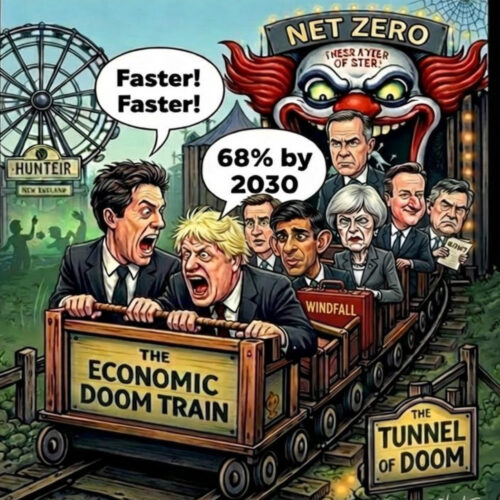
- Having left the EU in December 2020, the UK set its own Paris Agreement emissions reduction target of 68 per cent below 1990 levels by 2030 – an extremely ambitious target, considerably higher than the previous EU target of 55 per cent – and among the highest by any signatories to the Paris Agreement. It was set by Boris Johnson and the Business, Energy and Industrial Strategy Minister following advice from the Climate Change Committee. This target still stands.
- In November 2020 Boris Johnson brought forward the target for ending new petrol and diesel car and van sales from 2040 to 2030 as part of the Ten Point Plan for a Green Industrial Revolution.
- In December 2020, the UK-EU Trade and Cooperation Agreement (TCA) was signed. It included a commitment by the UK and EU to: carbon pricing; not weaken, lower, or reduce its environmental regulations and targets below those in place at the end of the transition period; and to continue to recognise international environmental agreements, including the UNFCCC.
- In January 2021, the FCA introduced the Climate Disclosure Rulesfor banks listed on the London Stock Exchange (LSE), requiring them to disclose their exposure to carbon-intensive sectors, their climate risk strategy and scenario analysis, including for a 1.5°C and 2°C increase in global temperatures. This regulation increased the costs of lending to high-emission companies.
- March 2021, the Johnson Government introduced the North Sea Transition Deal requiring early reductions in Offshore production emissions of 10 per cent by 2025, 25 per cent by 2027 and 50 per cent by 2030 by electrification of offshore platforms, CCUS and Hydrogen.
- In 2021, the PRA introduced the Climate Risk Management Rules, which require banks to identify climate-related financial risks, assess exposure to high-emitting sectors, model transition risks, integrate these risks into their credit decisions and hold capital to cover material risks. This regulation increased the cost of lending to companies deemed to face climate risk.
- From March 2021, UK banks operating in the EU were required to comply with the EU’s Sustainable Finance Disclosure Regulations(SFDR).
- In April 2021, Bank of England Governor Mark Carney established the Glasgow Financial Alliance for Net Zero(GFANZ). The group included Banks (NZBA), Insurers (NZIA), asset managers (NZAM), Asset owners (NZAOA), investment consultants and financial service providers. The group required its members to commit to achieving Net Zero Scope 1, 2, and 3 emissions by 2050, including emissions from their lending, investment, and financing portfolios. Members were expected to phase out financing for unabated coal and new hydrocarbon expansion, and to increase financing for clean energy and transition activities. UK banks: NatWest, HSBC, Barclays, Lloyds and Standard Chartered all joined. UK Asset managers and insurers: Legal and General, Schroders, Aviva, Prudential and M&G also joined the group.
- In June 2021, the Bank of England launched the Climate Biennial Exploratory Scenario (CBES), commonly known as Climate Stress Testing. It required major banks and insurers to model their potential losses from possible climate change. This regulation also increased the cost of lending to high-emitting industries.
- In June 2021, the government introduced the Procurement Policy Note, which requires all applicants for UK government contracts worth more than £5 million to have a Carbon Reduction Plan.
- In December 2021, the FCA Climate Disclosure Rules were extended to cover asset managers, insurance companies, and FCA-regulated pension companies.
- In 2022, the Johnson Government introduced the temporary Energy Profits Levy(Windfall Tax) of 25 per cent until 2025, which was an additional tax on oil and gas companies, bringing their total tax rate to 65 per cent, but the Government continued the investment allowances of 29 per cent to encourage new developments and an 80 per cent decarbonisation investment allowance.
- Since 2022, under FCA Listing Rules LR 9.8.6, all main board LSE-listed companies must include in their annual report: governance of climate risks; climate-related strategy; Scenario analysis; risk management; metrics and targets for Scope 1 and 2 emissions and Scope 3 emissions if material.
- In June 2022, the Basel Committee on Banking Supervision (BCBS) introduced its Principles for the effective management and supervision of climate-related financial risks. These applied to all internationally active banks, which included almost all of the UK’s Banks.
- In September 2022, the then-Prime Minister, Liz Truss, announced that she would lift the fracking moratorium, arguing that a greater supply of domestic gas could improve energy security, despite her Chancellor, Kwasi Kwarteng, having imposed the moratorium three years earlier when he was the Minister for Business, Energy and Industrial Strategy.
- Truss’s replacement, Rishi Sunak, reinstated the fracking moratorium in October 2022.
- Sunak increased the EPL (Windfall Tax) to 35 per cent in November 2022 and extended it to 2028, bringing the total tax rate on oil and gas companies to 75 per cent.
- In May 2023, the UK-New Zealand trade agreement came into force and included extensive environmental compliance requirements and an agreement not to derogate from its environmental laws to encourage trade. The agreement also commits to reducing hydrocarbon use and to removing hydrocarbon subsidies that distort trade.
- In June 2023, Sustainable Financewas formally written into UK financial services regulation when the Financial Services and Markets Act (FSMA 2023) received Royal Assent. The Act introduced the UK’s first statutory sustainability-related duties for financial regulations, including a requirement for the PRA and FCA to support the government’s net zero and environmental objectives when making financial rules.
- In September 2023 Rishi Sunak pushed back the deadline to end the sale of new petrol and diesel cars and vansfrom 2030 to 2035, citing cost-of-living concerns and the need for a “pragmatic” transition.
- In January 2024, the Sunak Government introduced the UK’s Zero Emission Vehicle Mandate with financial penalties for manufacturers who fail to meet EV sales quotas.
- In January 2024, the Sunak Government, under pressure from the industry, released 31 new licences which attracted 115 bids from 76 companies, despite the 75 per cent tax rate. The licences were expected to produce about 545 million barrels of oil equivalent (MMboe) by 2050 and 600 by 2060.
- In February 2024, the Offshore Petroleum Licensing Bill mandates that the oil and gas regulator, the North Sea Transition Authority, hold annual licensing rounds for offshore petroleum production, subject to two tests being met. First, the carbon intensity of domestic natural gas is lower than that of liquefied natural gas imported into the United Kingdom. Second, the UK is expected to remain a net importer of both oil and gas. However, the bill lapsed after failing to pass before the end of the 2023/24 parliamentary session.
- From June 2024, UK companies with large EU operations or EU-listed securities must comply with the EU’s Corporate Sustainability Reporting Directive(CSRD).
- From June 2024, the Economic Regulation Act 2024extended the duty to regulate for ‘Sustainable economic growth’ as defined in the FSMA 2023 to other regulators: Ofgem (energy), Ofwat (water), Ofcom (communications), ORR (rail and road), CMA (competition), Civil Aviation Authority, and the Payments Systems Regulator.
- In July 2024, the current Labour Government was elected, and in its first fiscal statement, the Chancellor, Rachel Reeves, increased the EPL from 35 per cent to 38 per cent, extended it to 2030 and removed the investment allowance of 29 per cent and reduced the decarbonisation investment allowance to 66 per cent. The Government claimed these changes were not expected to have ‘any significant macroeconomic impacts and no impact on individuals, households or families’.
- In August 2024, the Labour Government ceased to grant new oil and gas licences but agreed to respect those granted by the Conservatives before they left office.
- In August 2024, the government announced that it would not defend the legal challenge brought by Greenpeace and Uplift against the approval of the Rosebank oil field and the Jackdaw gas field.
- In January 2025, GFANZ removed the requirement for its members to align with the Paris Agreement after threats of an antitrust suit by US legislators.
- In June 2025, the government published guidance requiring oil and gas companies to include Scope 3 emissions – eg emissions made by their customers while using their product – in their Environmental Impact Statements.
- Following the 2024 general election Labour’s Ed Miliband reinstated the 2030 deadline for banning the sale of new purely petrol and diesel cars and vans, with Hybrids banned from 2035.
- The current Energy Secretary, Ed Miliband, announced in October 2025 that he would ban fracking by replacing the moratorium with a full legal prohibition. Miliband has committed to introducing legislation to end new onshore oil and gas licensing, including fracking licences.
- In November 2025, Chancellor Rachel Reeves announced that after the EPL expires in 2030, it will be replaced by the Oil and Gas Price Mechanism – an additional tax of 35 per cent applied to UK oil and gas firms operating in the UK and the UK Continental Shelf, and will be charged on the realised price a company receives above a threshold of £90 per barrel for oil and 90p per therm for gas.
- In November 2025, under political pressure and amid concerns about job losses, Ed Miliband, the UK Minister for Energy Security and Net Zero (DESNZ), introduced Transitional Energy Certificates, which allow limited new oil and gas developments if they can be connected to existing fields and pipelines.
- In November 2025, the North Sea Future Plan ended new offshore exploration licences and new onshore oil and gas licences in England. The policy also prevented fracking anywhere in England.
New entries to the chart shall no doubt emerge – watch this space…
Established in 2006 and celebrating twenty years, ThinkScotland is not for profit relying on donations to publish our wide range of opinions. You can subscribe to our FREE newsletter here – share and follow us on ‘X’ here – like and comment on facebook here and make a donation here. Every contribution helps to meet our overheads.
Illustration courtesy of GBBC, the Great British Business Council.