
IN 1988, Ken Livingstone published a book entitled ‘If Voting Changed Anything, They’d Abolish it’. The Holyrood election of 7 May 2026 demonstrated that sense of disillusionment. It became customary, before May, for commentators to talk about the ‘scunner factor’ and predict that it would lead to a low turnout. And so it came to pass that a mere 53.2 per cent of eligible Scots could be bothered to vote in this opportunity for them to exercise their democratic choice.
The accepted version is that it was not always so. We are routinely told that the 1997 referendum vote showed Scots’ enthusiasm for devolution. After all, 74 per cent voted for devolution. But that was 74 per cent of those who voted – about three-quarters of those who actually bothered to turn out. Only 60 per cent of those entitled to vote did so, while 2 in 5, or 1.6 million, did not. So in reality, 44.4 per cent of those eligible to vote supported devolution on the day of the vote.
Holyrood elections tell a different story from the accepted version. In 1999, 2003, 2007 and 2011, the turnout was even lower than in 1997, and in 2003, 2007 and 2011 it was lower than the 58 per cent reached in 1999. In 2003, the turnout was a mere 49 per cent, but then it rose to the dizzy heights of 56 per cent in 2016. In the 2011 alleged ‘landslide’ win for the SNP, only 50 per cent stirred themselves to vote. The SNP won 45 per cent of the vote on a 50 per cent turnout and went on to demand a secession referendum. In any other circumstance, that would be called a ‘mandate’ for nothing.
Perhaps there has been a change, with the 2021 election enticing 63 per cent to vote. The SNP won 44 per cent of the vote. Yet in 2026 we are back to the scunnered levels of the early years of Holyrood. Between 2021 and 2026, 10 per cent of those eligible to vote ceased to feel the need to do so – or to see the point of doing so. Perhaps it was simply that the 2021 turnout of 63 per cent was an outlier, another result of the Covid pandemic. Perhaps Scots were sufficiently impressed by the SNP’s handling of the crisis. Yet the SNP’s vote had declined from 46.5 per cent in 2016 to 44 per cent.
In 2026, the SNP’s vote declined further, losing 9.5 per cent in the constituency vote and 13.2 per cent in the list vote. This latter undoubtedly derived from SNP voters’ realisation that, when the SNP won the most constituency seats, it won penny numbers of list seats, because of the vagaries of the d’Hondt electoral system. This led a tranche of SNP voters to give their list vote to the Greens, with the result that the Green party increased its list vote by 5.9 percent, although its constituency vote had increased by only 1 per cent. Again, through d’Hondt, this meant that the Greens almost doubled their number of MSPs from eight in 2021 to fifteen in 2026, although it was noteworthy that the Greens this time won three constituency seats, including Nicola Sturgeon’s former seat, Glasgow Southside, the first time they had, in the devolution era, won any constituencies.
The Greens have been adept at gaming the Holyrood system. Because it has become clear that their attempts to win constituency seats have resulted, until this year, in total failure, they have simply not stood in the constituencies to any great extent, thus saving money and effort. Patrick Harvie did stand in Glasgow Kelvin in 2016, and won 24.3 per cent of the vote, coming second to the SNP.
In 2021, the Greens contested 12 constituencies, out of 73, but their lack of success then and the obvious advantage of using the list system to win seats reduced their constituency candidate list in 2026 to six. Whether most Scots, not least the SNP supporters using the list for their second secessionist vote, knew anything about the Green list candidates is a moot point. Voters would know something about other parties’ list candidates because usually the candidates who were numbers one or two on their regional lists were also constituency candidates, whose biographies and details featured on election leaflets. But many list candidates for all parties are an unknown quantity to most voters.
It would be interesting to know how many voted for Kate Nevens knowing that she wants to close our jails. How many who voted Green in Glasgow knew that Iris Duane, now a ‘trans’ MSP, wrote in January 2022: ‘I cannot wait until big lizard Lizzie kicks the bucket, not because she’s dead but because of the absolute meltdown it will cause the British consciousness’? The new ‘non-binary’ MSP in Edinburgh and East Lothian, Q. Manivannan, told us of his platform: ‘As a queer Tamil immigrant, I am standing to be an MSP to bring a politics of care and compassion to Holyrood’. Yet he had already written on X in February 2023: ‘Goddamn White people’. He also wrote of a distinguished feminist author: ‘infamous transphobe and bigot Kathleen Stock’, which is mendacious as well as deeply unpleasant. Anyone who thinks that the Scottish Greens are still the cuddly environmentalists they once were needs to think again. They are not: they are subversive radical socialists whose aim is to shake the foundations of our country.
The low turnouts at Holyrood elections have not been ameliorated by the extension of the franchise – to 16-17 years olds and to incomers previously not entitled to vote. In the May election, almost 70,000 foreign students were eligible to vote. This undoubtedly affected city centre constituencies in Edinburgh and Glasgow, with thousands of young foreigners adding substantially to the Green vote.
The fact that Q Manivannan is not only a student MSP when, importantly, he is an Indian citizen, is a result of a law passed in Scotland in 2024 allowing citizens of other countries to stand for election here. This was passed in the face of expert legal advice with no MSP voting against it. Someone needs to ask Messrs Sarwar, Findlay and Cole-Hamilton why that was: why did they not at least try to have this new law stopped? Investigation shows that countries including France, Germany, Canada, the US and Russia do not permit citizens of other countries to stand as candidates in their elections. It is enough here that we have foreigners – including the Green MSPs Maggie Chapman and Lorna Slater, who hail from, respectively, Zimbabwe and Canada – who have come to our country in order to try to break it up.
We are heading for a potentially disruptive political order, not least because of the d’Hondt electoral system. If those who designed it had stopped to think, they would surely have included a clause requiring all parties hoping to win MSP seats on the list to contest at least half of the 73 constituencies. That would not exclude individuals from standing as independent candidates. The inclusion of large numbers of student voters and other transients – who will mostly leave Scotland before the five-year Holyrood term in which they voted is completed – undoubtedly makes these voters less responsible in wishing on us policies and people whose effects will not affect them beyond the short term. The capriciousness of Holyrood was demonstrated by the 2024 law allowing citizens of other countries to stand for our representative assembly. Why the opposition parties as well as the separatists voted for that is a mystery, especially when MSPs who are citizens of a foreign country could even end up representing their constituents here virtually from hundreds of miles away. As the long-time separatist blogger, Stuart Campbell, put it recently: ‘Suddenly, being ruled merely from London doesn’t sound so outrageous’.
It remains to be seen how much of a break with the past the new order will be. One thing, however, is clear. The instruction to us all needs to be: ‘Fasten your seatbelts. We are expecting turbulence’.
Established in 2006 and celebrating twenty years, ThinkScotland is not for profit relying on donations to publish our wide range of opinions. You can subscribe to our FREE newsletter here – share and follow us on ‘X’ here – like and comment on facebook here and make a donation here. Every contribution helps to meet our overheads.
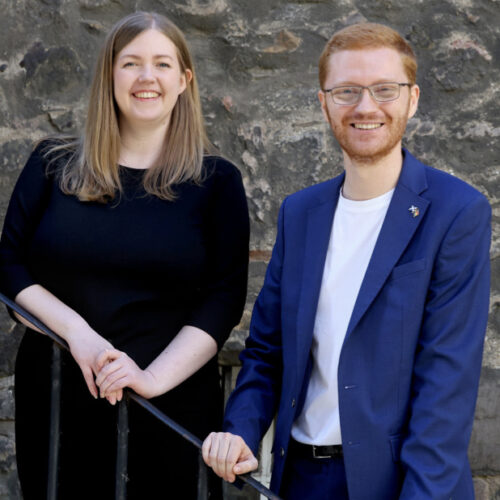
Image of the Scottish Green co-leaders from the party’s very long and detailed manifesto.