
In praise of unearned income
THE WORLD owes to Darwin some ground-breaking insights into the history of life on earth. Mankind and its environment, he argued, was not a creation of God’s but the product of many millions of years’ evolution, starting from much simpler life forms. The theme of this book is how Darwin changed our view of history. No longer was it dependent on the plan or caprice of some Supreme Being but rather on the process of evolutionary change throughout a long history. Darwin did not know how long, but it was his achievement to have persuaded the sentient world that we ought to review both the history and, implicitly, the morality which derived from the creationist tradition.
Charles Darwin was a gentle but industrious man who loved his scientific work. But love is rarely enough to change the world; you need resources too. Thanks to capitalism, Darwin had those resources when he needed them. Without both unearned wealth and abundant leisure, he could not have been able to work as he did.
On all sides we hear the cry that one of the problems afflicting modern contract society is “the gap between rich and poor”. But really, that is one sign of a free society, since people are not equal in talent and capability. In social conditions of practical liberty those differences will manifest themselves in unequal wealth. The drones of the thick-left have long tried to pretend that juridical equality — i.e. before the law or in the polling booth — represents the whole of reality and that nobody should be allowed to display, much less enjoy, their superiority in any competitive field, like sport, art or business life.
Rousseau tried to argue that freedom was not possible without equality, which is roughly the assumption behind modern artificial egalitarianism. But his illusions did not survive the Terror, which killed many of France’s most distinguished scientists because they had been born to unearned wealth and abundant leisure (as touched on in connection with Lavoisier in my review of a biography of Humboldt, Darwin’s hero). I mention all this as Darwin’s life proved the opposite. Without economic inequality he could never have changed world’s thinking in the way he did.
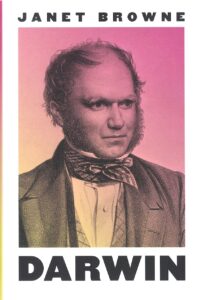
Janet Browne’s Darwin – a Biography (2026) is a single-volume condensation of a previous two-volume account—Voyaging(1995) and The Power of Place (2002). The Introduction opens with this truism: “Few men shook Victorian England as deeply as Charles Darwin did with the theory of evolution by natural selection.” (p. ix) Professor Browne then notes that Darwin had some special advantages. “Generated during the age of empire, Darwin’s ideas self-evidently thrived in the age of capital.” (p. x) That is my point. Without capitalism we might never have heard of Charles Darwin and the dispute between apes and angels as the ultimate forebears of all humanity.
Prof. Browne notes further in her Introduction: “[Darwin] had a large private income derived from the industrial revolution and he never had to find a job.” (p. xii) It was this freedom from the cares of the ordinary world that allowed him to devote time to things like wondering whether earthworms could hear a bassoon. Towards the end of his life, in 1880 and 1881, Darwin tried to “train” some earthworms, but he had little success because, as he himself confessed, they can “neither see nor hear” (p. 527) His methods included blowing a whistle at them, breathing tobacco fumes on them and waving a red-hot poker over them. Nothing worked, but that would not deter any man of true curiosity. Instead, as Prof. Browne comments: “More and more, he enjoyed the company of worms.” (p. 526) How charming, you might think.
But there was a worm in the rose, not for Darwin but for his twenty-first century biographer.
It was only because he was heir to a fortune from his father and another one from his wife’s family, the Wedgwoods, that Darwin was able to spend his entire life as what Lenin would have called a “bourgeois bloodsucker”. Dr Robert Darwin was a successful doctor who, throughout a long life, put all his spare money into property with such effect that when he died in 1848 his probate amounted to nearly quarter of a million pounds, an enormous sum for the time. That was even more than the fortune left by his industrialist brother-in-law, the second Josiah Wedgwood, which came to £150,000.
That was the basis of Charles Darwin’s ability to devote his time to researching the sensory equipment of earthworms. We know from Charles Dickens just how hard and unpleasant the lot of the average factory hand was in the early part of the nineteenth century, when inequality of outcomes was at its height in Britain. Conceptually, it was that which financed Darwin’s leisure. Socialistic equality of the sort that is currently fashionable in Britain destroys not only creativity in art and literature, as we know from the Soviet experiment, but also the practical freedom of thought which makes imaginative science possible.
Professor Browne’s book is a delight to read—though for some there might be a bit too much on Darwin’s family rather than on the man himself. But that is a quibble. It is clearly a labour of love, financed in this case by an expensive public education system. Despite that, Browne is curiously sniffy about Darwin’s private means and about the wider context of his work.
Getting out and about in the world can apparently be an example of “imperialism” if described by a biographer who, strange as it may seem given her subject, does not seem to believe in evolution as far as morality is concerned. Today’s morality is self-evidently different from that of the mid-nineteenth century. Browne acknowledges that, but for some reason assumes they should be the same. If you take that idea to the extreme, we should be putting cavemen on trial in absentia for murder, cannibalism and ecological destruction.
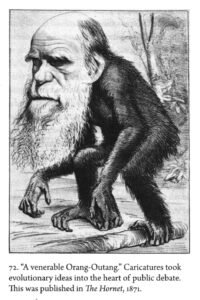
Morality, to Browne, is unchanging over time, as if it came from God. This is equivalent to the Creationism which Darwin rejected. It is, of course, logically unsustainable to judge nineteenth century Victorians by the morality of twenty-first century Carolingians. I am not a professional philosopher, simply an amateur human being, but it seems to me that Creationism stands to evolution rather as Flat Earthism does to geography. The result is some deeply unconvincing criticism of Darwin’s approach to his work.
Prof. Browne tells us that “exploring expeditions were central to the process of colonisation as well as science.” (p. 66), and also that “like other collectors of the time, [Darwin] considered that he possessed the right to take material as he wished. Wild nature, so to speak, was there for the taking.” (p. 100) Darwin was “fully embedded in the lattice of imperial endeavour.” (p. 101) Referring to the three Fuegians whom he took back to London, where they “bowed and curtsied to King William and Queen Adelaide”, Prof. Browne comments; “It was a deeply exploitative moment in the relations between Europe and the global south.” (p. 124)
This had moral implications. Darwin was “no more and no less than a typical figure of empire, seeing both simplicity and savagery as characteristic of Indigenous peoples, neither of which could match the civilisation of his own kind.” (p. 172) Yet, in the same paragraph, Prof. Browne notes Darwin’s approval of “the Tahitians’ unsophisticated society [which] made them natural gentlemen, the ‘finest men I have ever beheld’.” Browne comments: “He seemingly had no problem characterising one set of Indigenous peoples as savages and another as noble.”
What on earth is going on here? Prof. Browne appears to think that all “Indigenous people” (her capitalisation, which is a clue: the word is more than a simple adjective) should be evaluated as the same. That is the Rousseauian equality fantasy writ modern. It seems to have escaped the mind of this highly-educated woman that some non-Europeans are disgusting and others admirable, while most are somewhere in between, like the rest of us. Why has her ability to observe, judge and evaluate deserted her? Is she in fact indifferent to the relative quality of various groups of Indigenes?
By contrast, Europeans attitudes can be warped. Darwin, along with Captain Fitzroy who commanded HMS Beagle, “openly subscribed to a particular view of human nature, a view embedded in racial paternalism and the belief that all people possessed a capacity for progress through education and the alleviation of external circumstances.” (p. 186) So, it is racist to believe that some people are capable of progress while others are not, yet it is also racist to believe that Indigenes were intentionally static. Yet, the whole story of the Fuegians as Browne tells if is of a lack of “progress” and a complete indifference to it. Darwin and Fitzroy were guilty of “racial paternalism” in accepting the facts as they observed them. The logic is chaotic. Methinks the learned lady has got her prejudices in a twist.
Finally, the trendy explanation for all this is early industrial capitalism’s inherent evils. That meant that while some people got very rich, others stayed very poor. How very shocking! Darwin, poor chump, “never really came to understand the depth of deprivation already suffered by working people. The great advances in manufacturing of the era depended on oppression and servitude, while the new wealth of the upper classes derived from extractive capitalism, enslavement in overseas territories, and exploitation of natural resources in England and its colonies.” (p. 195) That is largely true, as far as it goes, but that is not very far. It has been a cliché since Dickens’s day at least and, in any case, it makes no difference to Darwin’s scientific achievement—unless Browne is making the absurd, Leninist point that because he was rich and others poor, he should not have engaged in anything so frivolous as evolutionary biology which, I emphasise, Professor Browne is not saying. My objection is only to her static moral flat-earthism which she parades like a badge of righteousness.
Why? Might there be a professional explanation? I note that Browne started her academic life at Trinity College, Dublin in the 1970s. That was a period in Ireland when it must have been obvious to any undergraduate that there was an unbridgeable moral gulf between the “primitive savages” who committed terrorist bombings in crowded pubs and Ireland’s “Tahitians” who sucked silky pints of Guinness in Grafton street bars while making insider jokes about Flann O’Brien’s mockery of the “noble savage” propaganda on behalf of native Gaelic culture.
Browne taught in London until 2006 when she relocated to Harvard, an institution with a foundation of about $60 billion, of which perhaps a third is estimated to have been derived indirectly from the profits earned by what might politely be called “racial paternalism”.
The question must remain open – is this confused thinking on race and socio-economic differentiation a product of political correctness in wokey, Blairish Britain or did it evolve at Harvard where the world is currently being instructed in the etiquette of apology for the interest-bearing financial consequences of the race-based sins of the early United States?
Either way, it is a profound weakness in an otherwise fascinating and clearly-written book which taught me a great deal about one of the most important thinkers of modern times. Whatever disobliging things can be said about Darwin—and there are very few—he at least was never a static-brained moral authoritarian. In that, he was more like the mute, inglorious earthworms whose undemanding company he so enjoyed in his sunset years.
Images kindly provided by the reviewer.