
An interesting account of the long history of the Indian sub-continent
WRITING OF THE FIRST European conquest in India, Audrey Truschke says in her fascinating book India 5,000 years of History on the Sub-Continent: “the Portuguese instituted colonial rule—a distinctive, new kind of political subjugation by a foreign state—whereas the Mughals carved out a pre-modern kingdom as others had done for centuries.” (p. 223) The implication in context seems to be that Mughal conquest was OK, but European conquest was “colonial”. Is this racism, cynical political sail-trimming or, more likely, lazy thinking on the basis of popular prejudice? What is the difference between Muslim conquerors and Portuguese ones?
The only difference that I can think of other than race is that the Mughals—descendants of the Mongols—came into India overland whereas the Portuguese came by sea. I omit the fact that the Mughals killed infinitely more Indians than the Portuguese ever did as they were not there to trade but to take overall control. They first invaded in 1526 when they set up “a small fledgling state founded by Babur, a failed Central Asia ruler who decided to try his luck in northern India.” (p. 236)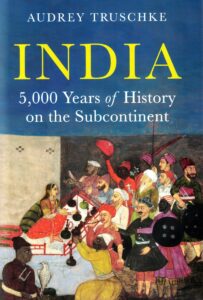 The Mughals were not the first Muslims to invade India. Babur viewed Hindustan as his “birthright, because he was the great-great-great-grandson of Timur who had sacked Delhi in 1398. India was a wealthy land that promised fertile farming, a flush treasury, and a fresh start.” Is Truschke’s position that resource and population capture represent “aristocratic” behaviour, whereas trading by Portuguese box-wallahs is sinfully “colonial”?
India was weak because it was almost as fragmented as eighteenth-century Germany. Professor Truschke notes, “It is critical to cognize that, as of about 1750, India did not exist as a unified political entity.” (p. 330) The plain fact is that the state of India as we know it today was created by the British over the century following the battle of Plassey in 1757. The Mughal empire, which reached its maximum extent about half a century before that, never covered the sub-continent completely. Even at its peak, it controlled less than 90 per cent of the area which was later incorporated into British India.
The Islamic rulers did not even try to accommodate Hinduism, the religion of the overwhelming majority of Indians. Islam was imposed upon them at least as ruthlessly as commerce, education, free markets, modern legal codes and the railway system were imposed by the British. I have read a great deal about India in the context of my researches into Russian history, which has a large Islamic element deriving from the Mongol-Tatar conquest, and I cannot for the life of me see why British India was any more exploitative or unpleasant than the Mughal empire was. In many ways I think it was a lot better, and certainly more modern. It helped integrate India into an increasingly international world of commerce.
Audrey Truschke is Professor of South Asian History at Rutgers University in the United States, and her speciality is Sanskrit scholarship and Mughal history. She is too good a scholar to indulge in anti-colonial polemics, but right through her book, she snipes at British rule in India while appearing not to take more than routine exception to the asperities of Mughal rule. By the time I got to the end of this long book—which I hasten to add I enjoyed reading—I felt as if I had been tutored by an old-fashioned FDR-type of “anti-imperialist” who thinks imperial exploitation began and ended with the British.
For example, ordinary racism becomes merely “colorism” (sic) when a Mughal is guilty: “The Mughal emperor Jahangir used colorism language to express his loathing of Malk Ambar, who defied Mughal state authority. He referred to the Habshi kingmaker as ‘black-fated’ and ‘black-faced’.” (p. 263) By contrast, “the British Raj remained fiercely racist.” (p. 382)
Was it “fierce racists” who abolished sutti (the burning alive of widows), ended slavery (to which India had been subject for at least a thousand years) and limited child marriage. Rather than allowing men to take girls as young as eight as “wives”, which seems to have been common, the British twice legislated to raise the age of consent—to twelve in 1891 and to fourteen in 1929.
I wondered whether Prof. Truschke’s problem with Britain was really institutional. Maybe it is an unspoken condition of employment in American history faculties (or at Edinburgh “university” generally) that you have to conform to the fashionable idea that British colonialism was a sin while other regimes resulting from conquest, including the Mughals in India, were not. I make the point because, otherwise, this book provides a fascinating account of Indian history. It is long—500 pages of narrative and 200 of references, bibliography, etc.—but it manages to compress five thousand years of history into a readable narrative, with both pictures and quotations from some of the more colourful sources.
An example of the later is the letter, published in the Times of India in 1885 about underage marriage, by “a Hindu Lady”.
Sir, I am one of those unfortunate Hindu women whose hard lot it is to suffer unnameable miseries entailed by the custom of early marriage. This wicked practice has destroyed the happiness of my life… Without the least fault of mine I am doomed to seclusion; every aspiration of mine to rise above my ignorant sisters is looked upon with suspicion, and is interpreted in the most uncharitable manner… Men cannot, in the least, understand the wretchedness which we Hindu women have to endure. (p. 386)
The most interesting part of this book is undoubtedly the period after 1947. Having been united by the British, India was able to become an important country, though apparently not a particularly peaceful one. From the time of Gandhi’s murder less than six months after independence, there was less law and order than under the Raj.
Truschke notes that India is now said to exhibit “electoral autocracy”. Hindus rule a country that is home to about 200 million Muslims (15 per cent of the total population). Their approach to governance can often involve violence against what the current Prime Minister, Narandra Modi, has called “infiltrators”, by which he meant Indian Muslims. Yet he greets his friend Vladimir Putin with flowers while proclaiming the universal brotherhood of man. It is that sort of “selective universality”, a contradiction in terms, which is the root of most racism (“We love everybody BUT the …”)
Indian Muslims bear the lion’s share of [extremist Hindu] harassment, violence and oppression. India houses the world’s third largest Muslim population… In 1992, a Hindu mob tore down [a sixteenth century mosque in northern India] brick by brick, thereby committing a major act of anti-Muslim iconoclasm and destroying a piece of Indian cultural heritage… Following the destruction , riots broke out across India, and a few thousand Muslims were murdered…
Hindu nationalists later repeated the tactic of unleashing anti-Muslim violence. Notably in 2002, Narendra Modi, then chief minister of Gujarat, oversaw three days of Hindu-led violence against Muslims in his state. In that instance about 2,000 Indians were murdered (mostly Muslims) and hundreds of thousands were displaced by Hindu mobs…. International investigations have concluded that the Gujarati police acted on Modi’s orders… and later engaged in a brutal cover-up. (pp. 490,1)
As a result of his racism, both the British and American governments banned Modi from entering their counties for a decade. In India, by contrast, he was hailed as “a strongman who stands as a muscular defender of the Hindu majority.” Modi never apologised for what he did and, in 2014, became Prime Minister. The attacks on Muslims continued, as they did on Christians.
Interfaith couples were persecuted by Hindu far-right groups… [and] some Indian Muslims were assaulted, even killed, over accusations of eating beef. [They did this] with tacit or explicit support of the Indian government. (p. 492)
Worst of all, India has got the ultimate nationalist disease, namely the destruction of the independence of the courts. The suspicion is that, as in Russia and China today, political interests dictate the attitude of the courts, just as they used to under the Stuarts, in both Scotland and England. India is moving from being “a secular democracy striving for equality to a Hindu state with shrinking human and civil rights.” (p. 493) As a result, India was downgraded from “free” to “partly free” in 2020 in the Freedom House rankings.
 Truschke (pictured) quotes the aftermath of the destruction of the mosque. Twenty-seven years later, in 2019, the Indian Supreme Court finally passed judgement on the 1992 case. It found that, though the destruction of the mosque was illegal, its replacement by a Hindu shrine was perfectly legal. Truschke comments: “The 2019 judgement was also symptomatic of a larger issue, namely that Hindu nationalists had eroded the Indian judiciary’s independence. As a result, courts no longer provided the checks on [extreme Hindu] challenges to Indian democracy, freedom of religion, and the rule of law.” (p. 493)
It is a shame that Prof. Truschke did not see fit to note that free courts and an independent judiciary were one of the most important legacies of the “fiercely racist” British Empire.
Established in 2006 and celebrating twenty years, ThinkScotland is not for profit relying on donations to publish our wide range of opinions. You can subscribe to our FREE newsletter here – share and follow us on ‘X’ here – like and comment on facebook here and make a donation here. Every contribution helps to meet our overheads.
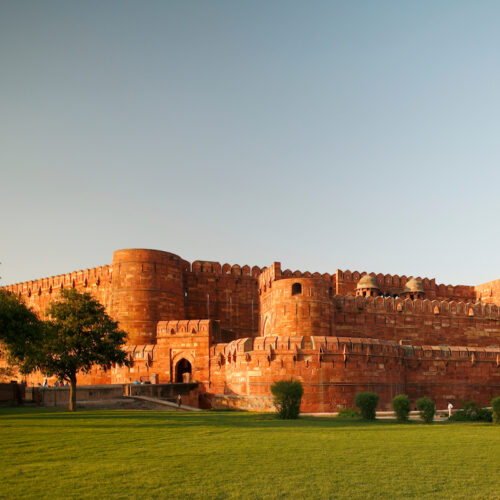
The Mughal Red Fort at Agra, Uttar Pradesh India by abc foto from Adobe Stock.