
FOR DECADES, Scottish politics has argued over how much money Scotland receives. The debate has revolved around the Barnett Formula, fiscal transfers, oil revenues and competing visions of the constitutional future.
Yet perhaps we have been asking the wrong question.
The real question is not how much money Scotland receives. It is what Scotland has to show for it. For as long as people can remember, Scotland has enjoyed a level of public spending above that of most parts of England. Supporters of the current settlement point to Scotland’s geography, remote communities and unique public service obligations. Critics point to a spending premium that has too often been consumed rather than invested.
Both sides miss something important.
Scotland is not primarily a rural country. Around 80 per cent of Scots live in towns and cities, concentrated largely within the Central Belt and a network of urban communities stretching across the country. While remote and island communities face genuine challenges, the overwhelming majority of Scotland’s population lives in places more comparable to northern English regions than to isolated Highland settlements.
That matters because the Barnett Formula was never designed to ringfence money for remote communities. It simply provides a block grant. Once the money arrives in Holyrood, spending decisions become a matter for the Scottish Government. (Pre-devolution it used to arrive at the Scottish Office and spending decisions were influenced by the fact that its ministers were from the UK’s Governing party.)
For twenty-seven years, Scotland’s political leadership has enjoyed that freedom.
The question is whether enough has been done with it.
Even when compared not to England as a whole, but to higher-spending regions such as the North West of England, Scotland appears to have benefited from a significant funding advantage. The precise figure can be debated, but over time it amounts to several billion pounds annually.
Imagine if a substantial portion of that advantage had been invested rather than consumed.
Assume, conservatively, that around £8 billion per year had been available for long-term investment. Over twenty-five years that would amount to £200 billion in contributions. Invested with returns comparable to a balanced long-term portfolio, the resulting fund could plausibly have approached £400 billion today.
That figure sounds extraordinary because it is.
Yet it is simply the mathematics of compounding. The largest contributor to the fund would not be the original contributions themselves, but decades of investment growth.
This is where the Scottish debate has often become trapped by history.
For years, discussions about national wealth have centred on the question of oil. What if Scotland had created a sovereign wealth fund from North Sea revenues? What if those resources had been invested rather than spent?
But perhaps the Oil Fund was always a MacGuffin?
The fixation on what governments did or failed to do in the 1970s and 1980s distracts from a more uncomfortable reality. Scotland did not need direct oil revenues to begin building national wealth.
In effect, Scotland has enjoyed oil revenues by proxy.
Not literally and not by design, but through decades of fiscal advantage delivered via the public spending settlement. A government with sufficient discipline and long-term vision could have begun converting part of that advantage into productive assets at any point during the devolution era.
Instead, the dominant model has been one of consumption rather than accumulation.
Successive governments have focused overwhelmingly on annual spending cycles. Some spending has undoubtedly been worthwhile. Yet too often resources have flowed into programmes, administration and initiatives that leave little lasting economic legacy. High-profile failures such as the ferry programme have reinforced a wider concern: the growing gap between money spent and value delivered.
The real cost of such failures is not simply the money itself. It is the opportunity cost.
Imagine instead a Scotland that had committed itself to building 10,000 homes every year for a generation.
Over twenty-five years, that would have produced 250,000 homes.
The consequences would have been transformative. Housing supply would have expanded dramatically. Rental pressures would likely be lower. Home ownership would be more attainable. Entire communities could have been renewed.
More importantly, Scotland could have developed a permanent national housebuilding economy employing tens of thousands of skilled workers, apprentices, engineers, planners and tradespeople. The benefits would have spread throughout the wider economy, supporting manufacturing, logistics and professional services while adding materially to economic growth.
And housing need not have been the only ambition.
Imagine what sustained investment could have achieved along the banks of the Clyde. Glasgow possesses one of Europe’s great urban rivers, yet large stretches remain underdeveloped relative to comparable continental cities. Hamburg and Düsseldorf have spent decades transforming former industrial waterfronts into thriving districts of housing, commerce, culture and public space.
Scotland possessed the resources to pursue projects of similar scale. What it lacked was an institutional mechanism that prioritised long-term capital accumulation over annual expenditure.
That is why it may be time to think beyond the Barnett Formula and towards a Barnett Fund. The principle is simple. Instead of treating every additional pound as revenue to be consumed this year, Scotland should begin treating a portion of its fiscal advantage as capital to be invested for the next generation.
A Barnett Fund would be legally separate from day-to-day government spending. Its purpose would not be to fund payrolls, routine administration or annual political priorities. Its purpose would be to build productive assets: housing, infrastructure, energy systems, industrial development, urban regeneration and strategic investments capable of generating returns over decades.
The goal would not be austerity.
The goal would be wealth creation.
Established in 2006 and celebrating twenty years, ThinkScotland is not for profit relying on donations to publish our wide range of opinions. You can subscribe to our FREE newsletter here – share and follow us on ‘X’ here – like and comment on facebook here and make a donation here. Every contribution helps to meet our overheads.
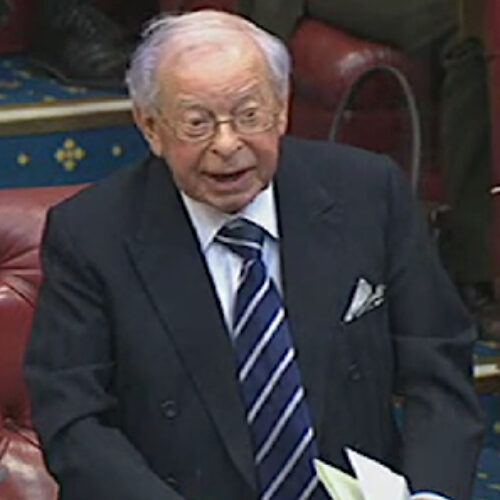
Photo of Joel Barnett, creator of the Barnett Formula, by BBC Parliament – Original publication: TelevisionImmediate source: http://parliamentlive.tv/Event/Index/0bdeb80a-d4ac-4b04-95df-7a12d29f8f8c, Fair use, https://en.wikipedia.org/w/index.php?curid=54678284