
BY-ELECTIONS are straws in the wind – a side-show that cannot change the Government of the UK, but give people a free hit to express how they’re feeling. And that’s as it should be, because the voters in a single constituency should not be deciding the future for the whole of the UK.
That’s true, normally. The Makerfield by-election is different. This is a by-election explicitly for the purpose of changing the Government: Josh Simons stood aside for Andy Burnham in order for him to take on Keir Starmer as leader of the Labour Party and hence Prime Minister of the UK.
It will have a huge impact on the future of the UK. Will Burnham win or the insurgents of Reform? Our country will follow two contrasting paths determined by this decision.
Should the people of Makerfield alone have this responsibility? Like it or not, Josh Simons, Andy Burnham and the Labour Party have foisted it on them. Now we must all await their decision on our lives
If Labour wins – as the media and the pundits expect – then Burnham is going to replace Starmer and we’ll have a new left-wing Government with new vigour and a harder socialist edge.
At least, that’s the story today. Since Burnham has notoriously been a weathercock – spinning in whichever direction the wind is blowing – then what we might actually get is unclear. My guess is that in practice, he’ll differ only slightly from Keir Starmer, constrained by the same forces and imprisoned by the same Labour beliefs. What he says today is presumably designed to please the majority of Labour MPs who sit to the left of the Party and whose votes will be needed to make him PM.
It might seem odd that his prescription – effectively ‘the same colour, but much redder’ – is so popular with MPs who presumably want to be re-elected, given that today’s mess has come about because we have (for example): the highest taxes we’ve ever had, bigger rewards for contributing less to society than ever in history, the highest energy costs in the world, the most dramatic flight of wealth and high-value working people out of the country ever seen, policies that prioritise the needs of criminals who have just arrived illegally in this country over people who have spent their entire lives contributing to it, and a level of state control of the economy that rivals – and in many areas exceeds that which brought the Soviet Union to its knees.
More of all this is, however, what the majority of Labour’s MPs want. It seems that for today’s performative political poseurs, who have never in their heads left the student union, being as economically destructive as the Soviets is a kind of wimpy soft-leftishness that’s hardly seen as left-wing at all. And it passes muster as these are the people who now dominate not just the Labour Party, but all the important protected spaces of public life, like the broadcast media, the public sector, and big charities.
The consensus position here is that you can’t be too left-wing. It doesn’t matter what pushing all this does to ordinary people and the country: their entrenched views can’t be challenged. Even if an alternative perspective is put to them, they are no longer able to hear it.
If the rumours are right, and the mood does keep changing, Burnham will call a quick election after becoming PM to capitalise on the expected bounce before the electorate can discover he’s as bad as Starmer. He’ll expect to win outright, having demonstrated that for now, he can beat Reform even in the heavily pro-Brexit white working class constituency of Makerfield.
Can he do it? It’s unlikely he’ll have a majority like Starmer’s and maybe it will be a coalition with the Greens or SNP – but after a Makerfield win, confidence in Labour will be high.
Who stands to gain if Makerfield chooses this path? Burnham and Labour, clearly. Against the odds, they survive into a second term (just about) hanging onto power.
Surprisingly, though, Reform wins too. It will likely be the second-biggest party after an early election – perhaps even the biggest party facing a coalition Government – and will form the official opposition, with hundreds of MPs instead of a handful, plus lots of new Short Money funding (this is the allowance given by the state to fund the opposition, based on the number of MPs each party has).
Then Reform will rise as Burnham in power plunges depths of unpopularity that sink below even Starmer, with a ruined economy, a divided nation, oppressive government, and an increasingly poor, angry, jobless, and alienated population. If it’s a fragile coalition which collapses, Reform could even be in power by 2029.
I also expect that Reform will be better off without their candidate in parliament, though they would miss the momentum that a win in Makerfield would give them. He is clearly not equipped to withstand the kind of scrutiny that Reform should expect. Already, it has emerged that he has previously said on social media that women shouldn’t drive (that’s a ballot box of votes gone right there); Putin was justified in invading Crimea; and – though standing for a pro-Brexit party in a constituency where there was overwhelming support for leaving the EU – that Brexit was ‘nationalistic pish’.
He has big red labels slapped all over him screaming, ‘Warning, electoral liability!’ As one of the small band of Reform MPs, he could scarcely be more obviously a target for the other parties and the media if he had ‘I will hand you the ammunition you need to discredit Reform’ tattooed on his forehead. On current form, he probably will have by the time he gets to Parliament.
Who loses if Burnham wins? Above all, the Conservatives – who, ironically, are desperate to see Reform fail. For them, a Labour win and a swift general election would spell ruin – both literally and metaphorically. With Reform installed post-election as the main opposition, the party will struggle to be heard or attract donors. The importance of funding is often forgotten. With few MPs and thus a dramatic cut in its Short Money, the Conservative Party will struggle to pay the bills. Without money, parties die.
The Greens will lose too. A new, more left-wing Labour agenda will see the part of Labour’s base which has swung their way return home, delivering much of the Burnham bounce at the General Election. The Green surge will peter out, so that instead of the substantial parliamentary contingent they might expect to gain if an election were called today, they will hardly advance at all. The equation is simple: a Labour recovery means a Green collapse.
By contrast, a Reform win changes the direction of travel. The big losers will be Labour, clearly. The message from Makerfield that an ordinary Reform candidate is more attractive to working-class voters than Labour’s preferred leader would be hugely damaging.
Yet Keir Starmer may well cling limpet-like to power. Without Burnham, Labour lacks plausible challengers. Angela Rayner is mired in yet another scandal, this time over vote-rigging in her constituency; Wes Streeting has shot his bolt and lacks the crucial support from the left of Labour; John Healey has little public profile. But there couldn’t be a worse way for Keir Starmer to survive – because his strongest rival couldn’t win an election for Labour in what was until recently a rock-solid Labour seat in his own backyard with a big following wind from the media around the leadership.
What a terrible wounded leader he would then be: a failure whose own abject performance destroyed his biggest rival by making him unelectable.
The party would tear itself apart in internal squabbles, never stable enough to do much actual governing, ever more unpopular, likely seeing defections to the Greens and maybe even one or two to Reform. Labour would be on the road to wipe-out at the next electoral opportunity.
But what of Reform? Of course the win would give the party momentum. But without Burnham, there’s likely a long stretch yet before the next general election. Maybe I’m wrong to be so critical of Robert Kenyon – I know little of him besides what has been reported and the media inevitably highlights only the worst of his words – but if not, Reform may come to rue his election.
A victory is always seen as desirable in politics, as in life, but sometimes, winning is the worse outcome. The stand-out example is the 1992 election. Had Kinnock beaten Major, the disasters of the ERM and much else would have been Labour’s (Neil Kinnock and John Smith his shadow Chancellor had both supported entry into the ERM). Consequently a Conservative landslide in 1997 and a decade in power instead of Blair would have been more likely. Perhaps for Reform, Makerfield is better lost?
The obvious winners from a Reform victory are the Greens – as Labour bleeds support, so they gain it. It’s not surprising they refused the demands to stand aside for Labour. If Labour collapses, the Greens will win in many of its former seats – especially in the cities.
The equation is more complex for the Conservatives and Reform, though many would see a Reform victory as bad for the Tories. Indeed, they do themselves.
Yet though Conservatives hate the possibility of a Reform win in Makerfield, it’s the outcome they desperately need. It means that there will be no swift election, so they will have more time to rebuild and regain trust. Time is what Kemi Badenoch needs. As memories of the past errors fade and people remember that they were better off when the Conservatives were in power than they are with Labour now, she has a chance to reconnect. Amidst Labour crisis and potential Reform blow-ups, Kemi might just be able to win back support in the parts of the UK that will really start to hurt under Labour.
As punitive taxes bite ever harder, the long flirtation between the affluent and the left will come under increasing strain. The chatter at those cosy leftish dinner parties will turn from the importance of green issues and the nastiness of the right to how holidays have become unaffordable and how unfair it is that the plan for a comfortable future is falling apart.
The Conservatives alienated many in their old strongholds when they effectively abandoned the moderately affluent and aspirational to milk them for funds to buy popularity amongst Labour’s old base.
However, the escalating impoverishment we are seeing today eclipses that pain. With more and worse likely to come, the Conservatives have an opportunity to rediscover their old winning formula – incentivise the wealth-creators, cut waste and bureaucracy, boost business, run things efficiently, and make the country rich again. Nobody believes they can actually do it, of course, and they almost certainly can’t – but we desperately need someone who can and it’s an offer no other party can make.
Reform would absolutely love to own this territory but won’t without alienating its traditionally working-class and welfare-hungry base in the Red Wall, because it would mean cuts that bite hard there.
That’s the difference between the Labour/Green equation and the Reform/Tory divide: Labour and the Greens mostly appeal to the same voters, but Reform is strongest in working-class Labour areas where the Conservatives receive no love.
There is one other notable feature of the Makerfield by-election: how the rhetoric around it has changed.
A commentary on Makerfield by Brendan O’Neill, the Chief Political Writer of Spiked Online, offers a vivid example.
For him, Labour is no longer the red, insurgent working-class party, but a failing arm of the clapped-out old elitist establishment. He calls Labour “the listless, dull-eyed horse of technocracy” running a contest “magicked up as a coronation for the King of the North.”
Thus the by-election becomes “one of the best chances the working classes have had in years of sticking it to the political machine.” A Reform victory will “deny the zombie uniparty down south the breath of life it thinks Burnham will bring.”
Meanwhile, Rupert Lowe (of Restore) is “a privately educated prick robbing the working class of its means of rebellion” by splitting the Reform vote.
As O’Neill himself says, “apologies if this all sounds a little class war.”
Yes, it does – more than a little. But how fascinating that the language of struggle has now been flipped. For O’Neill, Labour – once the party of the working class – has jumped the wall and is now one with the Conservatives as part of an out-of-touch elite, desperately fighting to hold the masses at bay. Reform now has become the party of rebellion and the vehicle for working class anger – and it’s demonised by the left as the far-right, ostracised by the broadcast media, and hated by the establishment in consequence.
Makerfield thus marks an inflection point in our politics, where the labels ‘left’ and ‘right’ are more meaningless than ever, the old parties are more desperate to fight the new ones than each other, winning and losing are not always what they seem, and instability reigns. Many will cheer change – but the parties which are moving to fill the void are at best untested with power, while unrealistic expectations abound. Transition will not be easy.
Established in 2006 and celebrating twenty years, ThinkScotland is not for profit relying on donations to publish our wide range of opinions. You can subscribe to our FREE newsletter here – share and follow us on ‘X’ here – like and comment on facebook here and make a donation here. Every contribution helps to meet our overheads.
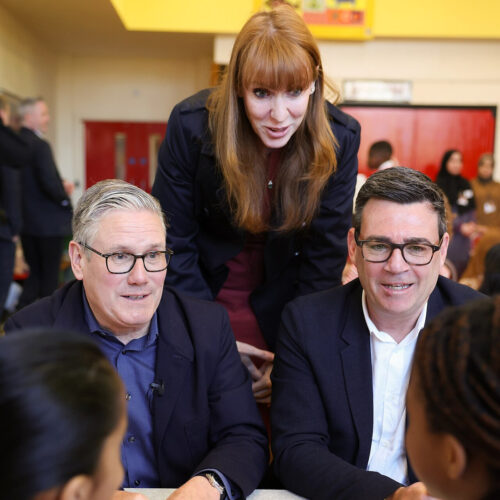
Photo by Number 10 – Prime Minister Keir Starmer visits Holy Trinity Primary School in April 2026 with Angela Rayner and Andy Burnham, OGL 3, https://commons.wikimedia.org/w/index.php?curid=191980545