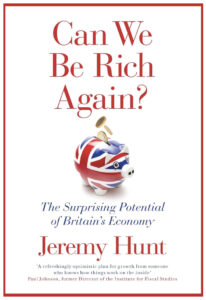
Can We Be Rich Again?: The Surprising Potential of Britain’s Economy, Jeremy Hunt Swift Press, 304pp
SIR JEREMY HUNT’S ambition was to make a million pounds by the time he was 30 and then become a cabinet minister. It took him a little longer, but he achieved it. Now knighted and languishing on the back benches, he’s turned his hand to writing. His second book, “Can We Ever Be Rich Again?” is easy to read, well-informed, and interesting.
He addresses a number of issues such as debt, employment, education and risk, identifying problems and quantifying the impact of his proposed improvements. There are some informative but depressing snippets. For example, he tells us that 30 per cent of school leavers have no GCSE in maths or English. That doesn’t augur well for a knowledge economy. He reveals that the Department of Work and Pensions has no limit on its spending on welfare payments. Its spending on staff and infrastructure is limited and under pressure, with the net result that it is much easier for them to award benefits than to rigorously assess them. His analysis shows that American pension funds invest $1 in startups for every $200 they hold; the equivalent figure for the UK is £1 for every £14,000. (Note that I have not checked these figures, or any of his others, in detail. There are ample references in the book should you feel the urge).
So far, so good. The book outlines the depth of the mire that the United Kingdom is in, which is depressing. Hunt also dismisses the notion that his is a problem across Western liberal democracies, citing equivalent figures from other European countries and US states. It’s abundantly clear that the UK is in a mess and that mess is entirely of our own choosing. Although he was against Brexit, he doesn’t blame this mess on that happy event, not least because the data would not support it. The problems we have are of our own making, that is, of successive governments—some of which he was part of.
His analysis also covers the UK’s strengths. Bizarrely and despite the appalling illiteracy of 30 per cent of school leavers, he cites the English education system as one and particularly our good universities. The financial centre of London is another strength, as is our current leadership (second only to China and the United States) in Artificial Intelligence. Our life sciences database (an unexpected benefit of the NHS) is another. So, he concludes, we could easily become a wealthy nation.
So why aren’t we?
Hunt’s suggestions for fixing the deficit are predictable; improve public sector productivity and embrace AI. He doesn’t explain how he sees the former being achieved, but notes that the Treasury is very powerful and suggests that power should be relaxed. He acknowledges that he failed to achieve that when he was Chancellor; one suspects that he was rather intimidated by some of the intellectual capacity of Treasury mandarins. Sir Jeremy is no intellectual lightweight; he got into Magdalen College Oxford and left with a first in PPE. (Our current Chancellor, Rachel Reeves, managed a 2:1 in PPE from New College Oxford and must be terrified of them. It would explain a lot, but I digress).
The author also avoids, or ignores, the problems of AI’s rising costs and electricity demands, although there is a chapter on energy. That’s not really good enough; the author bases his optimistic assessment on a public sector improvement that has never been delivered and a nascent technology reliant upon a power infrastructure that does not exist. That’s hardly credible.
His explanation of the HS2 fiasco, considered in the chapter on infrastructure, is equally limited and disappointing. He says that the 250mph target speed, which lies at the core of the cost and failure, was non-negotiable as that was the speed necessary to deliver time savings that drove the value for money argument in the Treasury. What he doesn’t tell us is why no one challenged this at the time; the engineering implications of the speed dictated the route, the route dictated the objections and mitigations and those, plus inefficiency, drove the cost. Yet no one said, “No, Prime Minister.” £100 billion later we need to understand why not. Similarly, he identifies why the Treasury models think immigration is a solution to a lack of a skilled workforce, but he doesn’t challenge that assumption (now proven false).
Sir Jeremy started life as an entrepreneur; unlike many in modern government, he has tasted failure and the grind of building something from nothing. He cites Churchill: “Success is the ability to go from failure to failure without losing enthusiasm.” The book is certainly full of enthusiasm for the potential of the United Kingdom, but, as he knows, enthusiasm alone does not solve problems. The answer to the question posed in its title is left dangling in the wind. Perhaps he’ll address it in his next book.
This book is well worth buying. It’s well written and well informed. It contains some juicy and interesting snippets and thoughtful, cogent analysis. Its weakness is that it doesn’t go beyond suggesting small cuts (always expressed in percentage terms) for moderate gains in GDP. That would be excusable in a student economics thesis, but in the real world improvement and growth don’t come from a spreadsheet but from people working hard.
Inadvertently, this book is a snapshot of all that is failing in our country: leaders who are long on theory and short of practical experience. Sir Jeremy wasn’t one of those when he entered parliament; it seems the place is so toxic that he is now. Parliament needs new blood and new ideas if it is to save the country.
Established in 2006 and celebrating twenty years, ThinkScotland is not for profit relying on donations to publish our wide range of opinions. You can subscribe to our FREE newsletter here – share and follow us on ‘X’ here – like and comment on facebook here and make a donation here. Every contribution helps to meet our overheads.