
THE PARADOX of the auction house is the profession is as old as the hills and many of the great British auction houses have been around for as long as family firms of funeral undertakers. But it is also an industry rejuvenated by modern technology.
Gone is the trip to the local saleroom hoping for a bargain when the world of algorithms and the saleroom.com brings almost very auction house live to your living room. The market has thus become remarkably efficient. Other than the great London houses, like Christies, auctions pre-internet were a local business where you could get something ‘for a song.’ It is very hard to do so now as the market is way more ‘efficient’ as buyers trawl the internet for that bargain.
Here is an industry which is a strange mix of Del Boy, gent with a carnation in lapel and raw animal instincts, all in one. It is also a largely a reactionary world where the goods of the deceased, or downsizer, are on display, thus it is yesterday’s fashion not today’s. This is a world pre-multiculturalism, woke or modernity.
A week ago the honourable Messrs Golding, Young and Mawer (Established 1864) held the Colin Young 40th Anniversary Sale. Young being the MD of the company partially bearing his name who celebrated his 40th year in the industry.
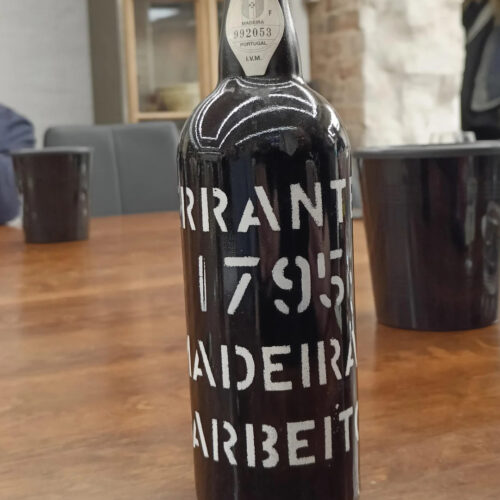
I was watching online as I had spotted an extraordinary bottle of wine, a 1795 bottle of Madeira. Yes it really was that old and Madeira being Madeira it was most probably still perfect in the bottle. A thing of great rarity, likely only a tiny number of such bottles still survive and a living time capsule to a period when Pitt the Younger was PM, Henry Dundas was Secretary for War and The Royal Navy doubtless stocked up by the barrel for the West Indies run. Spoiler alert. I didn’t get the bottle. The internet meant the world had seen it and it sold for £3,200. I was well outbid but in truth for such a rarity it’s not a huge price.
However, what else happened in that auction was perhaps more illuminating as I had a good while to watch as I waited for my lot to show up. Given it was the auctioneers 40th anniversary sale he was understandably slightly nostalgic and this nostalgia painted an interesting picture.
The first lot to come up was a George III mahogany bachelor’s chest, a superb example. The auctioneer explained that this piece had sold at another auction house in 1989 for some £10,000. That in today’s money that is £32,295 for a wooden chest! Last week it sold for £4,000, in other worlds it had lost 88 per cent of its value since 1989. A few lots later a George II chest on chest which had made £10,500 in July 2010 sold £3,700 last week. That’s down around 75 per cent in real terms in just 15 years.
I could go on. This was a high end auction selling fine examples. In fact I thought the prices achieved were pretty decent in modern context and have seen many other auctions where amazing Georgian furniture sells for a few hundred pounds and Victorian or Edwardian for so little that it will often cost more to get it delivered. There is perhaps a modest revival in ‘mid-century’; the teak your grandparents may have had, but that seems a fad to me. The truth is brown furniture, unless it is absolutely exquisite quality or provenance, is often worth buttons.
It was not always thus. In the 1980’s and 90’s in the upwardly mobile world of that time ‘period’ furniture was in vogue. You paid a large premium. Antique deals proliferated and ‘brown furniture’ sold in the thousands. The fall in value described above of 70-80 per cent is typical. Today, frankly, much of it sells for less than a cheap Ikea imitation of some 1950’s Danish minimalism.
One, particularly if Georgian or earlier, is handmade, of solid wood has an amazing patina and will last another 250 years. The other says you’re with modernity and the programme if you like. It’s yours today and will be on the skip in 15 years. Disposable fashion against timeless tradition and craftsmanship. The latter is in vogue and that says quite a lot about modern culture.
Fashion is fashion and of course you might guess my preference but it is a preference only. If someone else prefers Ikea good luck to them but it does seem odd that the collapse in value of antique furniture is so profound.
There is perhaps something deeper going on here. During the Thatcher period when ‘brown furniture was all the rage‘ there was a throwback to traditional values, an understanding of history, culture time and place.
Then the Revolution. ‘We are a young country’ Corbusier’s heir yelled. Just as the faux classicism of Quinlan Terry was toppled the constitution too was ripped up and replaced. Instead of the state of nature of the Common Law mirrored in the Gothic Order of a medieval Cathedral, it has been replaced by glass, steel, mdf, veneer and sofa.
This is mirrored by dress. The City fashion on 30 years ago of pinstripe and braces would look absurd now. It is de rigueur to dress down. ‘I’ve made it myself, not through convention or leg up you know.’ With this anti ‘old elite’ elitism the subliminal message was buy ‘brown furniture’ and you are part of the Ancien Regime. We might not cut your head off but you’ll be showing your colours if display your inner Regency.
Ironically there is one part of the auction market for ‘old stuff’ that is on fire and for all the wrong reasons. Silver. The family silver has probably tripled in value over the last two years as the underlying commodity has gone from $20 an ounce to well over $60. and the auction houses are making out like bandits. The irony is, however, while in the main the silver salver and cutlery set is making good money, the end result is not for fine dining and the formal table but for the smelter. Perhaps a further metaphor?
Maybe it is not the opinion polls we should follow, but the auction houses. If we see a revival in George III bow fronted chests, or even better a Charles II geometric chest, we shall know the current globalist order’s goose is truly cooked. I am not holding my breath.
Established in 2006 and celebrating twenty years, ThinkScotland is not for profit relying on donations to publish our wide range of opinions. You can subscribe to our FREE newsletter here – share and follow us on ‘X’ here – like and comment on facebook here and make a donation here. Every contribution helps to meet our overheads.