THE DEATH of Prince Philip last Friday, 62 days short of his one hundredth birthday, led to most parties suspending their electoral campaigning in Scotland. Nicola Sturgeon’s brief and rather terse statement after learning the news was very much in keeping with her tendency to reduce most things happening in the wider world to their apparent Scottish dimension, Prince Philip had “deep and longstanding” ties to Scotland. His “long contribution to public life in Scotland will leave a profound mark on its people.”
There was little of the warmth contained even in the statement issued by the Russian authorities, “Our heartfelt condolences on the Passing of…Prince Philip. [He] was admired and will be mourned by many Russians. May his soul rest in peace.”
But the chilly propriety preserved in Edinburgh was not the case among some independence supporters. @meljomur tweeted: “I will say if anything can bring together the pro-Indy side in Scotland, it is the sycophantic British worship of an old racist man, who died at age 99.” I’ll take a pass on airing the other Tweets I witnessed that took a more bitter approach.
I suspect also many nationalists joined members of the metropolitan left in venting their anger on the complaints page which the BBC opened for critics of the coverage of the royal bereavement. Anger continued when it was announced that there would be a special meeting of the Scottish parliament on 12 April to allow parliamentarians to pay their respects to Prince Philip. Councillor Christopher McEleny a candidate for the newly-formed Alba party complained, “I & hundreds of thousands have been denied the opportunity to attend the funerals of friends + family for a year – a void that will never be filled. There is no justification for parliament to be recalled to repeat eulogies, we weren’t afforded that opportunity for our loved ones.” @ChrisMcEleny
Yet only thirty people will be able to attend Prince Philip’s funeral and at his own request it will be a very restrained occasion, falling far short of being a state funeral. This is indeed more opportunity than many got to bid farewell to a departed loved one during the pandemic. But there is no sign of many taking offence beyond those who have exploited the culture of complaint to carve out a niche in politics.
For the past fourteen years the ruling Scottish National Party has been manipulating ethnicity and spawning a grievance culture against traditional pillars of order so as to gain, retain and tighten their grip on power. The party is currently well ahead in the polls but the stiff and ungracious attitude to the death of Queen Elizabeth’s husband for the past 73 years may suggest that it is also on the defensive.
The wider nationalist movement is split over personality, tactics and ideology. After fourteen years in office, and now facing into an election, the party seems rudderless. Economically, Scotland has been worse affected by the pandemic than any other part of Britain. Given the unemployment and hardship that will lie ahead for many currently economically active individuals, it might have been better if a note of unity had been struck on the passing of Prince Philip. The SNP might have derived some advantage by depicting him as a figure who had achieved many successes in his long life.
Visionary thinkers, who at the moment are completely absent from the party, would have had everything to gain for their cause by depicting him as someone who deserved emulation in the Scotland of the future due to the way he had tried to place his stamp on events. He epitomised qualities that nationalists hoped would be at the centre of national life in a Scotland of the future: valour, dedication to his duties, fidelity, administrative abilities and practical gifts. The SNP could even have stolen a march on other opinion formers who are only beginning to acknowledge how impressive a figure Philip was, by proclaiming its pride that someone of his stature had held the title of Duke of Edinburgh.
But inevitably a good many nationalists stuck with the anti-establishment narrative. He belonged to an old order which had outlived its usefulness. It was time for a figure like Philip to be forgotten rather than emulated. Ironically, some of the more far-seeing communists such as Marshall Tito of Yugoslavia possessed the self-confidence to cast aside political sectarianism and be seen with Philip. Even Mary Lou McDonald, Sinn Fein’s leader in Ireland was noticeably warmer in her statement than any Scottish anti-Unionist, “Sincere condolences to Queen Elizabeth and family on the death of her husband Prince Phillip. Sympathies to those of a British identity on our island, for whom his death will be felt as a great loss.”
A Scottish government seeking to weaken and break British ties would have had nothing to lose by praising the British royal for establishing the Duke of Edinburgh’s Award Scheme. Founded in 1956, this, rightly, will be seen as his personal legacy, both because of the worldwide impact (several million young people have taken part in the scheme in 115 countries) and because the qualities the award encourages and rewards – self-reliance, compassion, fitness, skill, endeavour – were those closest to the Duke’s own heart.
Similarly, he was a pioneer in the battle for the conservation of wildlife and the environment. In 1961, encouraged by his friend the naturalist Peter Scott, he became president of the World Wildlife Fund (now the World Wide Fund for Nature) in the United Kingdom, a position he held until 1982. From 1981 to 1996 he was the charity’s international president.
The leader of the Greens at Westminster Caroline Lucas MP had the stature to recognise this old school royal’s immense contribution to global ecology. She offered, “[D]eep condolences to The Queen on the loss of her husband after 73 years. Many have spoken of his decades of public service – I think particularly of his role as first President of @wwf_uk from its foundation in 1961 My thoughts are with the whole Family at this difficult time.”
The contrast between her words of clear sympathy and the sparse and grudging acknowledgment of his death from the Scottish Greens was palpable: “we recognise that the passing of the Duke of Edinburgh will be felt deeply by some across the country and express our sympathy with his family, who join many others who have lost loved ones in the last year.”
Philip’s dedication to preserving the balance between man and nature on planet Earth was expressed with more gusto and practicality than has been shown by the Scottish Greens. MSPs Patrick Harvie, Ross Greer and co are happy to endorse the mass slaughter of seabird and raptors by the industrial wind turbines which they are pledged to erect on every hillside, bay and promontory in Scotland. Their real passion is to redefine humanity in ways that would make science fiction writers like Aldous Huxley and HG Wells gawp. Andy Wightman, perhaps the only genuine environmentalist in their parliamentary ranks able to stand some comparison with Prince Philip was driven out last December for refusing to endorse the party’s crackpot militancy on transexual rights supplanting those of women and girls.
Top-down control of state and policy by angry folk driven almost demented by society’s conventional ways is increasingly emerging as the new threat to liberty across Britain. Philip warned prophetically against an over mighty state in the hands of self-righteous authoritarians long before the threat became as pressing as it is now. He saw the philosophy that the individual exists to be the servant of the state as a dangerous one, “You get pushed around and in the end people go to prison.” He was an unapologetic critic of the nanny state and its risk-averse culture. From his time in Scotland, he would have been only too aware that it had acquired a willful government intent on controlling and micro-managing virtually everything that moved. In a land which had once been the epitome of the rugged individualism which was carved into his own DNA, perhaps this would have grieved him even more than the fact that the gimlet-eyed controllers were also dedicated to breaking up the United Kingdom.
How ironic that his formative years of schooling were spent at Gordonstoun school in Moray founded by Kurt Hahn, a Jew and a critic of Hitler, after he fled Nazi Germany in 1934. Close to the sea and the mountains, the bracing weather and the wild location suited Hahn’s challenging educational philosophy. He believed young people were “surrounded by a sick civilisation in danger of being affected by a fivefold decay: the decay of fitness, the decay of initiative and enterprise, the decay of care and skill, the decay of self-discipline, the decay of compassion.”
His school sought to inculcate these values of masculine self-reliance and fortitude and in Philip they found a pupil who gave them effective meaning and expression through a life well lived. But having been crucial in enabling Britain to repulse fascism, a struggle in which the prince played a distinguished role, these values are now facing discredit and erasure. They now stand for toxic masculinity and an ideological vanguard present in every branch of society, from education, the arts, business and administration is working at a furious pace in order to try and eradicate them.
The curious situation has arisen in Scotland where the crusading feminist shield of its political leader Nicola Sturgeon has faded as her absorption with the trans movement has grown. To the dismay of many former supporters her widely-perceived misandry seems now to be increasingly matched by a creeping misogyny in which she backs changes to the law that places women at a disadvantage as ill-thought-out experiments with gender obtain powerful state backing.
A less divisive and ideological leader would benefit herself and her cause by learning from Prince Philip. History may judge that Sturgeon has gone badly astray and made many unwise decisions that have harmed her unhappy land because she lacked a partner in her life who could keep her grounded. Without being overbearing, a dutiful Philip offered his wife, Queen Elizabeth, wise advice based on his own immersion in life. He triumphed over a dysfunctional childhood and after an inspiring education, acquitted himself with honour in the armed forces. Later he would excel as an administrator, inventor, benefactor, reformer, and tireless representative of the Crown at thousands of functions up and down the land and overseas.
If he had pursued his own career on the Royal Navy, it is likely he could have risen to the top. But he chose instead to devote his life to being of constant service to his wife in her arduous role of British head of state for an incredible 69 years.
How much better might the story of Scotland under the SNP be if instead of being married to a man who controlled the affairs of her own political party, Scotland’s First Minister instead shared her life with someone who had a fraction of Philip’s far broader hinterland?
A tribe on the island of Tanna – part of Vanuatu or what was the New Hebrides, encountered Prince Philip in the 1970sand were so taken by him that they proclaimed him to be a God.
A leader gifted with imagination in today’s Scotland would not need to go that far. But it could surely be arranged for one of the many fertile and accessible small islands in the Scottish Hebrides to be turned into a celebration of the life of Philip, his achievements, the range of his talents, his devotion to family and realm, and indeed his triumph as a man. My guess is that, if the enterprise was carried out with imagination, flair, and balance, in a short time, people from all across the world would flock to such a place. Most people know that without men who display the qualities that enable horrible jobs to be done on a daily basis – tyrants to be occasionally fended off, and foolishness to be put in its place – the world would very quickly fall apart. A society that tries to banish such men from the stage is doomed. Philip was an alpha example of responsible manhood. He spent long periods in Scotland during nearly all stages of his life. For 50 years he was Chancellor of Edinburgh University.
If Scotland was in the hands of visionaries rather than noisy and insecure dolts, active steps would now be taken to immortalise his memory. It would mean that down the ages Scotland would be associated not just with Wallace, Bonny Prince Charlie or David Livingstone but also with Philip, Duke of Edinburgh.
Tom Gallagher is Emeritus Professor of Politics at the University of Bradford. He is the author of Theft of a Nation: Romania Since Communism, Hurst publishers 2005. His latest book is Salazar, the Dictator Who Refused to Die, Hurst Publishers 2020 (available here) and his twitter account is @cultfree54
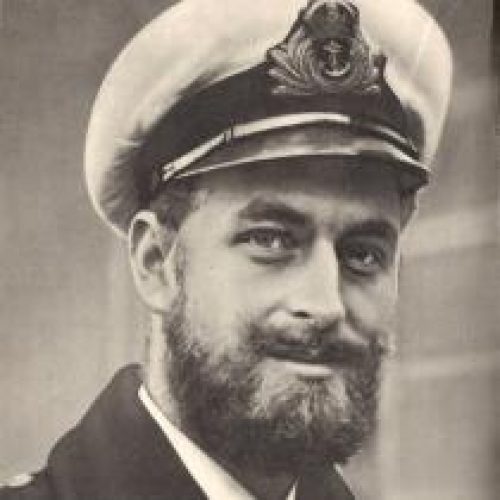
Photo of a hirsute Philip taken just after serving in the Pacific theatre as second-in-command of Royal Navy destroyer HMS Whelp.