AFTER EDINBURGH COUNCIL’S Transport Committee agreed to press ahead with its plan for a cycle superhighway along George Street (mislabelled as a pedestrian scheme) it was the turn of its Finance Committee to throw taxpayers’ money around like confetti.
Left wing councillors may regularly plead a lack resources, but their tax and spend habits reveal their true instincts. From the supposedly middle of the road Lib Dems through to the extremist Greens, councillors were delighted with their council officers’ expensive draft budget proposals.
Written to “support delivery of the Council’s strategic priorities”, increased spending was labelled as “investment” to sound more palatable – but involved splurging £27m of reserves intended to be kept for a rainy-day. This, when the Council’s Section 95 Finance Officer had to admit the Council would be below the two per cent threshold that it is recommended councils hold in reserve in case the worst happens.
The report included lots of lines labelled as “savings” but many of these were extra taxes and charges or cuts to service delivery. For example, cutting school crossing patrols, introducing more cameras to catch out drivers in bus lanes with the newly confusing operating times, charging groups new and increased fees for using parks, and increasing cremation fees.
What do they want to spend your money on? First up, the cycle superhighway along George Street will cost an extra £10m on top of £20m from Tourist Tax money. But even this may not be enough after the Transport Committee put trees back in the scheme. The result is there is no likelihood of Princes Street pavement improvements until at least 2029.
They also want to top up benefits paid through the Scottish Government’s “Welfare Fund”, employ a “community cohesion” officer, give “free” food to children in the school holidays (something that used to be a parental responsibility), and employ staff to coordinate what foodbanks do.
£86m is proposed to improve “staff reward and recognition”. While some of this has merit (like increasing the number of apprenticeships), the Council pay bill and staffing cohort keep increasing. There is no corresponding productivity plan or predicted improvement in services for those who pay the bill so, in reality, this is mostly an increase in pay and holiday entitlement.
By budget time in February, councillors will dream up yet more cash-hungry pet projects. It is baked in as a concept with any “unexpected” increase in government grants becoming a slush fund rather than a contribution to core services.
The officers predict the Scottish Government will give us a zero per cent increase in grant. While John Swinney’s government is notoriously stingy towards Councils, this is unlikely. Even a small, below inflation increase then becomes a few million in spare cash available for allocation. But as the Council officers’ inflation prediction is one per cent below the Bank of England’s forecasts going forward and they expect politicians to hold off union demands by keeping pay increases at three per cent, you will see that these predictions aren’t even worthy of Mystic Meg.
If that’s not enough, expect them to reach for even higher fees and charges. Like the UK Labour Government that has increased or imposed new taxes at least 37 times in the last two years, this Council is addicted to “raising revenue”.
Recent examples include garden waste bin charges, the 400 per cent Council Tax on second and empty homes, increased parking permit charges for bigger or diesel powered cars, the unnecessary Low Emission Zone, the Tourist Tax, and the many inflation-busting Council Tax increases.
A separate proposal approved by the Committee shows exactly how the bulk of the members of the Finance Committee think. The Council intends to spend an estimated £15.5m on a “whole house retrofit” programme at Kirkgate House in Leith. This amounts to £242k for each of the 64 flats in the block – but these flats are only worth about £90k each.
The retrofit isn’t economically or financially viable to do – as the properties’ valuation won’t change – but it meets the Council’s Net Zero ambitions, bless.
Irrespective of the dreadful economics, nine of the eleven Councillors voted to go ahead and spend about £1.2m on consultants to take the RIBA process through its next few stages. Unlike the predictions I referenced above, I’m fairly sure the £15.5m estimated cost will increase through that process.
This is a housing contract so, technically, the financial cost should impact upon tenants across the city through higher rents, rather than be paid by the wider taxpayer. The Greens, however, have already cajoled the other left-wing parties into accepting that all taxpayers should cross subsidise the heavily discounted Council rents that tenants pay compared with the market. So, watch this space.
The building is all electric so it doesn’t even make any environmental sense if you accept the changing nature of the grid. It would be far cheaper to subsidise the electricity bills of tenants for many years than to install heat pumps and insulated cladding that will never pay back the cost of installation.
If it was your car you’d scrap it. If it was your house, you’d pay the bills as currently stand rather than borrow more than double what it’s worth on top pf the purchase price.
The cost-of-living crisis is as much a product of tax rises as inflation. Like our Governments, Edinburgh Council is itself to blame – labelling yet another projected five per cent Council Tax increase as “comparatively low”.
It is high time councillors started to look on taxpayers’ money as if it was their own and spend it with the same care. Only then can we end their tax and spendthrift mentality.
Established in 2006 and celebrating twenty years, ThinkScotland is not for profit relying on donations to publish our wide range of opinions. You can subscribe to our FREE newsletter here – share and follow us on ‘X’ here – like and comment on facebook here and make a donation here. Every contribution helps to meet our overheads.
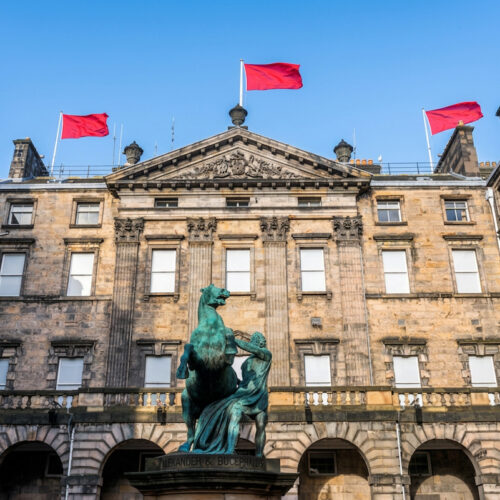
City Chambers image courtesy of Adobe Stock using AI.