
GORDON BROWN spent much of his political life telling Scots that they were better off in the United Kingdom. Now, apparently, he thinks those of us in Northern Ireland should prepare to leave it. The former Prime Minister declared at the weekend that, “in the long term, Ireland will be united”.
Really?
This is the same Gordon Brown who argues passionately against Scottish independence because Scotland is geographically, economically, socially and culturally connected to the rest of the United Kingdom.
Yet when it comes to Northern Ireland, geography suddenly appears to point in precisely the opposite political direction. Scotland should remain British because of its connections to the rest of the UK. Northern Ireland, apparently, should eventually become Irish because it shares a land border with the Republic.
You cannot have it both ways.
Geography is not political destiny. If it were, there would be a great many countries around the world wondering whether their borders were about to disappear.
Northern Ireland is part of the United Kingdom because that is the constitutional wish of its people. The Belfast Agreement – which Gordon Brown’s own Labour government helped deliver – could hardly be clearer about that principle.
Our constitutional future is determined by consent, not inevitability. That is why I find the language used by Mr Brown so troubling. To describe a united Ireland as something that “will” happen reduces the people of Northern Ireland to spectators in their own constitutional future.
We are not.
Nor should anyone assume that support for constitutional change is destined simply to grow until a united Ireland becomes unavoidable. There are very practical reasons why many people who do not regard themselves as traditional unionists may nevertheless conclude that remaining within the United Kingdom is in their interests.
Take security. The world has become substantially more dangerous. Russia’s war against Ukraine has returned large-scale conflict to Europe and forced countries across the continent to reconsider defence.
The United Kingdom is a nuclear power, a permanent member of the UN Security Council and one of NATO’s leading military powers. The Republic of Ireland, by contrast, maintains its longstanding policy of military neutrality. That is its democratic choice and one I respect. But it is hardly unreasonable for people in Northern Ireland to ask which arrangement offers greater protection in an increasingly unstable world.
Then there are the economic, social and cultural relationships that bind Northern Ireland to the rest of the UK. They are not theoretical. They are lived every day. Families, businesses and institutions operate across the United Kingdom. Our political system is British. Much of our media is British. Our armed forces are British. Our constitutional institutions are British.
None of that prevents us having the closest possible relationship with our neighbours in the Republic. I want that relationship to flourish.
I have spent much of my political life working with people across the border and believe strongly in practical North-South cooperation where it benefits everyone. But cooperation is not the same thing as constitutional absorption. That distinction seems to have escaped Gordon Brown.
There is another irony.
Few politicians have made the emotional case for the Union more passionately than Gordon Brown. During the Scottish independence referendum, he understood something important: identity cannot simply be reduced to economics or geography. People have a sense of belonging. He understood the depth of Scottish Britishness because he shared it.
Why, then, is Northern Irish Britishness apparently regarded as more temporary? My British identity is no more provisional than Gordon Brown’s. Nor does it come with an expiry date. Perhaps Mr Brown should spend a little more time in Northern Ireland before confidently predicting our constitutional destination. He might discover a place rather more complicated than the map suggests.
Northern Ireland has changed enormously since the Belfast Agreement. Identities are more varied, politics is changing and increasing numbers of people refuse to fit neatly into the old unionist and nationalist boxes. That does not mean they are all waiting patiently for Irish unity. It means their votes will have to be earned. That is precisely how it should be.
The future of Northern Ireland belongs to the people who live here. Gordon Brown spent years arguing that Scotland should not be broken away from the United Kingdom because of the powerful ties binding its people together. He was right. Those ties matter. But they don’t suddenly stop mattering when you cross the Irish Sea. Not right for Scotland, but apparently all right for Northern Ireland?
I don’t think so.
Established in 2006 and celebrating twenty years, ThinkScotland is not for profit relying on donations to publish our wide range of opinions. You can subscribe to our FREE newsletter here – share and follow us on ‘X’ here – like and comment on facebook here and make a donation here. Every contribution helps to meet our overheads.
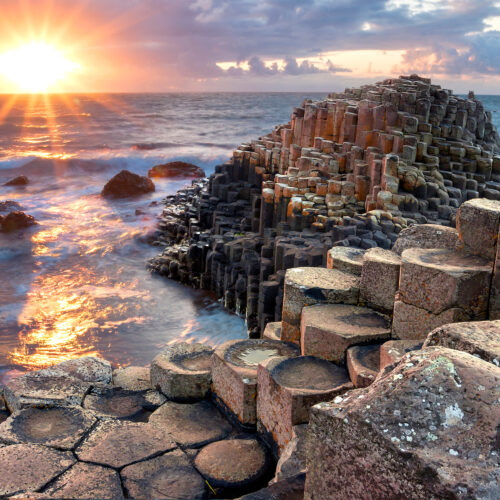
Photo of the Giant’s Causeway, County Antrim, Northern Ireland, by aitormmfoto via Adobe Stock.