
IT IS UNUSUAL for me to quote Aldous Huxley but he did observe that “men do not learn much from history”. In politics that goes for recent events too.
Buried away in a “Business Bulletin” at an Edinburgh City Council committee recently was a short item with a supposedly neutral response from the Council to a Scottish Government consultation on a “Mansion Tax” for homes worth more than £1m, by creating two more Council Tax bands at the upper end for homes worth more than £1m.
From the Lib Dems leftwards everyone seems happy with this proposal which breaks all the principles on which Council Tax was introduced. Most importantly, it’s not so much a property tax but a charge for local services used. Hence the single person discount.
The SNP and other leftists now want the top 1 per cent by house price to pay even more while failing to justify how they use more local services. In truth, they probably don’t as many who are genuinely wealthy will make private care arrangements and send their children to independent schools. Social Care and Education are 85 per cent of Council spending. They might even have access to private waste collections such as Biffa.
Council Tax is only a fifth of Council income in Edinburgh with much more coming from other taxes through government grant. The top 1 per cent of earners pay about 30 per cent of Income Tax so are already contributing more than other residents towards the grants the Council receives before we even consider contributions to things like VAT, Corporation or Capital Gains Tax.
The new additional bands that form the Mansion Tax will potentially raise only £16m across Scotland, 0.02 per cent of the £67.9Bn Scottish Budget, this is the politics of envy rather than practicality and a further hike on the top of the increases in Bands E to H introduced in 2017.
Worse, about half will be raised in Edinburgh but only about 9 per cent will ever be spent here with the rest redistributed to other parts of Scotland.
It seems Edinburgh’s left-wing councillors’ empathy is limited in only one direction too. In opposing this measure, I raised the prospect of the elderly cash poor single pensioner who is living in a now highly valued property that was bought relatively inexpensively 50 years ago. How are they meant to pay?
Apparently, they should just sell up and move from the family home. Yet what was thrown at me was that it was wrong for me to raise this when a previous Conservative Government introduced a spare room supplement in social housing in England. (It is usually forgotten that Labour actually introduced the measure but limited it only to those living in private accommodation.
The result of this thinking? Those living in scarce taxpayer subsidised housing with a low rent, also paid for by the taxpayer, should never move when taking up too much space (e.g. having a spare room). But for anyone who worked and saved to pay for their family home many years ago should just stump up thousands extra or shove off elsewhere.
For the left, fairness means people who don’t work and don’t pay are sheltered while anyone with income or wealth is clobbered for having the temerity to aspire to do well. Even if those they consider “the rich” already pay the bulk of the tax needed for those getting the freebies in the first place.
Kemi Badenoch recently labelled Labour as the party of welfare. It seems they’re not alone.
And what have they all failed to learn? The additional high Income Tax bands the SNP introduced have reduced tax income as people move away, work less or place it in their pension savings. It is literally the Laffer Curve at work.
We already know that some of Scotland’s highly paid civil servants have moved to Northumberland to work from home and pay less tax. That may just accelerate if a large rural or coastal detached home will cost them far less in Council Tax over the Border than an Edinburgh villa in Barnton, Colinton, Ravelston, Trinity or Morningside. With house price inflation already running at 8.3 per cent in Northumberland but only 2.4 per cent in Edinburgh I foresee lower demand for expensive properties in Scotland if this policy comes to pass.
Economic growth in Scotland anyone?
Established in 2006 and celebrating twenty years, ThinkScotland is not for profit relying on donations to publish our wide range of opinions. You can subscribe to our FREE newsletter here – share and follow us on ‘X’ here – like and comment on facebook here and make a donation here. Every contribution helps to meet our overheads.
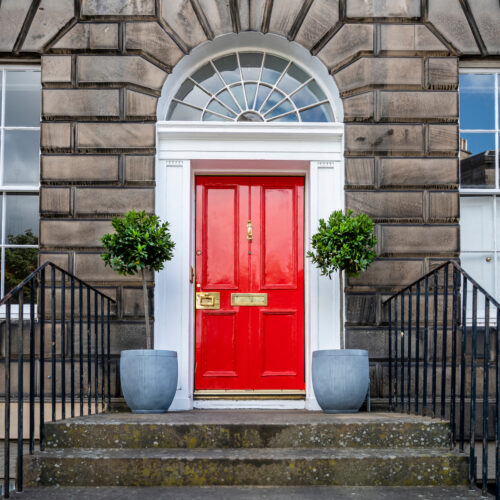
Photo of an Edinburgh New Town property by Giannis from Adobe Stock