
THIS ARTICLE started off as a technical investigation into the inefficiency-betraying trend of falling UK wind power capacity factors but along the way it grew into another full-blown denunciation of the futility and deceits of the entire Net Zero agenda. Much of it has been said before but that does not mean new information cannot be added to the mix.
Many realists predicted years ago that the Net Zero zealotry blindly supported by the uniparties would result in today’s sky-high energy prices, de-industrialisation and mass fuel and food poverty.
(For the “I told you so” record, here are just four of my past posts on this subject: Apr 2015 Submission to a Scottish security of supply inquiry; May 2024 Debunking the climate change hoax; Aug 2025 The charade of Net Zero; Mar 2026 Scotland’s delusional climate change plan.
Net Zero incoherence
For many years while in opposition, the Labour Party fatuously pledged that by 2030 the UK would be “the first major country in the world to run on 100 per cent clean and cheap power”, describing the UK as a potential “clean energy superpower” – always an idiotic oxymoron. This pledge was watered down to 95 per cent in Ed Miliband’s December 2024 “Clean Power 2030 Action Plan”. A Power Outlook study of June 2026 predicted an actual 2030 outcome of 83 per cent. The outcome will now be deliberately set back (hooray!) by Labour’s budget freeze on energy bill-inflating wind and solar power which it previously claimed was “cheap”.
The economy-wrecking incoherence of Net Zero is laid bare. First, the Government says it will cut back on wind and solar because it’s too expensive. Then it moves to kill off North Sea UK oil and gas for good, forcing the UK to import hydrocarbons from abroad in future, if they can be affordably procured. Or does Labour really think we won’t need them at all and can get by on intermittent wind and solar which it now says is too expensive? It feels to me as if Labour is enacting a national suicide pact which the general public is too distracted or otherwise occupied to see. My closing paragraphs below perhaps explain the lack of public outcry or even any balanced debate to protest against the disastrous path we are being led down.
My study on faltering wind power seems almost irrelevant now but I’ve seen it through as it leads into the many incoherences built into Net Zero from the very beginning. It started when I began to suspect that UK wind power was suffering diminishing returns on its electricity supply as its installed nameplate capacity was expensively expanded, expressed in falling wind capacity factors. Data held on the DESNZ website clearly confirms this.
The DESNZ Energy Trends spreadsheet ET 6.1 gives UK annual renewables electricity capacity and generation data which can be downloaded from this page of its website. These data allow annualised wind capacity factors to be calculated, revealing the following chart showing a few single-year dips from 2011 and then a steady falling trend from 2022.
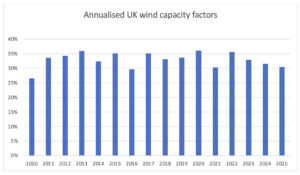
For each year the wind capacity factor (CF) is calculated from the electricity supply (ES in GWh) and the installed capacity (IC in MW) at the end of the preceding year by the formula
CF = ES/(0.001*IC*24*365)
The supply figures are what is metered after curtailment so the simplest explanation for the falling capacity factors is grid transmission capacity bottlenecks. Without wind electricity curtailment the metered wind supply and capacity factors would be higher.
I’m speculating now but maybe wind (and solar) supply peaks are being curtailed (or will have to be in future) not just because of transmission constraints but to limit the share of inertia-less power sources supplying the grid (this shortcoming also applies to battery systems and international interconnectors), to pre-empt a potential nationwide grid shutdown like the one that happened across Iberia in April 2025. In the case of sunny Spain it was due to excessive inertia-less solar supply and insufficient conventional synchronous plant supply. Recent UK grid analysis by David Turver reveals that “grid instability is increasing and the grid is becoming harder to manage” due to lack of inertia.
Kathryn Porter has described how the Scottish electricity grid is uniquely vulnerable to destabilisation due to lack of inertia as it has only two remaining large synchronous generators, Torness (nuclear) and Peterhead (gas), both of which face retiral by 2030. Unfortunately the ruling SNP is ideologically opposed to nuclear and the plans for replacing Peterhead are mired in the ideological mandate that it must be fitted to support ruinously-expensive and pointless carbon capture and storage. Fortunately, NESO is installing a number of expensive synchronous condensers to provide “artificial” grid inertia.
The following is a chart of Gridwatch UK wind electricity supply data (MW) at 5-minute intervals for 2026 to 25 Oct. The authorities usually avoid making public the terrifying reality of our chaotically intermittent wind power electricity supply. We usually only see bland, carefully-curated wind supply graphs like the one from NESO/Bloomberg in this article showing no intermittent spikes and no direct indication of falling capacity factors.
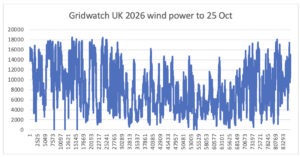
Today’s falling wind capacity factors support my long-held suspicion that NESO will get nowhere near its 95 per cent grid de-carbonisation 2030 target. In practice, after its CO2 emissions accounting sophistry described below and assuming no carbon capture and storage by then, this means just 5 per cent unabated dispatchable gas-fired electricity supply to balance and back up the wind power chaos charted above. This calls into question the central plank of our ruinously-expensive yet pointless unilateral Net Zero endeavour.
An average of 5 per cent gas-fired electricity supply is just not credible. The recent mild anticyclonic weather with national electricity demand still well below the midwinter peak of ~47GW has seen gas supply reach 71 per cent of total supply. Emissions-cheating biomass (explained below) has been at 12 per cent and emissions-cheating interconnector imports were previously at 23 per cent.
Don’t forget that intermittent solar power is also being massively expanded, much of which (with some wind) is embedded within the local distribution networks and as such is not under NESO control. It only see changes in such embedded supply as changes in overall demand. The unpredictable uncontrollable intermittency of combined wind and solar makes the task of keeping the grid exactly balanced between changing demand and changing supply “every second of every day” look increasingly liable to failure.
Don’t forget the other major flaw in electricity supply from weather-dependent renewables – namely its potential near total absence for days on end – especially dangerous in cold dark midwinter when power is needed most, e.g. winter 2010. The rash of subsidy-farming battery systems installed all over the country will be of no help as their combined storage capacity could only power the grid for about 20 minutes. Also, imports will almost certainly dry up in a winter 2010-type continent-wide anticyclone. With NESO already struggling to keep the grid balanced, the so-called “Super” El Nino and polar vortex disruption could conspire to bring about a rollercoaster of winter blackouts.
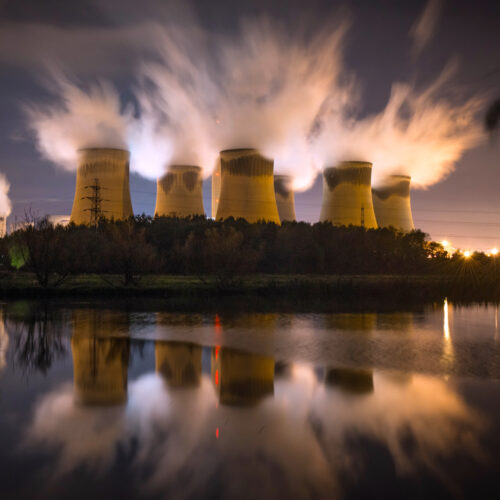
Don’t forget that the authorities are taking us for fools by deeming biomass (wood pellets shipped from North America) to be “carbon neutral” rather than a form of hydrocarbon. This inefficient biomass is used to fuel dispatchable Drax power station (pictured), giving off higher CO2 emissions than coal. The authorities likewise pull the wool over our eyes by deeming the foreign electricity we import via international interconnectors to be entirely “emissions-free”.
The latter CO2 emissions sleight of hand is just one aspect of the much wider false narrative based on the (internationally-agreed) convention of ignoring the CO2 emissions of imported products. For many years the UK government has used the stock boast (with variations) that “Since 1990 we have cut emissions by 42 per cent while our economy has grown by two thirds”. What it is reluctant to admit is that these cuts are mainly due to self-rationing and exporting our emissions abroad through offshoring and de-industrialisation.
It also take us for fools by parroting the false narrative that the price of electricity is set by the price of gas, implying that if only it can fully de-carbonise the grid of gas everything will be hunky dory and electricity prices will fall. That is not only untrue, it is at odds with its ideological plans to fit gas power stations like Peterhead with expensive carbon capture and storage. It persists in repeating this falsehood despite it having been exposed a year ago in testimony to parliament. For example, the head of EDF UK testified that even if gas prices fell and wholesale prices halved, electricity bills would continue to climb.
For some unknown reason the government recently recanted on its past misinformation on our historical emissions cuts by admitting that from 1996 to 2023, UK net greenhouse gas emissions fell by just 15 per cent. This admission coincided with the annual report from the International Energy Agency which disclosed that the world as a whole is still 86 per cent dependent on hydrocarbons for its primary energy supplies, with the UK not much better after two decades of striving, being at 79 per cent. These official facts prompted me to post on the futility of pursuing Net Zero.
Don’t forget that the Net Zero targets demanded by the unelected UN IPCC to supposedly avoid its hypothetical scientifically-unvalidated man-made 1.5°C temperature increase are that the world must achieve a 45 per cent cut in CO2 emissions by 2030 and 100 per cent by 2050. The 2030 target is officially still barely off the start-line and the 2050 target is pure dreamworld fantasy, so what on earth is the point of self-suiciding Net Zero, especially when pursued unilaterally while the majority of the rest of the world carries on with fossil fuel business as usual?
The blinkered focus over the past two decades on “getting rid of fossil fuels” has left our national energy infrastructure in dire straits which could lead to societal collapse if we don’t change course. This sorry state of affairs is laid out by Richard Lyon in his new book “The Energy Trap”, summarised online here. As a society we ignore his message at our peril. He has also produced the Subsidy Clock showing our Net Zero £billions racking up in real time and the Grid Margin tool which is useful for monitoring looming power cuts.
Conclusions
I had been hopeful that the world would come to its senses as harsh economic reality and exposed Net Zero deceits combined to trump political ideology, leading to the nightmare Net Zero experiment quietly fizzling out. I’ve now become more pessimistic, mainly as a result of Labour’s clearly-displayed intent, in the words of a fellow campaigner responding to my query “Are they mad or are they bad?”, to treasonably sabotage the economy.
I doubt if the US lurch to “liberalism” in the midterms will have much impact on UK Net Zero. There is unlikely to be much federal legislative change in the next two years because of President Trump’s veto and it seems (to me) unlikely that the 2028 US electorate will vote for more Biden-style economy-wrecking Net Zero after watching two further years of UK and European self-immolation in the pointless pursuit of Net Zero, and maybe similar madness in its own Democrat-controlled states.
Ironically for those celebrating his loss, the midterms may lead President Trump to be more open over the next two years in his ongoing but as yet publicly undeclared war to take down the deep state to create a more just world order. That would help the general public to see how badly it is being abused under the globalists’ “rules-based international order”.
I tried to gather my thoughts on the geopolitics of Net Zero in this mini-essay in which I postulate that the deep state is the main driver of the Net Zero agenda and other globalist agendas of recent years which have been deeply harmful to the wellbeing of ordinary people. This insight explains all the play-acting and false narratives we get fed daily and how these agendas are rigidly coordinated and enforced by the empire’s legacy political parties, organisations, media and overseas affiliates, all with coordinated messaging and all following the openly-displayed lead of the deep state’s titular head.
The deep state has spoken and all must obey! The strange exception is the Conservative Party which seems to be planning to defer the worst of ruinous Net Zero to some unspecified date beyond 2050. Can the Conservative Party be trusted after all the harms it has inflicted on us over the years? I wouldn’t put it past them to be play-acting in a devious deep state-instigated ploy to counter what it sees as the greater threat posed by non-conformist Reform UK.
I haven’t even touched on the menace of dystopian Agenda 2030, founded on the pretext of the UN’s anti-scientific climate change hoax and wisely neutered in the USA by President Trump. Sorry I cannot yet suggest any easy way outof this unfathomable incoherent despotism.
Established in 2006 and celebrating twenty years, ThinkScotland is not for profit relying on donations to publish our wide range of opinions. You can subscribe to our FREE newsletter here – share and follow us on ‘X’ here – like and comment on facebook here and make a donation here. Every contribution helps to meet our overheads.
Charts kindly provided by the author
Photo of Drax power station by crofty136 via Adobe Stock