
AFTER NEARLY two decades in power, the record of the Scottish National Party is no longer a matter of promise, but of performance. And for Scotland’s business community, that performance raises profound concerns about the country’s economic direction and its future.
Scotland is a nation rich in talent, resources, and entrepreneurial spirit. Yet economic growth has lagged, investment has faltered, and too many businesses now face a climate of uncertainty rather than opportunity. This is not the result of global forces alone. It is the product of political choices.
For years, constitutional division has taken precedence over economic delivery. The relentless focus on independence, despite the clear complexities it would entail, has created a drag on confidence. Investors hesitate. Employers delay expansion. International firms look elsewhere.
Let me be clear, independence is not a cost-free aspiration. It raises fundamental, unanswered questions about currency, debt, trade, and fiscal sustainability. Businesses do not operate in a vacuum. They depend on stability, clarity, and access to markets, particularly the rest of the United Kingdom, Scotland’s largest trading partner. The risk is not abstract. It is immediate and practical. What currency would Scotland use? How would cross-border trade function? What will happen to public spending if revenues fall short? These are not ideological questions. They are the bread and butter of economic reality. Meanwhile, day-to-day pressures mount. Many firms face rising costs, regulatory burdens, and skills shortages. What they need is a government focused relentlessly on growth, improving productivity, supporting enterprise, and attracting investment. Instead, they see drift.
This is not an argument against Scotland. It is an argument for Scotland’s success. Businesses want to invest, to hire, to grow. But they need a stable foundation on which to build.
Unanswered questions
The prospect of a majority government led by the Scottish National Party pressing ahead with another independence referendum will alarm employers, investors and entrepreneurs across Scotland. For more than two decades, businesses have operated under recurring constitutional uncertainty, rising costs and an increasingly punitive tax environment. Higher business rates and the heaviest personal tax burden in the UK have left Scottish firms at a competitive disadvantage. At a time of fragile growth, stubborn inflation and intense global competition for capital, Scotland does not need another prolonged constitutional campaign.
The mere prospect of a referendum causes companies to delay or divert investment. We saw this in 2014, when many firms adopted a “wait and see” approach. In today’s more economically strained environment, repeating that uncertainty would carry greater risks.
Fundamental issues remain unresolved. What currency would an independent Scotland use? How would fiscal sustainability be secured given the current deficit? How would pensions and public services be protected during transition? These are practical questions affecting jobs, mortgages and living standards. Without detailed and credible answers, reopening the constitutional debate risks undermining economic confidence at precisely the wrong time. If a Labour Government at Westminster were to concede another referendum, it would prolong instability when focus should be on competitiveness and growth.
The Greens Are Not a “Soft Option”
At the last Holyrood election, some voters treated the Scottish Green Party list vote as a secondary or “soft” choice. That assumption is misplaced. The Greens advance one of the most left-wing programmes in Scottish politics and have shown a willingness to pursue economically disruptive policies. During their cooperation agreement with the Scottish National Party, the Deposit Return Scheme imposed significant costs before being abandoned. Proposed Highly Protected Marine Areas covering 10 per cent of Scottish waters threatened coastal livelihoods. Rent controls risked constraining housing supply, while restrictive short-term let licensing added burdens to the hospitality sector. Their target to reduce car use by 20 per cent by 2030 was widely regarded as unrealistic. Even the former First Minister, Humza Yousaf, ultimately ended the arrangement and removed Green ministers from office. Now co-leaders Ross Greer and Gillian Mackay are signalling demands for further tax rises and new wealth taxes as the price of future cooperation. A list vote for the Greens is therefore not symbolic. It could help deliver a pro-independence majority committed to renewed constitutional upheaval.
A clear Priority
Scotland’s priority must be economic recovery, productivity and competitiveness. Businesses generate employment and the tax revenues that fund public services. Undermining confidence ultimately harms communities and living standards. Stability is not a luxury. It is the foundation of prosperity. Scotland cannot afford another divisive referendum or policies that deter investment and weaken competitiveness. The focus should be on growth, resilience and restoring economic momentum, not reopening a constitutional battle the economy can ill sustain.
The upcoming Holyrood elections are not simply another political contest. They are a choice about Scotland’s economic future. More of the same risks entrenching stagnation. A change in direction could unlock opportunity. Voters do not need to accept decline as inevitable. They can demand better. They can demand a government focused on jobs, growth, and prosperity, not constitutional obsession. Scotland’s future should be built on economic strength, not economic uncertainty.
Established in 2006 and celebrating twenty years, ThinkScotland is not for profit relying on donations to publish our wide range of opinions. You can subscribe to our FREE newsletter here – share and follow us on ‘X’ here – like and comment on facebook here and make a donation here. Every contribution helps to meet our overheads.
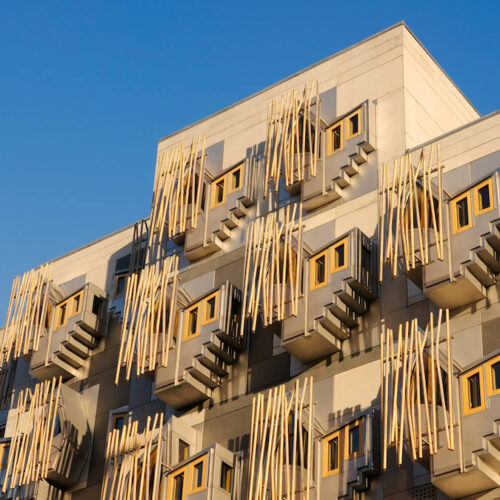
Photo of Holyrood windows courtesy of SBUK.