
Hamish Gobson’s diary: the view from across the Uisge
11 February 2023
LIKE ALL PEOPLE who live far from light pollution, we on the isle of Great Todday (Todachs) take a close interest in the night sky, and therefore space more generally. The Chinese balloon which sailed over the US last week at an altitude of nearly 100,000 feet has had us all riveted to our screens as we follow the information coming through on our encrypted links to NASA. Now that we know hundreds of smaller balloons have been sent up all over the world, you will struggle to find a croft house on this island in which a light is not burning late while someone studies the plots and trajectories trickling in from NASA HQ at Hidden Figures Way, near the old Washington Navy Yard.
Now the Americans have shot the balloon down, we are agog to know what they will find when they retrieve the wreckage from the seabed off South Carolina. This is not idle curiosity; it is a matter of vital local interest because we, too, have been the object of attention of some strange balloons, less high-flying perhaps and not necessarily of Chinese origin, but ominous and unsettling, all the same—and quite possibly hostile.
Dr Mike Wall, writing in Space.com, notes that most balloons of this sort have been classified up till recently as UFOs, or UAPs – Unidentified Ariel Phenomena. Now, a Department of Defense report has analysed recent sightings. Dr Wall concludes: “About one third of those 510 sightings — 171, to be precise — remain ‘uncharacterized and unattributed,’ according to the report. But nearly as many, 163, were identified as balloons or ‘balloon-like entities’.” It is these “balloon-like entities” that are the focus of concern on Great Todday.
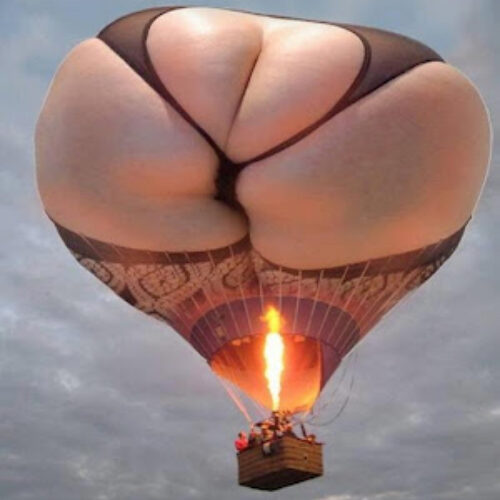
The problem is that “balloon-like entities” range from old-fashioned blimps to modern Bransons. Most are obviously balloons but some can be deceptive. They have “balloon-like” qualities, but they come in all shapes, sizes, colours, genders and sexual orientations. About the only thing they have in common is that they are filled with hot air. To use analogies from public life, they range from jumbo Salmondoids to jaunty Sturgeonoids, and include junior Swinnoids, which are spherical, smooth and pale. They seem to glow and throb very slightly, like pulsars. In an unkind light, they appear to be polished with ivory paste.
Great Todday’s most celebrated sighting occurred in 2014, the year in which, as older readers might recall, there was a referendum on something to do with independence. Todachs are more interested in the weather than the constitution, so they watch the sky more closely than the news—unless it concerns alien incursions into the “community environment”. This turned out to be one such.
We were both interested and concerned when, on a bright summer day, we noticed a helicopter clattering in our direction at wind-turbine height. On its side could be discerned a message to the natives on the ground. Though my distance vision is not what it was, I thought I could read: “STRANGER FOR SCOTLAND”. This is exciting, we thought. Who might the stranger be?
The helicopter landed near the pier head and out stepped a “balloon-like entity” with two legs—even stranger than we could have imagined!
Because it was daylight, no-one had their UAP-detecting equipment with them. We were at a loss to know who had so kindly thought to favour us with a visit. If it was a celebrity, that would be the first to have bothered coming this far off-shore since Noah did the rounds trying to raise money for his Ark Project feasibility study. But that was back in Biblical times, when sea levels were rising due to global raining, and the Scottish parliament was not even a twinkle behind Donald Dewar’s curry-splattered spectacles.
Some islanders took photographs of the UAP, but they were hard to interpret as the images were foggy. The words the “entity” uttered were hard to follow. Some thought they concerned ferry procurement; others nuclear disarmament. We will never know for sure.
Balloon-like entities are more commonly sighted in Edinburgh, especially at the bottom of the Royal Mile, where a huge building was constructed twenty years ago to house them. Some are as inert as argon gas, while others can be quite active when they detect a camera pointing their way. However, balloons seem to have difficulty interacting with other balloons. The way it works is this: one asks a question and the other fails to answer it. Between themselves, they call this process debating, but to an outsider balloon-on-balloon conflict is about as interesting as a pillow fight.
The main problem with balloons is that they leak easily. We know that from press headlines like: “Government leaks….”, “Cabinet Secretary accused of leaking…” or: “Leak Row Probe Looms”.
The balloon-like entity who descended to earth that day in 2014 and came amongst in human disguise eventually managed to convince the small crowd that had gathered that it wanted to know if it could “count on” our votes. That did not go down at all well. It was seen as a monstrous intrusion on the privacy of the ballot box. Data protection and all that…
“Will ye nae vote for me?” it said a second time, for some reason trying to “communicate with the natives” in strangled Glaswegian.
“Neffer in my life will I fote for you,” said Archie the Fank, getting uncharacteristically angry. “Not so long as I haff a hoal in me airse will I fote for you. And if I didnae haff a hoal, I’d get all puffed up, chust like yerself. No offence meant, of course. But faacts are faacts, and we’ll aaall haff to face them at the Peearly Gates ye ken, even yerself, Sir.”
At that, the entity emitted a curious roaring noise from its fundament. More hot air was generated and then it started to lift from the ground, slowly at first then faster as the roaring reached a crescendo. Soon it was high up in the clear Hebridean air and far away, floating soundlessly east in the sunlight, heading back to its mooring base on the roof of the concrete bunker opposite the Palace of Holyroodhouse, where 129 publicly-funded balloons live for part of the year and prosper for all of it.
The local polis being absent on Little Todday that day, we spent the rest of the afternoon playing with the abandoned helicopter, saving for posterity some of the more useful items, like the navigational plotter and the radio transceiver. By the time The Puffer opened, the carcase of the machine was in a condition in which we could justifiably ask the Council to remove the rest of the by now smoke-blackened wreckage. “Bad for tourism, you know…”
– – –
Hamish Gobson lives on the isle of Great Todday (Todaidh Mór) and features in Nicola Sturgeon, vol. 1, The Years of Ascent 1970-2007 – A Citizen’s Biography of a Driven Woman in a Drifting Parliament (Ian Mitchell, 2022) – available on Amazon.co.uk and also reviewed here by Tom Gallagher.
If you appreciated this article please share and follow us on Twitter here – and like and comment on facebook here. Help support ThinkScotland publishing these articles by making a donation here.