

​AS WE MOVE into another Holyrood election season, one that could yet see another parliament session with a minority secessionist ‘government’ in control (which if successful they’ll have been in power for 19 years by 2026) – it’s worth taking a closer look at the current public appetite for the single blinkered issue that dominates their thinking, focus and interactions with our UK – #Scexit.
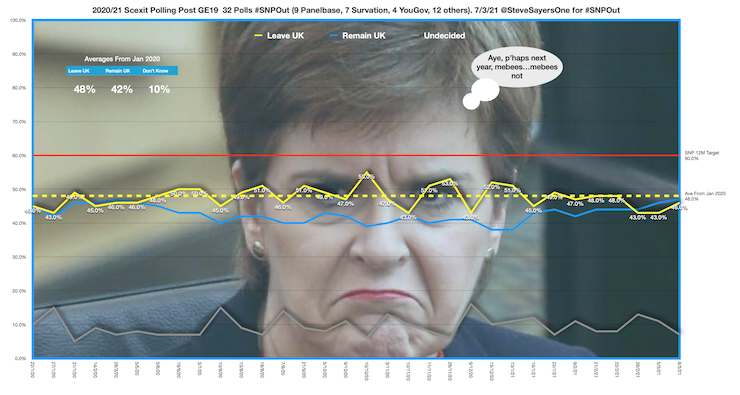
That appetite is regularly measured by professional polling companies, 99 per cent of whom are members of the British Polling Council (BPC), who’s president is Professor Sir John Curtice from The University of Strathclyde.
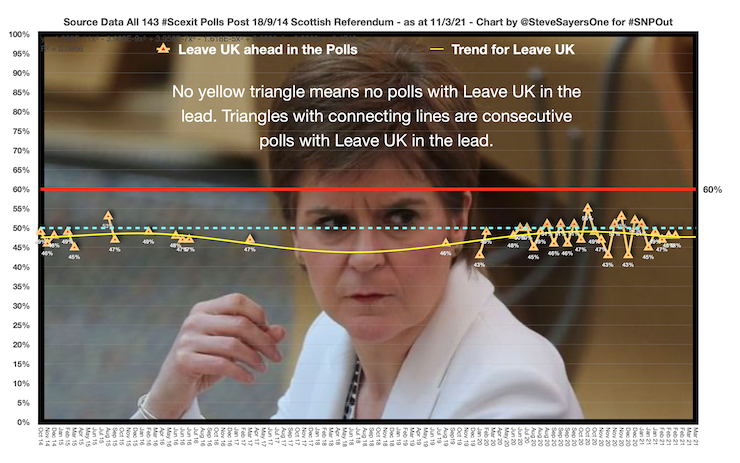
We’ve just passed an 8-month period in Scottish #Scexit politics, during which It seems all there is now Brexit is finally done (as a RemainEU voter who accepted democracy I just wish we can now all move on), is Scexit and Salmond. During this period the BPC polls have shown a lead for ‘LeaveUK’ 23 times consecutively. You’ll probably have heard about it, as it now seems the polls really mattered only when nationalists are in the lead, well, let’s humour them a bit, it’s the only decent run they’ve ever had or are likely to have.
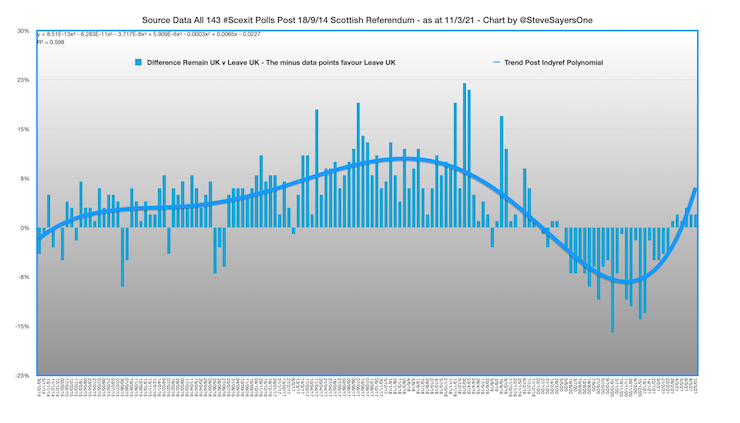
Since I took a keen and detailed interest in the polls (after the 2014 referendum was announced), there have been 253 since November 2011 and 143 polls since the referendum in 2014. In the post-referendum polls, LeaveUK has led 38 times, its longest run before its recent run of 23 was 3. It doesn’t seem coincidental to me that the run coincided with two key issues: a combined last ditch attempt by the SNP and remainers to attempt to stop Brexit – which failed – and a kickback against the Boris-led Tory government elected in December 2019.
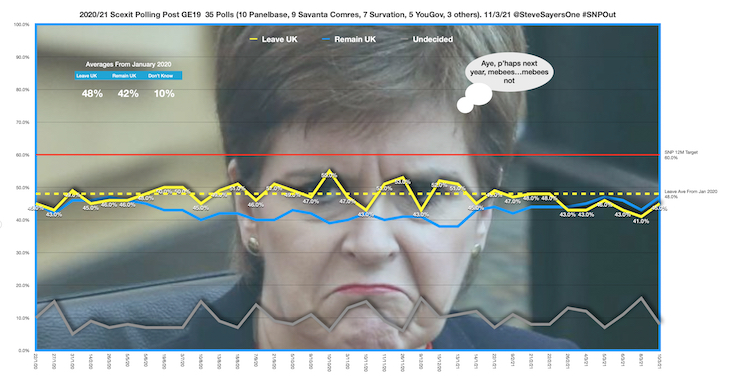
We have now left the Brexit transition period at the end of January 2021, and it’s shortly thereafter (and prior to Salmond and Sturgeon appearing at the Inquiry) that the mildly positive trend for LeaveUK reversed, the last 6 polls showing ‘RemainUK’ back in the lead again. As well as Brexit receding as an issue now the deed is done, it’s also quite possible the UK’s excellent vaccine handling from investment to rollout has also impacted positively on people’s perceptions, positive towards our UK that is.
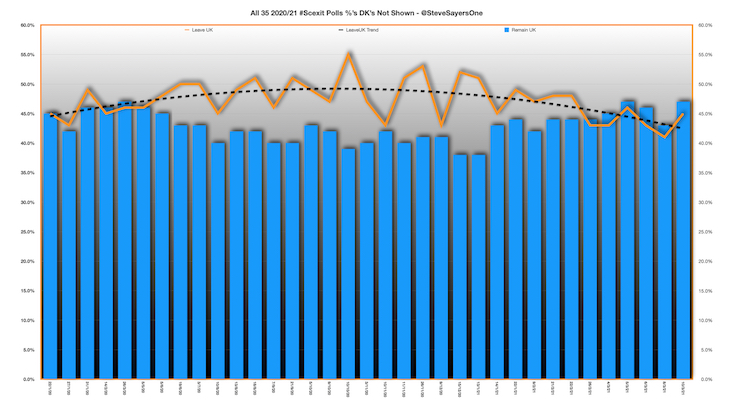
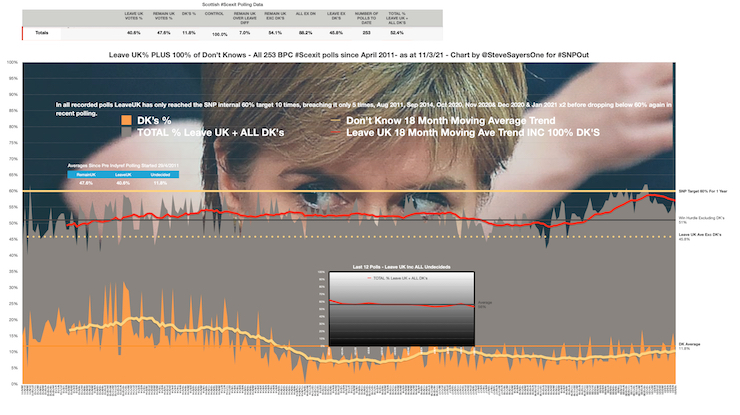
In reality, there’s no convincing lead for LeaveUK, no majority, no ‘settled will’ – there never has been and most likely there never will be. Even when LeaveUK is gifted ALL of those don’t know /undecided polling votes, it never gets anywhere near the SNP’s never contested internal target of achieving 60 per cent in the polls for a 12 month period.
When we exclude DK’s (all polls show results for LeaveUK, RemainUK and Don’t Knows/Undecideds/Won’t Vote – DK’s for short) LeaveUK has never achieved 60 per cent for one poll, never mind one year, and that’s in six-and-a-half years of polls. In the 9 months to 22 February 2021 (23 polls) the average for LeaveUK was 54 per cent excluding DK’s, with only one poll at 59 per cent. This period from 5 June 2020 was the zenith for LeaveUK, the start of its 23 poll lead sequence. Since the start of that period there has now been 29 polls and LeaveUK’s average is 53 per cent, starting at 52 per cent and ending now at 49 per cent. Immediately after the referendum in 2014, the first poll showed LeaveUK at 52 per cent, with its current polling at 49 per cent it’s clear there is no significant change, remember, DK’s are ignored, so the reality would be that percentage would drop in a real vote.
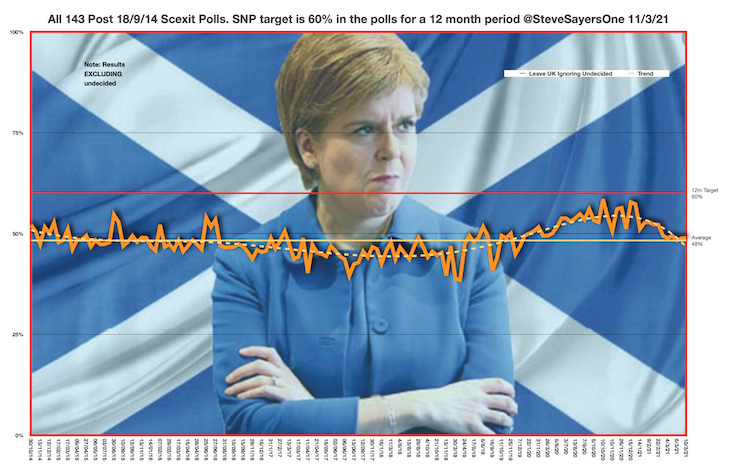
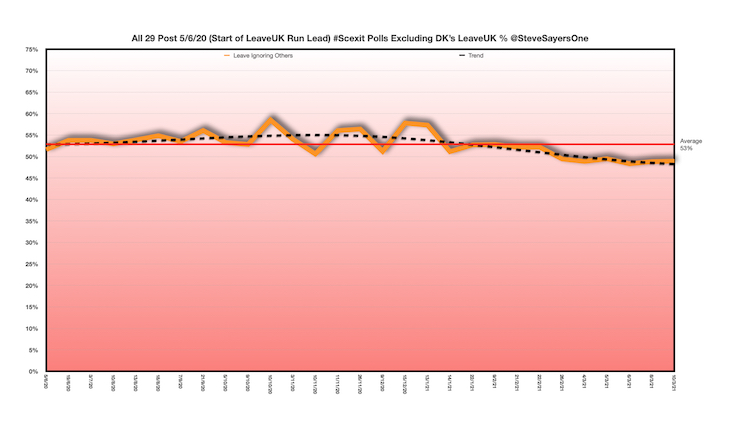
Individual polls by themselves mean nothing, yes they are of interest, but not as illuminating as the trend over time of multiple polls from a number of polling companies. Abstracting trends of individual pollsters is also interesting, we will look at one of these abstractions shortly as it is current and is carried out regularly. When you look at the wider trend and consider the previous three paragraphs, it’s evident to those with logic that the SNP-led LeaveUK has a huge battle ahead of it this coming Holyrood election. It and its nationalist supporters desperately wants a referendum, yet there is no perceived majority for and indeed no moral mandate for such a referendum.
The SNP has to win in May to keep its Scexit flame alive and it also has to promise its support that a referendum is coming, that’s a cleft stick as the public is tired of the hatred and division the obsession causes. The only way the SNP can get anything approaching a moral mandate is to campaign on a Scexit manifesto. This from a recent tweet of mine:
“There’s no SNP #Scexit mandate now. The only way of getting a publicly accepted mandate, is by getting 51 per cent+ of #HR21 votes based on a manifesto with Scexit as its primary promise. Nothing else cuts it & it isn’t going 2 happen, Scexit won’t be their primary manifesto commitment.”
So not only are the polls against the SNP but it’s unlikely it will go all-out in the campaign for a second referendum, the combination of lack of commitment and fading polling will lead, in my view, to further falls in support for ‘independence’ – a once positive word bastardised by Scottish nationalists.
The interesting fact about polls is that due to weighting aspects (polling technical data handling) I believe they are even worse for LeaveUK. So, those of you not interested in detail and numbers may well want to stop reading now, because this is going to get somewhat detailed, and as is evident from the preceding paragraphs, LeaveUK is on a hiding to nothing anyway.
Polls are weighted; this from Anthony Wells from YouGov:
“Weighting by Demographics: As we’ve seen from the sampling article, no sampling technique is perfect: quasi-random sampling by definition has some random variation in it and even YouGov, who know the demographics of all the people they invite to a poll, can’t be certain they will all respond at the same rate. If an achieved sample doesn’t match the known demographics of Great Britain (Scotland) then pollsters deal with it through weighting.”
Weighting really is more complex and difficult than YouGov would have you believe, especially in relation to Scexit polling which has a number of unique aspects.
When I first looked at data from polls around and after the referendum (polling companies publish a high level of detail as well as the headline results used by them and those who commission them) only Survation weighted results by the ‘likelihood to vote’. Most other pollsters in polls pre and after the referendum didn’t use turnout weighting. Even Mark Diffley when working at Ipsos Mori (he’s now with SNP-backed Angus Robertson’s ‘Progress Scotland’) didn’t use it. Survation was followed by others later who now all use it. The reduction in people questioned varies from 10 per cent – 20 per cent, this in my opinion has to increase the MOE (margin of error, normally +/-5 per cent) and reduce DK’s significantly. This means if the poll asks 1020 people to take part, they prune down the number asked the actual LeaveUK/RemainUK question by somewhere between 100 and 200 people. This turnout pruning is via a question asking how likely they are to vote on a scale of zero to ten, they then exclude those who selected (normally) 8 or less where 10 was most likely/definite to vote. It seems to me when it’s a simple binary question, excluding those from 1 – 8 is going to reduce the number of DK’s in the final result. These DK’s are the very people who decide a referendum’s outcome, they either vote one way or the other when push comes to shove.
In 2014 those DK’s gravitated hugely towards RemainUK when people were actually faced with the vote. The same will happen again, lack of information and poor forecast detail from the SNP will ensure it. In the 3 polls on the day prior to the referendum, the average results were: LeaveUK 44 per cent, RemainUK 49 per cent and DK 7 per cent, you know the result, LeaveUK picked up only 1 per cent of those DK’s, RemainUK picked up 6 per cent, (86 per cent) of the undecided vote to produce the 55.3 per cent / 44.7 per cent RemainUK result. Comparing that to the latest 3 polls, LeaveUK 44 per cent, RemainUK 46 per cent and DK 10 per cent, on a similar pattern to 2014 (which I suggest is highly likely), the result tomorrow would be 54.5 per cent/45.5 per cent RemainUK, absolutely no significant change. Bear in mind this is even with genuine DK’s now being removed from the polling results – I did say it would get detailed!
Chris Curtis from Opinion Research (pollsters) is of the same opinion as me, here’s his Tweet from the 7 March 2021when some people were ‘up in arms’ when Savanta ComRes released a snap ‘unweighted’ Scexit poll recently:
“I wouldn’t bother weighting a Scottish independence poll by turnout anyway. We have to assume almost everyone is going to vote (like last time) and there is no way of telling who won’t at this stage regardless” .
As well as turnout weighting, weighting is applied to party voting intention, previous referendum voting, age profiling, sex (not gender) and location, so it’s always worth looking at the initial raw data to get a feel for how much weighting has been done. Pollsters will of course defend their weighting, but to me, the more complex it gets the more MOE must increase. There is one other key aspect that has, again in my opinion, altered the LeaveUK/RemainUK polling results in favour of LeaveUK examined below..
Young voters/Age Weighting. 16 and 17-year-olds are now included in nearly all Scexit polling, their propensity to vote is low. In 2014 110K registered, 75 per cent of them say they voted. They represent 2.5 per cent of those who can vote and at that does not appear to be fully covered by any weighting.
“Daily Express, Scotland and the Union Poll – 8 March 2021 Savanta ComRes interviewed 1,004 Scottish adults aged 16+ online from 26 February to 4 March 2021. Data were weighted to be representative of Scottish adults by age, gender, region, 2019 General Election recall and 2014 Independence Referendum recall. Savanta ComRes is a member of the British Polling Council and abides by its rules. Full tables at www.comresglobal.com.”
In this poll of 1004 people, weighted down (for all factors) to 825 who were actually asked the question, the LeaveUK results (outcome 43 per cent) were as follows: 16-34 yr olds 60 per cent, 35-54’s 47 per cent and 55+’s 29 per cent. The ‘complexity’ comes in when you look at two things, firstly that the first age group are much less likely to vote by a considerable margin and secondly even after weighting, the reduced sample size of 825 is not representative of the respective age groups as a percentage of our population, namely, 16-34 27.4 per cent, 35-54 32.4 per cent and 55+ 40 per cent, you do the math.
For those that bothered to read past paragraph six, I hope the detail that followed has enlightened you a little. I would encourage you to look into the data tables yourselves when published. In the meantime, you can follow my charting of Scexit poll trends by following my pinned tweet on Twitter @SteveSayersOne where you will see my latest trend charts and occasionally some light analysis. #SNPOut
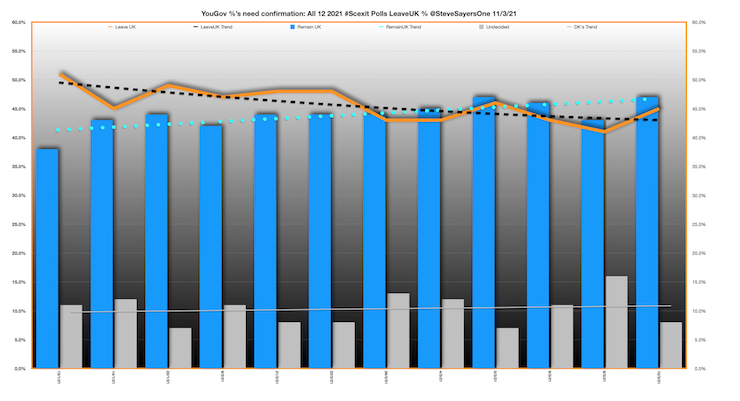
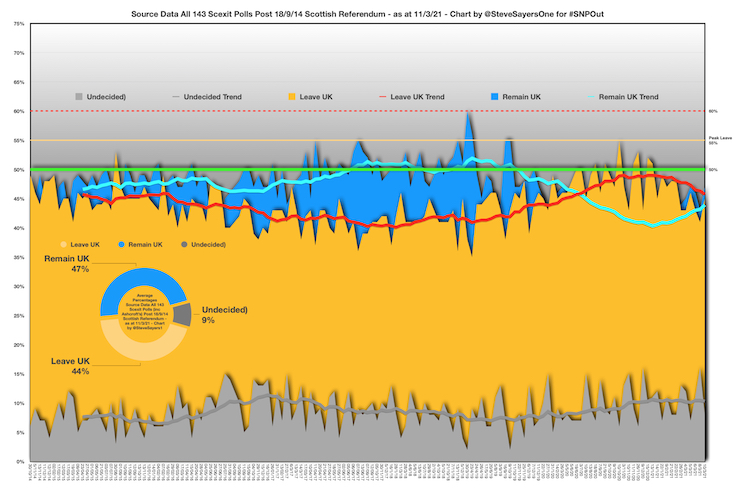
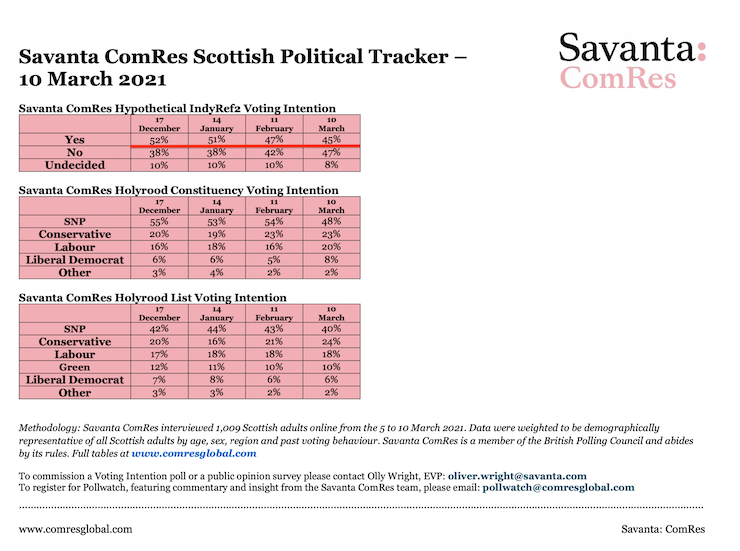
Ooops! Nearly forgot about that single pollster abstraction, here it is:
Steve Sayers is a regular blogger on polling and politics – and other matters more enjoyable. This article was first published on his Steve Sayers Blog on 11 March 2021. Thanks for letting us republish it Steve.
Image of falling red arrow going through the floor by pathdoc from Adobe Stock