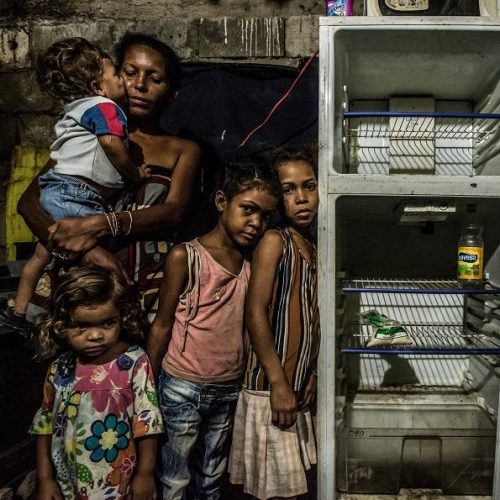

THE SITUATION in the Bolivarian Republic of Venezuela was far from pretty on the eve of Coronavirus’s arrival in Latin America. Struggling through the worst economic crisis of any country in peacetime, five million Venezuelans – one sixth of the entire population – have fled their home in the face of unmanageable hyperinflation, starvation and a corrupt Chavista petro-state that avoids collapse only by tightening its grip on the population.
The UN World Food Programme surveys carried out between June and September 2019 found that 59 per cent of familieshave insufficient income to buy food. 33 per cent said they had accepted food as payment for work – an unsurprising figure in a country whose annual inflation lies at over 80,000 per cent. Four in ten families experienced daily power cuts.
The situation in hospitals has been deteriorating for years. Blood tests, alcohol, lab equipment, ventilators and basic medicine are routinely absent and highly sought-after. One doctor reported that “there isn’t even paper so we can’t keep the patients’ medical history.” Medical professionals relied on donations from NGOs such as the International Red Cross and their own funds to purchase equipment.
And this was before Coronavirus arrived.
Half of the globe’s Covid-19 infections have to date been recorded in South America. Itself on a continent woefully unprepared for a pandemic of this scale, Venezuela was in a doomed position.
Nicolas Maduro instituted a nationwide quarantine on 17th March 2020, which was enforced by a corrupt cabal of police, armed forces, the FAES, and gun-wielding pro-government gangs. Arbitrary arrests and consistent harassment, already a staple for the lives of many Venezuelans, were recorded in increasing numbers.
Maduro’s state, which does not publish crucial epidemiological data, tasked itself in 2020 with harassing, persecuting, and intimidating health professionals and journalists who dared to bring attention to the deteriorating conditions in hospitals and quarantine camps. The state had, by October, detained and prosecuted at least 12 healthcare workers on grounds of conspiracy. In conditions like these, human rights groups shut down their reporting operations for fear of repercussions such as detainment, slowing the supply of accurate reporting to a dribble.
Disinformation is the game of the Venezuelan government, which claimed on the 16th August that there were only 1,148 new cases of coronavirus across the entirety of the country. Amnesty International’s discovery of 691 new patients in several of Caracas’ hospitals alone dispelled any trust that may have remained in the claims of the government. To date, the situation with regards to Covid-19 infections is murky and unclear.
Meanwhile, the situation for healthcare providers is more dire than ever. In a survey of healthcare providers’ ability to respond to coronavirus, 32 per cent of hospital workers reported that their facilities lacked any potable water, and 64 per cent reported only intermittent access. A Human Rights Watch report into 14 public hospitals in Caracas found that soap and disinfectant are virtually non-existent. A national survey on May 16 found that 57 per cent of the health sector were short of gloves, 62 per cent were short of face masks, 76 per cent were short of soap, and 90 per cent were short of alcohol gel. In Caracas, the healthcare advocacy group Medicos Unidos de Venezuela reports that 67 per cent of hospitals have no face protection and 92 per cent are forced to reuse face coverings.
In the final months of 2019 Maduro gave the Venezuelan economy breathing space by relaxing some socialist controls – monthly price increases largely stayed below 30 per cent. By the next April, however, that respite was gone as quarantine was announced and the gas ran out: consumer prices rose by 80 per cent and the Venezuelan bolivar depreciated by 60 per cent. A growing fuel shortage is a result the state-owned PDVSA’s continued corruption and mismanagement, combined with falling fuel prices that dropped both below production and importation costs. This has led to a crisis of transportation in which food is wasted as it cannot be delivered and all food delivery costs have risen substantially: the think tank Cedice reported that the cost of home-delivered chicken rose by 143 per cent in just two weeks.
Opposition parties agreed to withdraw from National Assembly elections on December 6 on grounds of suspected vote rigging. As they had expected, Maduro’s PSUV landslide was produced with an embarrassing turnout of only 30 per cent. That is not to say the opposition is united, however: 2021 will see divisions over whether to participate in a dodgy electoral system, goaded by low Chavista turnout, or to stick with their non-participatory guns. Compare the surge in support for Juan Guaido in January 2020 to the situation now and the picture for the opposition seems stark.
Ultimately, 2020 was a year that wrought havoc on the Venezuelan people and strengthened the grip of Maduro’s state. In this way, it was not so different from previous years. It proved that no suffering is enough for a country that has been brought to its knees by corrupt socialist despotism. It proved that if an incompetent state experiences a ravaging pandemic enough brutality will still enable a dictator to hang onto power.
Finally, it proved that a free flow of gas is not a requisite for Chavismo’s survival, as many had thought. Looking forward, 2021 may prove itself to be a tougher year than ever for Venezuela.