
A new book about Russia which illuminates the state of Scotland today
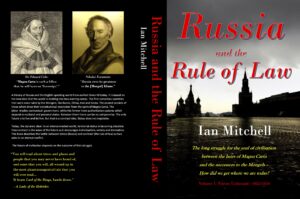
AFTER SOME YEARS of reviewing other people’s books for ThinkScotland, the editor has kindly allowed me to draw attention to my own title, published last week. It is called Russia and the Rule of Law. I hope it will be of interest to anyone who is worried about the fact that Russia and other authoritarian or autocratic states are making nuisances of themselves all over the place and the West seems incapable of dealing with them.
This situation is mirrored at home by the breakdown of orderly democratic government in Scotland. The etiquette of the debating chamber is being elbowed out by the self-righteous clannishness of the wokey agitprop meeting. As with drug-death rates, Scotland is leading the way internationally. The horrible fact is that if you want to understand the roots of the SNP’s cynical approach to power, your best course is to study the way President Putin conducts himself in the Kremlin.
At its widest, my story goes back to the middle ages. It describes the two conflicting forces which are still shaping the world today, eight hundred years later: Magna Carta and the Mongols. The Mongols first invaded Europe in 1223, just eight years after Magna Carta was sealed at Runnymede in 1215. They imposed imperial rule on Russia, China, Korea and Persia (amongst others). Though their power ebbed fairly quickly, the influence of their authoritarian but often highly intelligent approach to government continues in some of those countries.
This was especially true of Russia, which was ruled by the Mongols for 250 years (about the length of time the United States has existed). That was far longer than in the other countries (e.g. China, where the Ming dynasty replaced the Yuan in less than a century). The reason for the difference was that the Muscovite princes wanted it. Starting with Alexander Nevsky, a decade after the invasion, the Russian princes co-operated with the Mongols, then were appointed agents—sort of “estate factors”, really—to the Golden Horde, with the responsibility of raising taxes and recruits. That gave the Muscovite grand princes authority over their fellow countrymen. They used that power to weld the country into a single whole, which then became an empire after Moscow had taken over the whole enterprise.
When they finally took over, in the late fifteenth century, the Muscovite Grand Princes made little change to the Mongols’ systems of tax-gathering and military recruitment and continued to subject ordinary Russians to quasi-imperial authority. For example, serfdom, which was to blight Russian life for over three centuries, was introduced only after Russia was “liberated” from the Khans. The so-called “Mongol yoke” was never lifted off the backs of the average Russian in the fields or in the forest. It merely changed into the “Moscow yoke”. That set a pattern which is recognisable even today. Russia is still what I call an “internal empire”.
By contrast, in England, the basic idea behind Magna Carta was that everyone, including the king, was subject to the law of the land. Magna Carta was not unique in Europe. Many other states developed similar ideas, but Magna Carta was the only one which lasted. Though honoured more in the breach than in the observance for centuries, the principles of Magna Carta managed to survive the “warlording” of the late middle ages.
The man who did most to bring it back into government was a senior judge, Sir Edward Coke. He was the first lawyer to tell King James VI and I that he could not sit as a judge in a court of law. It was also Coke who drafted the Petition of Right, in 1628, which became one of the talismanic assertions of public co-responsibility for government in the run-up to the Civil War. The big idea was that law should be above the sovereign, and therefore itself sovereign. As I note on the back cover of my book, Coke famously said in the House of Commons: “Magna Carta is such a fellow that he will have no ‘sovereign’.” Given the context, there was just a hint of menace in those words.
The Russian historian, Nikolai Karamzin (also on the cover), made an equally famous statement of the opposite principle: “Russia owes its greatness to the Khans.” It was the authoritarianism and unified power of the Mongols, under a single Great Khan, that enabled the Grand Princedom of Muscovy to expand until it covered much of northern Eurasia. Karamzin, who lived in Napoleonic times and wrote the first authoritative but accessible history of the Russian state, was an Anglophile, and a believer in justice. But he understood a greater truth: “Russia is not England.”
In Britain, the laws actually became “sovereign”, at least in principle, after the Glorious Revolution of 1688. More importantly, the rule of law became a potential reality in 1701 when (by the Act of Settlement) judges were given full independence on the Bench. That meant that they could no longer be sacked by the monarch if he or she did not like their judgements. (King James VII and II fired 13 judges in his four years on the throne, including four in one day.) Since the Crown then was the executive arm of government, like the civil service today, that represented a seismic shift.
What is the rule of law? Apart from the practical issues of due process, the rule of law boils down to the idea that those who make the rules are appointed, and can be dismissed, by those who are expected to obey them. This is what I call the principle of “reciprocity”. It is what democracy aims to achieve, but also what President Putin and the extreme nationalists in the SNP try to suppress. They all think “the cause” is, in effect, sovereign. In its service, they are prepared to lie about matters of public controversy; to keep silent when information should be made public; and to intimidate anyone who is too bold in trying to uncover facts they wish to conceal. National government becomes personal government, which is roughly what a non-constitutional monarchy is.
Curiously, both Scotland and Russia have similar traditions of authoritarianism. In Russia, the long-term denial of reciprocity was epitomised by Catherine the Great who told the Commission she appointed to revise the laws of the Empire in 1767 that: “The Sovereign is absolute; for there is no other authority but that which centres in his [sic] single Person that can act with Vigour proportionate to the Extent of such a vast Domain.”
Pre-Union Scotland had a weak monarchy, and so was ruled by powerful landed oligarchs. Reciprocity was at a discount. One statistic will illustrate the contempt of the old Scottish elite for public opinion.
At the time of Catherine’s initiative, the total electorate for the whole of Scotland, which had a population around 1.4 million, was under 4,000. Argyllshire had about 50 electors, and the next constituency to the north, Inverness-shire, about the same. Most of the borough constituencies had tiny, often self-selecting electorates which came close to parochial oligarchies—in modern Russian terms, the provost and his baillies were “minigarchs”. Most controlled trade and manufacturing more for their own commercial convenience than for the official purposes of their office. The Acts of Union retained the voting franchise from the pre-Union Scottish parliament, which was grossly undemocratic. (I have written about this in The Justice Factory.)
That was all swept away in 1832 with the Great Reform Act. Though democracy was primarily an English initiative, Lord Cockburn and his friend, Francis Jeffrey (later Lord Jeffrey) brought the substance of it to Scotland for the first time. Between them, as Liberals under Lord Grey, they drafted the Representation of the People (Scotland) Act (1832), which was revolutionary. Whereas the English electorate was expanded by 60 per cent in 1832, from 435,000 to 652,000, the Scottish one exploded from less than 4,000 to over 60,000, a 1,400 per cent increase.
One further point should be made. Like Russia, pre-Union Scotland was not a country in which the people were allowed to influence government. For all the maunderings of Scottish nationalist factioneers today, the often-repeated term, the “realm of Scotland”, was meaningless in any practical modern sense of the word.
The shallow boastfulness of Scottish exceptionalism was epitomised by the late Professor Edward Cowan of Glasgow University who made (in a book on the subject which I reviewed on film) the ludicrous claim that the Declaration of Arbroath of 1320 was equivalent to the Magna Carta. Apparently, it expressed a “contractual” theory of government. Not at all. In fact it was oligarchic in the purest sense—the barons would choose and control a leader whose interests aligned with theirs—in this case, keeping English hands off their personal property.
The Swinney-Sturgeon tribe wants to control a state which is small enough that they can get their long digital fingers into every administrative till. They see their fellow “barons” as the civil service, the quangos, the NGOs and all the seditious weirdos whose fantasies include destroying the established order of the British state (and even redefining its biology). Obvious candidates include climate hoaxers, “post-truth” universities and the sort of crank who lobbies for “rewilding” from the safety of the suburbs.
Scotland, like Russia, but unlike Hungary, Denmark, Sicily, England and others, produced no medieval document which put the law above the king, which is a sine qua non of the rule of law. The barons in 1320 were not “representatives” of the country, but powerful public sector entrepreneurs with estates to expand and defend against the English. The Declaration of Arbroath did not make the king subject to the laws of the land, even in theory. Instead it made him subject to the barons, a completely different idea, which has less connection with “contract” government than it does with Kremlin-style plutocratic gangsterism.
The main point that civilisation should take from all of this is that the ideal of the rule of law is under threat. Whether it can survive in Scotland is an open question. It is dead in Russia; or rather, it was never properly born in Muscovy. It flourished magnificently in medieval Novgorod, but Ivan the Great invaded in the 1470s and killed not only the rule of law there but also thousands of the more influential people who favoured it.
The most effective counter to political piracy at home and authoritarianism abroad is for everyone to remember who we are and what we are. Traditional values are much derided in the anti-democratic media today, but our history is what gives shape and definition to our society.
My book is an attempt to show how both Russia and the West have come to be as they are—at daggers drawn, right now, but hopefully not forever. Russia is a wonderful country with a dreadful government, much as Scotland is. Now that our universities have joined the bureaucratic barons in tying to reconfigure our understanding of the past, it is important for us all to remember the full history. Hence my book.
Established in 2006 and celebrating twenty years, ThinkScotland is not for profit relying on donations to publish our wide range of opinions. You can subscribe to our FREE newsletter here – share and follow us on ‘X’ here – like and comment on facebook here and make a donation here. Every contribution helps to meet our overheads.
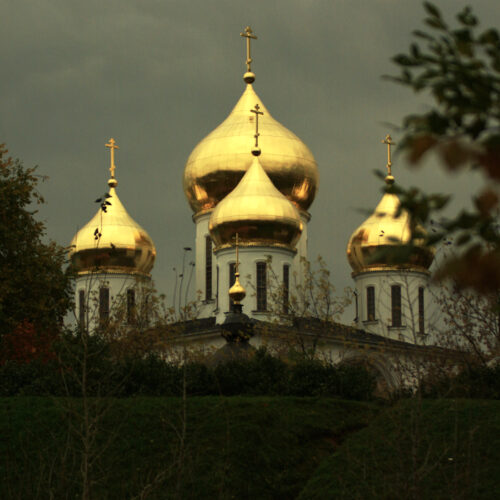
Photo of Dmitrov, first headquarters of the Gulag, by the author.