Nicola Sturgeon has resigned. This piece on polling, reporting what was obviously very bad news for the SNP, was written yesterday before the announcement, I doubt however this poll alone was her reason for jumping the ferry, but straws?
The SNP is straying way off target
I HAVE BEEN FOLLOWING Indyref polling for over 10 years, pre the vote in September 2014 and ever since. What is abundantly clear is the SNP’s unpublished but well known target of 60 per cent in the polls for a twelve month period is just never going to happen.
A Daily Business article on the 18 October 2015 said;
“The SNP will require 60 per cent of voters to be in favour of Scottish independence before calling another referendum, it has been claimed.
Senior SNP sources told BBC Radio 5 Live’s Pienaar’s Politics that they are setting this minimum target as a trigger point.
There has been no official comment from the SNP. SNP leader and First Minister Nicola Sturgeon has only stated that there would need to be a significant change in circumstances, such as a vote to take Britain out of the EU.
She stated at last week’s party conference that she would work at persuading more voters to support independence before considering a new poll. This appears to have led to today’s suggestion that a two-thirds majority would be the required benchmark.
An SNP spokesman said: “As the FM set out there will only be a second referendum on independence if there is clear evidence of a shift of opinion.”
Additionally a Herald article dated 18 October 2015 said;
“First Minister Nicola Sturgeon has been playing down the prospect of an imminent re-run of last year’s ballot – which saw a 55 per cent-45 per cent victory for the unionists.
She has suggested that a new vote could be triggered if the coming in/out referendum sees Britain exit the EU in defiance of Scottish wishes.
But senior SNP sources are said to have told BBC Radio 5 Live’s Pienaar’s Politics that they have also set a “test” of polls showing at least 60 per cent support for independence for more than a year.
British Polling Council president Professor John Curtice said he agreed that such a level of sustained support would be required to ensure Scotland voted to leave.”
Despite me and many others bringing up this internal target over the past eight years, has NEVER EVER been disputed.
With the recent Lord Ashcroft poll putting a ‘YES” vote at only 37 per cent (ignoring don’t knows), one of the 5 lowest polls (three polls at 37 per cent, two at 36 per cent) since September 2014, the heights of 60 per cent are clearly unachievable after the passage of time that has seen Brexit, Covid our UK vaccine rollout and Furlough, the war in Ukraine, the resultant cost of living crisis, the SNP ferries debacle, 5x England’s drug death rate, health services, the failed Independence bill rightly stalled by our UK supreme Court and, unbelievably, to top it all, the failed passing of the dreadful Gender Recognition Bill without allowing women’s groups input, resulting in our UK Government having to stop the bill with a Section 35 order!
To be fair, you can actually stop reading now, as what I’ve said so far in terms of our constitutional journey from 2014 to now should be enough to convince anyone that the SNP have lost the plot, however, for the polling aficionados, let’s press on.
The 37 per cent Ashcroft result if given an equal share of those polled who were uncertain or said they might not vote, 15 per cent of respondents, means his result can be classed as 45 per cent – that’s no movement since 2014,
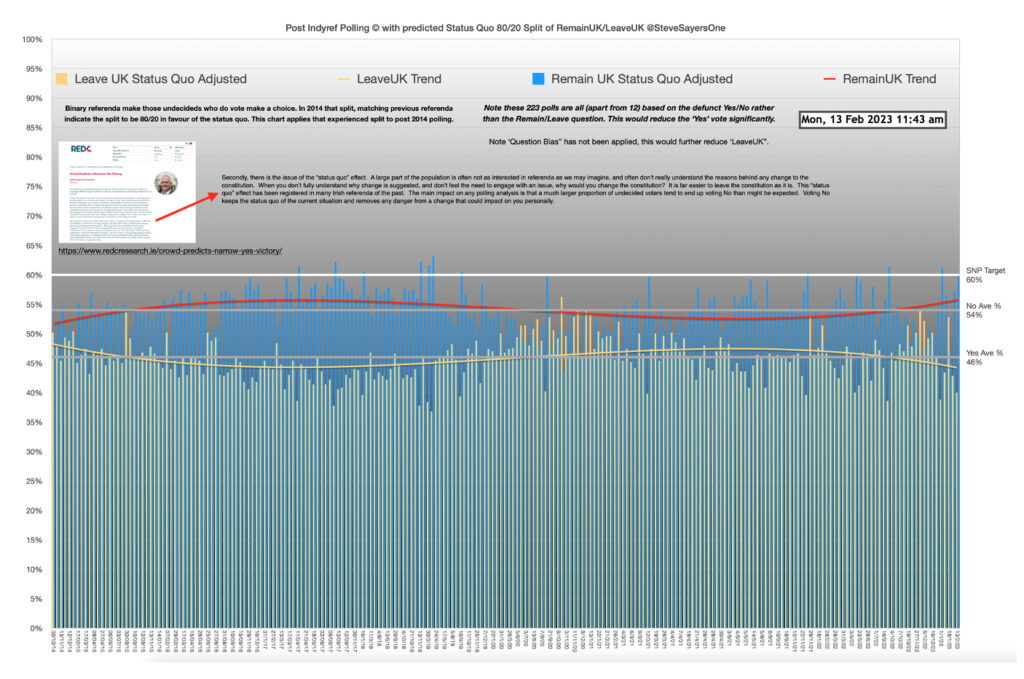
In reality, those don’t know votes actually split 80/20 to the status quo position, it happened in 2014 and has happened in many other similar voting scenarios. So we could say that the 37 per cent becomes 39 per cent, that’s well below 2014 and definitely NOT 60 per cent for a month never mind a week.
Polling however, whilst a serious and informative process, is not encapsulated by one poll by any particular pollster, yet Ashcroft’s three polls so far have been 46 per cent August 2019, 44 per cent April 2021 and now 37 per cent Feb 2023. Ignoring the don’t knows the three become 52 per cent, 49 per cent and 45 per cent – applying the status quo split of the don’t knows the three polls become 48 per cent, 46 per cent and 40 per cent.
The reasons for the Ashcroft poll trajectory (trend) over time are the factors I listed above and the SNP’s continuing failure to govern well, the polls haven’t seen the fallout of the bottle return scheme or the alcohol brand advertising kerfuffles yet!
Let’s move on to the bigger polling picture so we can all see why #Scexit (Indyref2) is not going to happen any time soon, if ever. I will bore you later with some complex polling graphics but let’s focus on what the percentages quoted in the polls in the media actually mean.
Firstly, polls are fairly accurate with a low margin of statistical error. Some companies with their panel and process favour over time either the YES or the NO vote, but when combined over time and trended they show an accurate picture of the will of the Scottish people.
But, and this is a very big but, there are things the pollsters and the media don’t do. There are two generally ignored factors at play that understate the NO vote significantly. The first is the status quo adjustment that takes account of those polled and splits them 80/20 in favour of NO, so if 10 per cent of those polled are split 80/20, YES only picks up 2 per cent, whereas ignoring the don’t knows they are inflated. Ashcroft’s poll results were 37 per cent YES 48 per cent NO and 15 per cent don’t know.
Ignoring the don’t knows gives a result of 45 per cent/55 per cent YES/NO (still no change from 2014), when the don’t knows are included and split 80/20 the outcome is 39 per cent YES 61 per cent NO, starkly worse for YES than the 45 per cent.
The second significant factor is the question the pollsters ask; 95 per cent of post Indyref polling has been carried out on the basis of YES/NO (should Scotland be an independent country?) As anyone with any sort of grasp on constitutional questions will know this basic format was scrapped with the Brexit referendum, and the question, if there was ever another vote, would be a LEAVEUK/REMAINUK type as dictated by the UK Electoral Commission. I sometimes think the pollsters encourage the defunct YES/NO format as it keeps things ‘interesting’ and is good for repeat business.
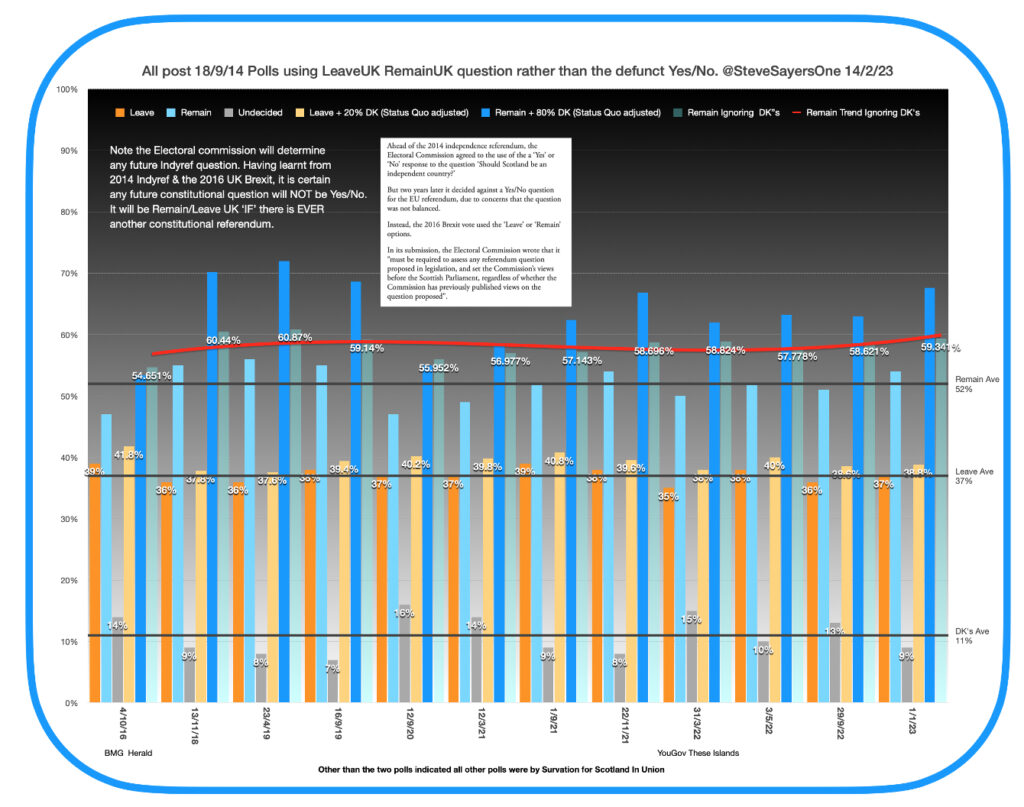
Thanks to Scotland In Union, who have funded 10 Survation polls with the Leave/Remain question, we can clearly see the impact the modern question has, for it drops LeaveUK support from the current average since 2020 of 44 per cent to 37 per cent, a 7 point drop.
Two other polling companies, BMG for The Herald and YouGov for These Islands have used the modern question and both results fit and confirm the SIU Survation results. Note Survation does most of its polls as the YES/NO version, in its 53 polls post 2014, including its 10 Leave/Remain polls for SIU, the average leaveUK result is only 42 per cent; so, on 43 versus 10 polls where Survation with the question from YES/NO to LEAVEUK/REMAINUK the difference, using their standard polling methodology, is minus 7 per cent for those wanting #Scexit.
So, summing up, IT’S POLL OVER NOW – especially as Surgeon has now resigned – have a peek at the charts below if you want.
Ps You will always catch a current(ish) polling update in my Twitter pinned tweet @SteveSayersOne
If you appreciated this article please share and follow us on Twitter here – and like and comment on facebook here. Help support ThinkScotland publishing these articles by making a donation here.