
SCOTLAND’S nearly 150 years as an industrial powerhouse were sometimes replete with communal tensions. Economic rivalry between workers, religious differences, and occasionally fierce ones over the fate of Ireland characterised the West of Scotland for generations. In European terms, Scotland wasn’t unique. In cities as different as Nuremberg and Barcelona ethnic or religious animosity combined with economic issues to jeopardise civic peace at times.
What was notable about Scotland was that the authorities kept the lid on the sectarian cauldron. Rivals for political office usually avoided exploiting these atavistic conflicts. More often than not it was economic and social matters that preoccupied them.
This tradition of prudence and restraint was carried over into the era of the 1969-98 Northern Ireland troubles. The main political forces closed ranks to deter the importation of terrorism, well aware that both of the Ulster camps had their fervent backers in Scotland.
It will be disbelieved by many, but today sectarianism is a shadow of its former self. Arguably as a source of division it has been easily superseded by friction between pro-UK and pro-Indy Scots. This cleavage is not confined to any specific corner of the country but extends really deep into many different crevices of life, dividing families, communities, generations. For the past decade calls from the SNP for restraint have been few and far between. The party represents around one-third of the electorate and supporters are kept energised not by what it achieves in power but by its narrative of protest and agitation against those who control the rest of Britain and their supporters in Scotland.
Well-known Scottish politicians from the mid-to-late 20th Century like Willie Ross, David Steel, George Younger and Donald Dewar would quite likely be astounded at the alacrity with which top power-holders advance identity politics, even taking the lead on emotive and inflammatory issues.
At one level this is pathetic. It is easy to shake one’s head at the passive aggressive stance of Nicola Sturgeon towards the royal family. This week the Duke and Duchess of Cambridge will be in Scotland mainly to thank frontline workers for their efforts to defeat the pandemic. Initially she would not be drawn about her thoughts on Prince William and Kate Middleton coming to Scotland. Very belatedly her office issued a statement saying she would be delighted by their presence, perhaps a recognition that she would be the loser if she snubbed a couple who are popular across Britain.
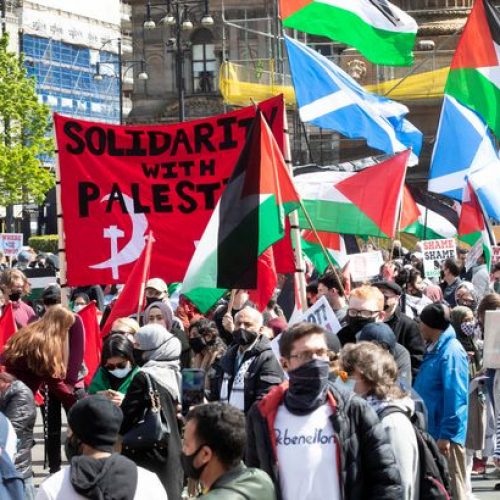
Humza Yousaf, justice minister until last week, differentiated between groups who recently congregated in Glasgow defiance of restrictions on assembly due to Covid. He did this on the basis of what he thought of their political leanings. Those who massed in Kenmure Street to prevent the deportation of two Indian nationals by the Home Office were saluted for their decency. His media ally Gerry Hassan talked of the “joy and solidarity” of an event which he attended. The minister declared that he saw his role as being to “‘delegitimise’ UK Government policies he sees as unjust.”
This salute of left-wing people power was in sharp contrast to their scorn about the Glasgow celebrations of many of the supporters of Rangers football club for winning the league after years of adversity following the club going into liquidation in 2012. Hassan demanded a significant points deduction in the new season which “would hit them where it hurts.” Yousaf warned that clubs ought in future to face strict liability for the behaviour of their fans.
This paragon of order, along with most of his SNP colleagues, has never been remotely as concerned when their own political supporters behave not just in a raucous but a sinister manner. The disclosure of a podcast in which named Nationalists said “there’s going to have to be a confrontation between Scotland and England” and also that they would “happily take them [English police] out with a high-powered rifle” produced scarcely any heart-searching in nationalist ranks given the paucity of statements issued.
The reaction to a spoof video of a Rangers gathering, including players apparently involved in anti-Catholic singing showed that an entirely different standard needed to be applied to a club with a strong British-minded following. Yousaf quickly tweeted that players should be forced out of the club if they were found guilty of “anti-Catholic hatred.”
Doubts expressed by the club about the authenticity of the video clips were soon borne out when the police issued a terse statement last Friday evening saying that “extensive enquiries have been carried out and no criminality has been established.”
A storm had been whipped up by the minister’s precipitate intervention. Thanks to Yousaf far more people saw this doctored video than would normally have occurred. The Conservatives claimed that “personal feelings had clouded his judgment.”
Perhaps something not altogether dissimilar occurred in 2012 when Paul Clark and David Whitehouse, lawyers and accountants administering Rangers football club were arrested, detained and maliciously prosecuted for fraud. They could well have languished in prison but for the tenacity that they showed in trying to clear their names. Their troubles occurred under the chief prosecutor, Lord Advocate Frank Mulholland, who had never hidden his support for Celtic football club. He is now a senior judge and he is quick to deny being a moving force in this affair.
In Scotland the head of the Crown Office (prosecuting service) is a political appointee and sits in the government. Indeed, he is the government’s own lawyer. Mulholland, resigned in 2016 around the same time his brother, also a lawyer, became embroiled in legal controversy. On 9 February 2021 his successor as Lord Advocate James Wolffe made a public apology to Clark and Whitehouse for the Crown having pursued a “malicious prosecution” against them “without probable cause”. In an earlier court hearing lawyers for Wolffe admitted that prosecutors acted unlawfully for a significant amount of time in the prosecution of the two men.
Heavy damages were paid out to them in August 2020 and it is seen as likely that the legal bill for the Scottish taxpayer could be not be far off £100 million in total.
The Herald newspaper’s investigative reporter Martin Williams has been praised for his tenacity in unearthing vital information that enabled two innocent citizens being crushed by a prosecuting service which his colleague Iain MacWhirter has described as “rotting, like a fish, from the head down.”
But there has been little heart-searching in civil society about how the prosecuting service pursues what seem to be vendettas. Few luminaries in Scottish life are prepared to come forward and state that Rangers has been treated harshly by the state and those under its sway because the club’s ethos is not a nationalist one. One of the few is the former editor of the Edinburgh Evening News, Scotland on Sunday and The Scotsman, now Edinburgh Conservative councillor, John McLellan, who wrote in the Scotsman on 22 May:
“This season represented the full return from a collapse many supporters believe was driven by an establishment hostile to everything they represent. They recall a crippling and inflated tax demand which sent the club into liquidation in 2012, the malicious 2014 prosecution of its administrators David Whitehouse and Paul Clark, which could yet cost the Scottish government £100m, and the trial and acquittal of the ex-owner Craig Whyte of fraud charges in 2017. Now the police blame manager Steven Gerrard for waving at fans through a window.”
McLellan has no time for the article of faith in polite society that sectarianism flows almost entirely in one direction, being primarily anti-Catholic.
It is ironic that secular-minded journalists promote this idea since much hostility to the little of what remains of Catholic power in Scottish life stems from ascendant left-wing nationalists, not to Protestants clinging to residual influence. It is secularists who are gunning for Catholic schools not the Orange Order which has ignored them for years. This organization never tried to discourage Catholics from attending religious services but in Edinburgh Green party councillors and their nationalist allies have been attempting to do this. They are behind draconian parking restrictions on Sunday mornings which threaten to make attendance at city centre churches a nightmare for those who are not fleet of foot.
The Catholic church finally seems to be striking back. It was starry-eyed about the SNP for a long time. Some woolly bishops assumed it would benefit from independence in some undefined way. The worm turned when Sturgeon stood by the decision of the NHS in Scotland to end the right of Catholic staff, such as mid-wives, not to participate in abortions. Recently, the church was the chief driver in taking the government to court over the harshness of its restrictions on religious services. Canon Tom White, who clashed with the Orange Order in 2018 after being abused by hangers-on at a Glasgow march, was the leading critic of the closure of churches.
Perhaps in some Catholic ranks, schadenfreude about the troubles faced by Rangers in the past decade is being replaced with a wary admiration for the determination of this once rival institution not to be crushed by the SNP?
The then justice minister without any legal qualifications, Humza Yousaf, demanded that Rangers fit into a Scotland mobilised by the SNP along leftist-nationalist lines, or else. The response of the club has been to initiate legal proceedings against persons as yet unknown, but after Yousaf’s claims about the club members involvement in a sectarian video were shown to be without foundation.
There surely must be some foreboding among professionally-minded officers about the consequences arising from the readiness of powerful politicians to create enemy after enemy and build a polarising narrative around them.
Naturally, it has proven impossible for Sturgeon to avoid adding Israel to this list of enemies. On 8 May, assuming that Israel was responsible for the flare-up around the Al Aqsa mosque, she declared that that, “Attacking a place of worship at any time is reprehensible but attacking a mosque during Ramadan is utterly indefensible.”
The Glasgow Jewish Representative Council wrote to Sturgeon suggesting that her understanding of what was happening when Jews now feared for their safety in the city while some of their relatives were cowering in bomb shelters in Israel was unhelpful.
Both Sturgeon and Yousaf thrive on exploiting issues near and far to advance their cause. Now various groups in the way of their juggernaut of unreason are calling out ‘Enough’. Perhaps ultimately it is only the British government which can act to prevent their gross misuse of devolutionary powers from sparking off serious trouble in Scotland.
If you appreciated this article please share and follow us on Twitter here – and like and comment on facebook here.