
IN THE EARLY 1900s my grandfather in Govanhill, a schoolteacher, knew many locals spent more than half of any income on food. The choice of shoes or food was real, many chose food. In the 1950s, as today’s affluent society emerged it would have been around one third incomes. Today, the national family’s average is around 10 per cent, although poorer families spend more, largely due to a propensity to buy pre-prepared meals and not using their kitchen very much for cooking from scratch.
That longer term context is important in assessing whether the SNP manifesto promise to cap the prices of some food has any relevance to the lives of less-well-off Scots. What has been termed a gimmick is very much a short-term political reaction to our recent post-Covid inflation, an inflation that revealed the stresses on the cost centres of the food industry supply chain.
The price of food has been rising largely due to state interferences. High diesel costs burdened by state levies, costs of fertiliser use soaring due to chemical handling directives, expensive electricity for everything from milk parlours to grain processing plants. Widespread regulatory interferences that kill off local abattoirs, submerge farmers in paperwork, and pay an army of expensive bureaucrats larger than the scattering of low-paid farm workers. Higher taxes, particularly of the lower paid working in food factories, and higher energy costs due to net zero policies put stress on the trade-off between job costs and product prices. This is a Big State dominated industry.
And the response of our politicians? To cap the price of some of our foods but not all goods, only the cheaper foods. Then leave it to the industry to sort out how to match supply and demand at a price that ensures survival.
Put yourself in the world of a supermarket boss. What are you going to do about price capped products? You are going to engineer the product size, the wrapping, the display position, the price of adjacent goods, both in your range and with respect to quality. One thing you are not going to do is reduce overall revenue from your range – especially if it is made mandatory to actually provide the basic price-controlled product. That would possibly be unlawful in the sense of being against your fiduciary duties to protect shareholders’ interests. In extremis, you would also consider the nuclear option of bailing out of your market.
Welcome to the USSR.
This is all Economics and Business Studies 101. So, I am doubtful of there being any real intention behind John Swinney’s purported proposal. Indeed, it is more than a little worrying if anyone in the Scottish Government, politician or civil servant, actually believes that a few policy wonks sitting in a room in Edinburgh coming up with lunatic ideas like this can compete with large organisations, replete with on-line data gathering technologies and dozens of data analysts, also on-line, who are watching purchasing trends in real time and react instantly to those with pricing and supply decisions that optimise their revenues and customer demand.
Get real, numpties, you are krill in a world of whales.
Of course, the SNP manifesto declares their proposal as an offspring of the minimum alcohol pricing legislation within the framework of public health. I love this. Make white bread, white rice and cheese, items without an ounce of fibre in them, “cheaper” while the NHS blabbers on about the importance of vegetables and a high fibre diet. They’ll be extending the controls to Lorne Sausage next so that you can benefit through more protein from a square sausage and fried egg roll that adds to your belly fat. Cardiologists will love that.
The idea that a policy that favours the large corporate providers of volume manufactured foods with pricing power – and punishes the small higher priced retailers dedicated to often locally grown and quality specialty foods with higher nutrient content – might be good for lower income health outcomes is just silly; a perfect example of a policy that trips up on its own internal contradictions.
There has to be a suspicion that this is really about being ready for a stramash about who has the power to control Scottish lives – the Neverendum rools ok. It has been said that the proposal will fall foul of the UK Internal Market Act and Westminster will disallow it. That would allow the SNP to cry foul themselves and air more grievance about “properly constituted powers” as John Swinney calls them. Apart from the fact that the constituted powers are a dog’s breakfast to begin with, the word “properly” in the context of using public health goals in a bizarrely totalitarian random fashion is doing a lot of heavy lifting here.
This is where a justification for a real moral repugnance of the policy lies. How dare the central state decide that what we eat, who we buy it from, and its cost to us be part of its remit?
However poor I am, this is still my stomach, and I can decide between shoes and meals. Indeed, I need to do so to learn what is best for me in my life. The role of the state is to protect me against public health hazards in the form of disease and unjust poisoning, not against my own choices, that road leads to despotism and despair.
Making me dependent is a cruelty, locking me into my lack of agency – study the outcome of US food stamp initiatives in lower income neighbourhoods; if you want a policy to instil and institutionalise stereotyped classist prejudice and racialism, that’s it; no jobs, no pay, no loans, no credit cards, no mortgages, no escape route. At least you could work your way out of Govanhill. Many of my grandfather’s pupils did just that.
As an electoral gimmick, price controls are really a sign of desperation. Scotland has prospered over a century to feed and clothe all of us to a relatively acceptable standard.
Yes, food AND shoes.
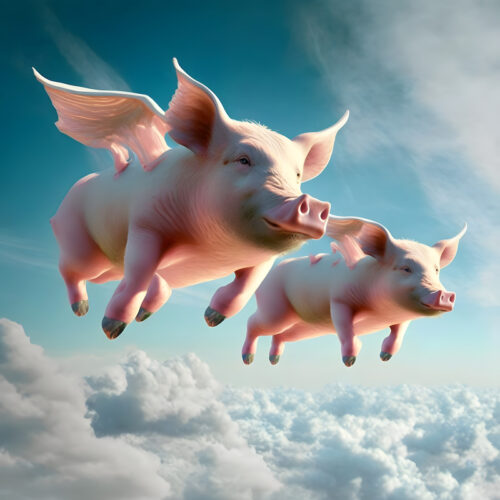
The reasons for the shortfalls within Micawber that many in Scotland are suffering are far more to do with our policies that engage socialist, egalitarian and wealth-destroying tendencies than with the price of food. John Swinney says he wants to create a prosperous Scotland; but using the policy mix of the SNP over the past 14 years, overflowing with aspirations parked uselessly on the backs of Unicorns, has become an exercise in the hopeful presentation of flying pigs. Cap the price of those, and the first thing the pig owner will do is remove their wings.
Established in 2006 and celebrating twenty years, ThinkScotland is not for profit relying on donations to publish our wide range of opinions. You can subscribe to our FREE newsletter here – share and follow us on ‘X’ here – like and comment on facebook here and make a donation here. Every contribution helps to meet our overheads.
Flying pigs by Alex from Adobe Stock.