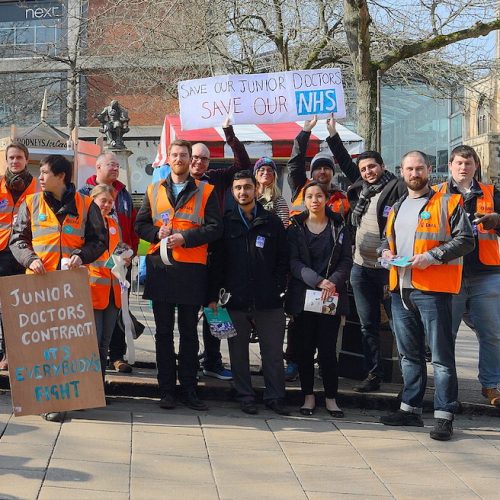

Public debate about junior doctors’ pay often begins and ends with a headline figure: £50,000 to £70,000 a year. To many outside medicine, that sounds comfortably middle-class, even generous. From this perspective, junior doctors’ anger about wages can appear ungrateful or ideological. In reality, it reflects a growing gap between responsibility, effort and reward that has been widened by fiscal policy, training structures and workplace culture. Be it England or Scotland’s NHS the problems are the same.
A central but poorly understood factor is fiscal drag. Unlike pensions and most benefits, income tax thresholds in the UK have not been consistently uprated in line with inflation. In 2005, the higher-rate tax threshold sat at just over £38,000. Had it simply risen with inflation in the same way that state pensions have been protected, it would now be close to £60,000. Instead, it sits just above £50,000. That single policy choice has profound consequences for junior doctors.
A doctor earning £60,000 today therefore pays higher-rate tax on roughly £10,000 of income that would not have been taxed at 40 per cent had thresholds kept pace with prices. Once National Insurance and student loan repayments are factored in, this translates into around £3,000–£4,000 a year in lost take-home pay. Because additional earnings at this level are taxed so heavily, replacing that loss would require close to a £10,000 increase in gross salary. This is why pay that looks generous on paper feels so much tighter in practice.
Student loan repayments compound the problem. For most junior doctors, loans operate as a long-term graduate tax rather than a conventional debt. Repayments of 9 per cent, and often more for those with postgraduate loans, are deducted on top of income tax and National Insurance. The combined effect is that junior doctors routinely lose more than half of any additional earnings to deductions. Extra shifts, nights and weekends remain essential to keeping services afloat, but increasingly feel financially pointless.
These pressures are not temporary. They are prolonged by the deliberate bottlenecking of training posts. While medical school places have expanded, specialty training numbers have not kept pace. Large numbers of doctors now spend years in non-training roles, unable to progress despite doing work indistinguishable from those in formal programmes. Progression to higher pay is delayed, while exposure to fiscal drag and student loan repayment is extended far beyond what previous generations experienced.
Competition at junior level further weakens doctors’ bargaining power. Active overseas recruitment is vital to the functioning of the NHS, and international doctors are not the problem. The issue is a policy environment that expands the workforce without expanding training capacity. Oversupply at junior grades makes it easier to suppress wages and harder for doctors to challenge deteriorating conditions, even as services remain chronically understaffed.
Overlaying all of this is a blame culture heavily weighted against junior staff. Junior doctors work at the sharp end of an overstretched system, making decisions in understaffed wards, covering rota gaps and managing risk with limited support. When things go wrong, accountability tends to flow downward. Juniors are disproportionately exposed to complaints, incident reports and regulatory scrutiny, despite having the least control over staffing levels, bed pressures or system failures. They carry significant legal and moral responsibility without the autonomy, security or pay that once compensated for that burden.
The public narrative that junior doctors are “well paid” deepens this sense of injustice. It ignores the erosion of take-home pay through frozen tax thresholds, the impact of student loans, the years of delayed progression and the reality of working under constant scrutiny. When doctors feel financially squeezed, professionally stalled and disproportionately blamed, anger is not surprising — it is rational.
There are, however, credible policy responses. One would be to cap student loan repayments at £5,000 per year, even if this extends repayment periods. This would not abolish repayment or create a subsidy for high earners, but it would limit the punitive marginal tax rates faced by doctors at the most attritional stage of their careers. Else the student rate could be cut to say 5 per cent once the 40 per cent threshold is reached. More broadly, restoring inflation-linking to tax thresholds, expanding training capacity and aligning responsibility with authority would go a long way towards repairing morale.
Junior doctors’ anger is not about entitlement. It is about arithmetic, incentives and fairness. Until policymakers engage with those realities rather than headline salaries, the claim that £50-70k should be “enough” will continue to ring hollow — and the anger will persist.
Sometimes it takes a very old fashioned conservative to challenge the left by saying one cannot represent workers when one can look them in the eye and say that half their wages in tax is still not enough.
Somewhere over the Laffer Curve, skies are a shade of blue.
Established in 2006, ThinkScotland is not for profit (it makes a loss) and relies on donations to continue publishing our wide range of opinions – you can follow us on X here – like and comment on facebook here and support ThinkScotland by making a donation here.
Photo of a previous junior doctors strike by Roger Blackwell – https://www.flickr.com/photos/rogerblackwell/25105058253/, CC BY-SA 2.0, https://commons.wikimedia.org/w/index.php?curid=126450523