
The third in a series from the Wealthy Nation Healthy Nation paper edited by Malcolm Offord
This chapter was by Councillor Tim Jones
SCOTLAND’S SCHOOLS used to be the envy of the world. However, over the past quarter of a century Scotland’s performance in international league tables such as PISA (Programme for International Student Assessment) has declined dramatically. The last results showed that in all three subject areas covered by PISA, the scores of Scottish 15-year-olds fell between 2018 and 2022. The drop was 18 points in mathematics, 11 points in reading and 7 points in science. A change of 20 points is approximately equivalent to one year of mid-secondary schooling.
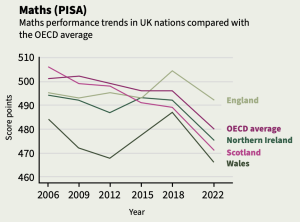
These results should give us great cause for concern. Yes, we have to accept that there was an impact from the pandemic. But since 2006, Scotland has gone from being the top PISA performer in the UK in reading and maths, and equal first with England in science, to being slightly behind it in reading, and very far behind it in maths and science. The picture is not one of rising standards, but national decline
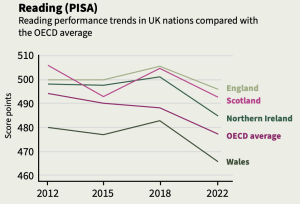
The decline in Scottish performance corresponds with increasingly centralised control, followed by the implementation of Curriculum for Excellence. There is now a need for a knowledge-rich core curriculum with a small number of high-level outcomes, along with more power and autonomy over content, design and implementation being given to local authorities and schools.
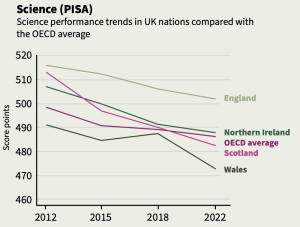
Successive Scottish governments, and the Scottish Parliament as a legislative body, have failed a whole generation of children by presiding over an overly-progressive and overly-burdened centralised system.
There is now a political consensus forming that falling standards must be addressed. However, this cannot be done unless there is a real openness to address the root cause. In a political system which is not designed for any one single party to have a majority, the need for cross-party cooperation and a willingness to put aside party ideology is essential if progress is to be made.
The curriculum
The CfE is really no more than a set of principles or objectives. There is no curriculum, at least, not in the traditional meaning of that word (a set of subjects and standards used by primary and secondary schools so children learn the same things).
RECOMMENDATIONS
- A core curriculum
- Abolish Education Scotland while retaining an
- independent inspectorate
- Every primary school to have access to a
- curriculum director
- Adopt progress 8-style assessment for Scottish
- schools
Phonics is central to this because reading is indisputably the key skill for every child to master. If you don’t have the basic skills of reading then access to the rest of the curriculum is severely hampered, if not impossible. English primary school children are now the best readers in Europe; it is only by making phonics statutory in the teaching of reading in every school that there can be any real and consistent improvement in reading ability.
RECOMMENDATIONS
- Make phonics statutory
- Rigorous phonics testing at ages 5 and 6
- Funding for phonics research
- Raise awareness of disciplinary literacy
Assessment
Assessment, or the lack of proper assessment is the single most important factor in understanding what has gone wrong in the Scottish system.
RECOMMENDATIONS
- Standardised testing should be aligned to the core
- curriculum
- Reintroduce the Scottish survey of literacy and
- numeracy
- Ensure Scotland rejoins all international surveys
- including TIMSS and PIRLS
- A national council-led attainment scrutiny strategy
- Re-engage parents with education
Discipline
The wholesale adoption of the restorative approach to pupil discipline is not working. There needs to be a much stronger focus and emphasis on the serious consequences for this level of disruptive behaviour.
RECOMMENDATIONS
- Nationally agreed set of parameters of what is
- unacceptable behaviour
- Head teachers should be given powers to exclude
- pupils
Closing the poverty attainment gap
Closing the poverty attainment gap remains the single most challenging task which the education system faces. Yet the very term ‘poverty attainment’ can be problematic. Attainment and poverty are two separate issues and to conflate the two is a mistake. Yet what is clear today, and has been for many years, is there are a significant and increasing number of children for whom school simply doesn’t work.
RECOMMENDATIONS
- deprivation (SIMD 1 and 2), based on the Newlands
- Junior College model
- Create a new National Investment Fund
- Ensure the close support of corporate employers in
- the region
- Promote the use of Teach First to provide additional
- talented resource into underprivileged school
- communities
- Review of guidance for wellbeing
Early years
A more transparent and equal funding model for nurseries is required; if an independent nursery meets the standards of the relevant national Inspectorates, parents should by right be able to take their full government-funded entitlement there as a ‘virtual voucher’.
RECOMMENDATIONS
- Online virtual voucher
- Review of quality of early years education
Established in 2006, ThinkScotland is not for profit (it makes a loss) and relies on donations to continue publishing our wide range of opinions – you can follow us on X here – like and comment on facebook here and support ThinkScotland by making a donation here.
For the full paper visit Wealthy Nation Healthy Nation.
Tim Jones is a former teacher in the state and independent sectors and also taught English abroad in the Netherlands, Kuwait and then Italy with the British Council.