
“Oh, what guid are the poor me’s now?”
THIS IS THE EXASPERATED QUESTION Agnes Bain’s mother puts to her drunken daughter when she seeks solace in a can of lager at her dying father’s bedside in Douglas Stuart’s Booker-winning novel Shuggie Bain.
“The poor me’s” was a new expression to me when I read the novel, but I was reminded of it during the First Minister’s marathon appearance at the Committee on the Scottish Government Handling of Harassment Complaints. Of course, Nicola Sturgeon doesn’t suffer from the alcoholic’s all-encompassing self-pity like Agnes Bain, but there was, as ever, an unmistakable undertow of the poor me’s as she sought to defend herself to the committee and to the world.
It is deliberate, and it is an act of seduction – even if it may also correspond to genuine feeling – designed to elicit sympathy for poor, wee, put-upon Nicola.
It is part of a much larger rhetorical trick Sturgeon has perfected in her Covid briefings: that even though she may be First Minister, she is really one of us. When confronted with a political challenge, she has an arsenal of weapons she characteristically deploys. Prime, of course, are obfuscation, misunderstanding the question, stating the obvious and hiding behind others – but she never misses a chance to play the “I’m just like you” card.
Some people praise this as her human touch, her ability to emote or be empathic; I see it as entirely self-serving. When confronted with her government’s fatal discharges of Covid positive patients to care homes, she has claimed countless times that the unnecessary deaths and the sufferings of the bereaved have haunted her late into the night, that she expects to reproach herself with doubts for the rest of her life. Do we really believe her? Even if we do, so what? Why should it be relevant to the political issue of accountability and responsibility? It not only distracts from that political issue, but actually supplants it. The topic becomes poor Nicola’s suffering – although she will frequently preempt any such charge by denying it, thereby refocusing the spotlight paradoxically on herself.
There was, therefore, a delicious irony to her throwaway remark at the committee hearing that “Alex tends to see everything as being about him”.
There were many moments when the First Minister took the “I’m just like you” tack. Never mind the contradictory statements about the 2 April meeting between Sturgeon and Salmond being a party business meeting or a Scottish Government meeting, and the ministerial-code-breaching failure to record it as the latter, plus Salmond’s corroborated evidence that she promised to help him: all these issues dissolved when she sought to characterise herself as a concerned and shocked friend who may have misled Salmond about her readiness to intervene – because she didn’t want to let down her former “bestie”:
“My head was spinning, I was experiencing a maelstrom of emotions, I had been told something pretty shocking by Alex Salmond and there were a number of things in my head … In all of this, there has been a lot of personal angst for me and others – me least of all – in all of this. But for me, one of the hardest things – which is maybe why I let him down more gently than I intended to on that April 2 meeting – sitting saying No to a friend who is asking you for help is a tough thing to do.”
Serious doubts remain that this was an entirely political, not personal, meeting – before, during and after – and that Sturgeon had prior knowledge as to what it was about. Nothing else can explain the arrangements beforehand and the denials and obfuscations afterwards.
Also on show for the Committee were two moves very familiar to anyone who watches Sturgeon’s daily Covid briefing: the apology – far from being the hardest word to say, it glides off the First Minister’s tongue as easily as dribble – closely followed by the humble admission that she is not infallible. Both these expressions go heavy on the emotion, and extremely light on the precise transgression or “mistake” she is apologising for. That is usually deferred to some future inquiry or authority or, now increasingly as we approach the Holyrood election, voters.
The second move is to round on her critics by claiming that had she had done the opposite of what she is charged with, she would also come in for (justified) criticism. The upshot is that “poor little me” can’t win: damned if she does, and damned if she doesn’t. Sturgeon presents herself as the victim of a sympathy-inducing double-bind, redolent of pop psychology. Once again, political responsibility is exchanged for the purely personal.
In many ways, Sturgeon’s bravura performance was more soap opera – or reality TV – than the elevated “Congress on public exhibition” as described by James Mitchell in the best commentary to date. The contrast with Alex Salmond during his evidence session could hardly be greater; by largely eschewing the personal, he came across as statesmanlike, with a gravitas and authority the “Chief Mammy” has never been able to approach.
As a feminist, I was appalled at Sturgeon’s attempts to dodge the charges against her by recasting herself as a feminist heroine – “As first minister I refused to follow the age old pattern of allowing a powerful man to use his status and connections to get what he wants” – and by misconstruing Murdo Fraser’s reasonable question whether “she owed the Scottish people an apology for having previously told them they should trust Salmond”, the man she’d previously said “didn’t have a sexist bone in his body”, as an invitation to apologise for him
I don’t think there is anyone at Holyrood who didn’t know that Alex Salmond had a propensity for “touchy-feely” behaviours – hence his “octopus” nickname. The suggestion that this came as “shocking” news to his long-term political collaborator on April 2 is not remotely plausible.
Behind all this are the anonymous female complainers, at least two of whom were demonstrably let down by the inadequate and unlawful complaints procedure implemented by Sturgeon’s government – and whose right to decide if and when to go to the police was usurped by Sturgeon’s officials.
The fact remains that Sturgeon’s government was variously instrumental in pushing for a criminal trial for Salmond, and he was acquitted.
To harp on now about apologies for “inappropriate behaviour” – given all the evidence of parliamentary lying, evasion, withholding of documents (some still being withheld even now) and breaches of the ministerial code which have undermined faith in the Crown Office, the civil service, the Scottish Government and the devolution settlement itself – is nothing other than a grotesque exploitation of #MeToo.
The great feminist mantra of my youth was that the personal is the political. Nicola Sturgeon has turned it upside down in an attempt to save her own neck. For ‘poor me’ Nicola, her defence is the political is the personal.
If you enjoyed this article please share and follow us on Twitter here – and like and comment on facebook here.
Linda Holt is a councillor for East Neuk & Landward in Fife and a prospective candidate for All for Unity in the coming Holyrood elections. lindaholt.org.uk
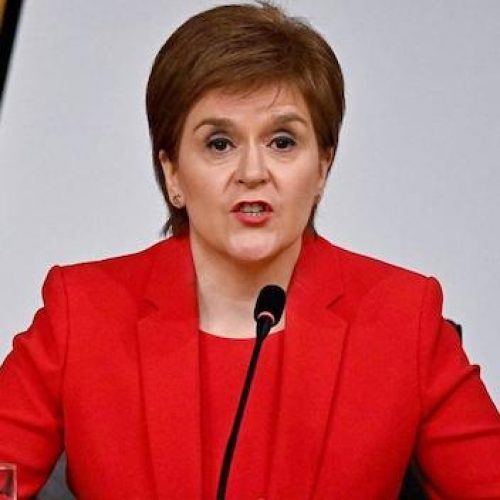
Photo of Nicola Sturgeon giving evidence at Holyrood courtesy of BBC Scotland.