THE OLD CERTAINTIES have taken a battering this past week. One of British politics’ most gloriously unrepentant characters has been snatched from us in circumstances so dark they seem to belong to another world entirely.
There will be those who never cared for Ann Widdecombe’s views. She would have been the first to acknowledge that, probably with a theatrical sigh and a brisk “so what?” She did not court popularity; she courted honesty, and if the two failed to coincide, she was perfectly content to let popularity go hang.
And yet, as the news of her death at 78 sinks in—compounded by the horrifying revelation that a murder investigation is underway—there is a peculiar emptiness. The political stage feels suddenly less colourful, less unpredictable, less fun, even when she was being utterly infuriating.
For that was the genius of Ann Widdecombe. She could exasperate and enchant in the same breath. She could declare, with absolute conviction, positions that made half the country splutter into their morning tea, and yet somehow you found yourself rather liking her anyway. It was a trick few politicians have ever managed.
Let us be candid about one thing: when the history of Brexit is written, Ann Widdecombe’s name deserves a prominent footnote—and perhaps rather more than that. While more cautious souls dithered and calculated, she saw the European project for what she believed it to be: a creeping federalism that had long since ceased to serve British interests. She did not arrive at this position by focus group or polling memo. She arrived at it by conviction, and she clung to it with the tenacity of a terrier worrying a rat.
Her decision to leave the Conservative Party in 2019—a party she had served for four decades—was not taken lightly. For a woman whose entire adult identity had been bound up in that blue rosette, it represented a genuine rupture. But she could not stomach what she saw as the betrayal of the referendum result. When she stood as a Brexit Party candidate and later as an MEP, she did so not for personal advancement—at 72, she had nothing left to prove—but because she genuinely believed Britain’s freedom was at stake.
“Enslavement,” she called our relationship with the EU. It was a word that made Europhiles wince and remainers recoil. But she meant it. She meant every syllable. And in an age of weasel words and calculated ambiguity, there was something almost bracing about a politician who simply told you what she thought, consequences be damned.
She was, in the finest sense of the word, a tribune. Not for a faction, not for a class, but for a conviction. If you shared it, she was your champion. If you did not, she was your adversary—but never your enemy. She would buy you a drink afterwards, and she would expect you to buy her one back.
Her faith was no less central to who she was. Born into an Anglican family, she converted to Catholicism in 1993, driven by the Church of England’s decision to ordain women priests. It was, she said, a matter of authority—she needed to know where the buck stopped. In Rome, she found her answer.
This was not a convenient conversion. It cost her friends, colleagues, and no small amount of ridicule in a political class that has long viewed religious conviction with a mixture of suspicion and condescension. But Widdecombe did not do convenient. She did what she believed to be right, and she let the chips fall where they may.
Her Catholicism informed her politics in ways that made her deeply unfashionable. She opposed abortion with a ferocity that made her a heroine to the pro-life movement and a villain to its opponents. She opposed the liberalisation of LGBTQ+ rights, viewing it through the lens of her faith. She supported the death penalty—a position that sat uneasily with her Christianity but which she defended with characteristic brio.
“I am not a liberal,” she once said, as if stating the bleeding obvious. “I do not believe that freedom means the right to do whatever you like. Freedom means the right to do what is right.”
It was a worldview forged in a different age, and she knew it. She did not care. She once told an interviewer, with that magnificent shrug, “If somebody wants to turn round and say, Widdecombe, you’re overweight and you’ve got crooked teeth, I say: you’re right, so what?”
It was the “so what” that defined her. She had been laughed at, caricatured, dismissed, and patronised—and she had simply got on with it. There was a steel in her that no amount of mockery could dent.
And then, of course, there was the other Ann Widdecombe. The one who submitted herself to the judges on Strictly Come Dancing with a courage that rather shamed the professional politicians who had spent years ducking difficult questions. The one who allowed Anton Du Beke to lift her like a sack of potatoes and twirl her around a ballroom. The one who lasted nine weeks when everyone expected her to be gone in the first.
“People were terribly surprised that I had a sense of humour,” she confided afterwards, with a mixture of amusement and exasperation. They should not have been. You do not survive four decades in frontline politics without a thick skin and a ready wit. But Widdecombe had more than that—she had a genuine relish for the absurd, a willingness to be the butt of the joke, a queenly contempt for her own dignity.
She took that spirit to Celebrity Big Brother, where she came second to a drag queen and treated the whole thing as a lark. She took it to pantomime, where she played the dame with evident delight. She took it to Covent Garden, where she performed as the Duchesse de Krakentorp—a non-singing role, mercifully, but one she threw herself into with characteristic commitment.
There was a liberation in all of this. After 23 years in Parliament, she could finally be herself—not the caricature, not the politician, not the firebrand, but simply Ann. And the public, which had spent years either cheering or booing the politician, discovered they rather liked the person.
Which makes the circumstances of her death all the more grotesque. That a woman so full of life, so brimming with opinions and energy and sheer presence, should meet her end in violence is an obscenity that defies comprehension.
The police investigation continues. Motives remain unclear. But what is clear is the sense of violation—not just for her family and friends, but for all of us who inhabited the same public space. In an age of rising political tensions, the murder of a public figure, however controversial, strikes at something fundamental. It is a reminder that the robust exchange of views, the cut and thrust of democratic debate, must always be conducted within the bounds of civility and, ultimately, safety. The area where she lived is serene, a short distance from this author’s home. She was the only local celebrity and the most humble person one could ever meet.
Ann Widdecombe would have been the first to insist on civility in politics. She could disagree with you until she was blue in the face—and often did—but she would never have wished you harm. She understood that politics is not warfare. It is argument, persuasion, and occasionally compromise.
She was, in her way, a great defender of that tradition. She gave as good as she got. She never whinged about media unfairness, never played the victim, never demanded special treatment. She stood up, said her piece, and took the consequences.
So what do we lose with Ann Widdecombe?
We lose a politician who could not be bought, bullied, or bamboozled. We lose a conviction politician in an age of triangulation and focus groups. We lose a woman who genuinely believed that public service meant something, who gave her life to it, and who asked for nothing in return except the chance to keep speaking her mind.
We lose a Catholic who took her faith seriously enough to let it shape her politics—and who never apologised for it. We lose a Brexiteer who saw the European project as a threat to British sovereignty and fought it with every fibre of her being. We lose a character, in the truest sense of the word—someone who could not be reduced to a soundbite or a party line.
And we lose a woman who, beneath the carapace of certainty, was rather more sensitive than she let on. Those who knew her speak of her kindness, her warmth, her genuine concern for the people she represented. The public persona was a shield; the private person was something else entirely.
She leaves behind a niece and two nephews. Her brother, a vicar, predeceased her. And she leaves behind a political landscape that feels poorer, greyer, and less interesting for her absence.
Ann Widdecombe once said, with typical bluntness, “I am not here to be liked. I am here to do what I believe is right.”
She was wrong about the first part. She was, in fact, immensely likeable—not despite her views, but because of the way she held them. With courage. With humour. With a complete absence of self-pity.
She was right about the second. She did what she believed was right, always, and she did it with a vigour that put younger, more cautious souls to shame.
In an age of political mediocrity, she was anything but. In an age of moral cowardice, she was brave. In an age of evasiveness, she was direct.
They say that politicians are all the same. Ann Widdecombe was living proof that they are not. She was one of a kind—and we shall not see her like again.
Rest in peace, Ann. You earned it. And if there is a God—as you so firmly believed—He has surely prepared a seat for you at His table, right next to the argument.
Ann Noreen Widdecombe, born 4 October 1947. Died 8 July 2026.
This appreciation was first published in Country Squire online magazine, which can be subscribed to here.
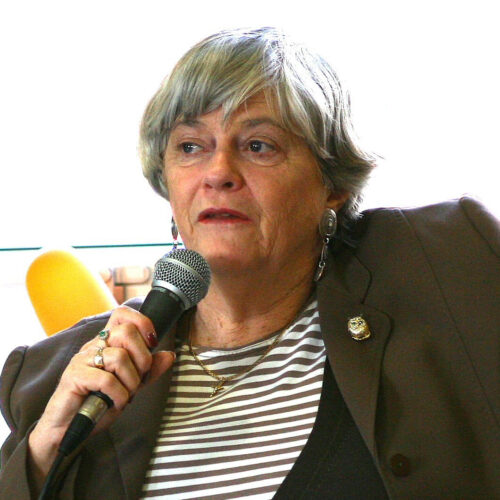
Photo by Brian Minkoff – London Pixels – Own work, CC BY 3.0, https://commons.wikimedia.org/w/index.php?curid=8874069