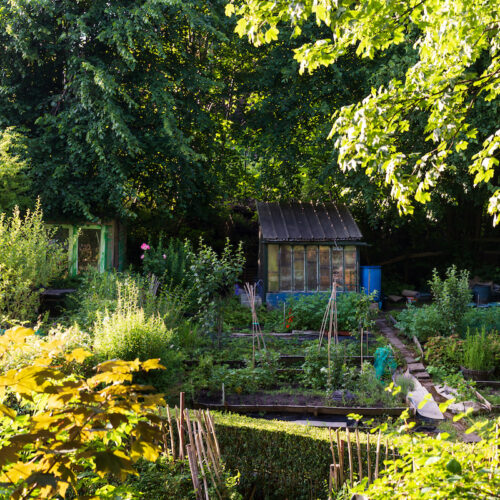

One proposal would be a National Orchard Service and Garden Croft Network: a nationwide system of publicly accessible orchards, community growing spaces and family garden crofts linked through Scotland’s railway system. The model is not based on state ownership of land, but on partnership with existing landowners and farmers.
Under this approach, farms and estates would lease portions of land into the network on long-term agreements, receiving rental income and enhanced agricultural support in return. A portion of farm subsidy could be redirected or supplemented to reward participation in fruit and vegetable production, orchard creation, biodiversity enhancement and hosting croft plots.
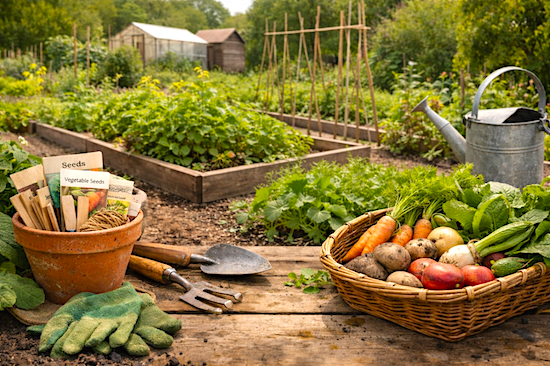
Productive agriculture and public participation would reinforce each other rather than compete. Families without gardens would be able to rent small countryside plots on long-term leases. Sizes would vary from compact growing spaces to larger croft-style holdings. Each would provide space for vegetables, fruit trees and flowers, with optional simple cabin facilities for weekend use. This allows people to grow food and engage with the land without owning it.
In many ways, this extends Scotland’s crofting tradition into a modern form. Crofting has always combined small-scale cultivation, shared land use and strong community ties with larger estates. Alongside individual crofts would be community allotments for those unable to commit to a full plot. Schools, youth groups, volunteers and local residents could all take part, ensuring access regardless of time, income or capacity.
The crofts would sit within larger Orchard Parks across Scotland. These would preserve heritage fruit varieties while establishing new orchards suited to future climates. Some areas would focus on conservation of rare apples and pears, while others would operate commercially, supplying local markets and supporting the network financially.
Each Orchard Park would also function as a public destination, with walking routes, cafés, garden centres, educational facilities and seasonal events. Visitors could experience orchards across the year—from blossom to harvest—and take part directly in food production through pick-your-own areas and workshops. A phased rollout could begin with pilot schemes near Glasgow, Edinburgh, Dundee and Aberdeen, each testing a different emphasis such as heritage restoration, community allotments, or commercial integration.
Transport would be central. Rather than building new systems, the scheme would integrate with existing rail networks through discounted fares and seasonal rural stops, making access to countryside land as simple as a short train journey from the city.
A family in Glasgow could reach their garden croft in under an hour, without motorway travel or high cost—just a direct connection between urban life and the land.
 There is something distinctly Scottish about this vision. Scotland has long had a civic tradition rooted in shared outdoor life—agricultural shows, gala days, village gatherings and public participation in communal spaces. Civic belonging was once experienced in fields and town greens as much as in formal institutions.
Modern environmental policy has often lost this dimension, focusing instead on targets, reporting and consumer behaviour. While necessary, these rarely inspire emotional connection. What is missing is participation. A network of orchards and crofts would restore that sense of engagement.
Families would plant trees, children would harvest fruit, volunteers would maintain shared spaces, and communities would mark the seasons together. The educational potential is significant: every child could visit an Orchard Park, study biodiversity, and take part in outdoor learning, reconnecting younger generations with food production and natural systems.
Economically, the system would support rural communities through diversified income: land leases, croft rentals, agricultural support payments, workshops, cafés and seasonal tourism. Farmers and landowners would gain stable returns while participating in productive, visible land use.
It is also worth noting that current agricultural subsidy structures are heavily skewed toward livestock and cereal production, and of course those “green” projects like rewilding – while comparatively little supports fruit, vegetable production or direct public access to agriculture. This scheme would rebalance that, strengthening both domestic food resilience and public engagement with land use.
But the strongest case is social. Modern society often treats nature as something to observe rather than participate in. People walk through landscapes, purchase food in shops and consume nature as experience rather than involvement. Garden crofts would reverse that relationship: instead of spectators, citizens become participants.
For Unionism, there is a broader implication. The most effective case for the Union has never been purely constitutional. At its best, it has been a civic tradition grounded in shared institutions and practical improvements to daily life.
A National Orchard Service and Garden Croft Network would reflect that tradition. It would not rely on abstract political argument but on a tangible national project rooted in land, food and place. Environmental groups would gain habitats and orchards. Educators would gain outdoor classrooms. Rural communities would gain diversified income. Urban families would gain access to land they could not otherwise afford.
There would be challenges around cost and administration, but demand for allotments and community gardens already suggests significant unmet interest. The appeal is not nostalgia but ownership. People want a stake in something real. In earlier eras, governments built libraries because they valued knowledge, parks because they valued recreation, and housing because they valued security.
Today’s challenge is to build institutions that restore connection between people, communities and land. If Unionism is to offer a positive vision for the future, it should speak less about constitutional arrangements and more about national participation. A Scotland of orchards, crofts and shared growing spaces would do something rare in modern politics: it would give people a stake in the land itself.
Established in 2006 and celebrating twenty years, ThinkScotland is not for profit relying on donations to publish our wide range of opinions. You can subscribe to our FREE newsletter here – share and follow us on ‘X’ here – like and comment on facebook here and make a donation here. Every contribution helps to meet our overheads.
Photo of an allotment by gavin from Adobe Stock