
Andy Burnham is wrong: group think trumps devo divergence and cannot save Port Talbot, Scunthorpe or Aberdeen
GROUP THINK is a problem in many settings. It can happen in markets, parliaments, sports crowds or even just around the sofa watching telly with the family.
It is when what is observed or learned results in a commonly held view that nearly everyone thinks must be right, with discordant opinions ignored or suppressed – only to have been validated later to some degree.
There are big debates to be had about global warming and climate change – they have been conducted on this site for most of the twenty years it has been publishing. ThinkScotland has tried to ensure that discordant voices could be heard so that the risk of group think – essentially, putting all our eggs in one basket – could be avoided. There was no settled science (the point about science is it is never settled) and the debate carries on with the climate sceptics increasingly being shown to have a point if not yet overturning the consensus.
That debate will probably carry on for another generation but we should be aware that how our governments and institutions see matters is nothing like the way such matters are viewed in India or China.
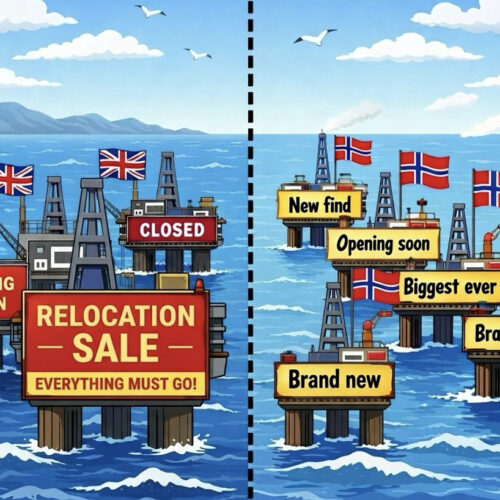
So when Andy Burnam stands up to speak in an all to unserious and jocular manner and suggests to the whooping and hollering of disciples that devolution max is the answer to the UK’s woes, it is pertinent to ask how come devolution did nothing to prevent the oil and gas industry – Scotland’s leading industrial economic sector – from such regular attack that is closing it down?
In fact devolution has accelerated the painful journey as the Scottish Parliament – under the hegemony of the supposedly nationalist SNP adopted even more stringent policies designed to kill the oil, gas, petrochemical and refining industries.
While unable to levy taxes like Westminster has, the SNP has used planning controls and default positions against exploration, development or extraction – which has not only led to the big investors moving away from the North Sea but hit the massive engineering and support base that has created so many jobs and spread the wealth into Aberdeenshire and the wider North east of Scotland.
Now, high taxes on domestic oil and gas producers, coupled with the effective ban on new exploration drilling has led to estimates of 1,000 jobs per month being lost in the oil and gas industry in the North Sea. We can see the real evidence of that without having to look hard. The economic impact of these job losses is far greater than the headline figure, because this sector generates more than six times the value added per hour worked than the whole economy.
The maddening aspect of allowing this to happen is appreciated when it is understood that this policy approach is nothing other than an utter con. It is national virtue signalling – justified as a sacrifice on the altar of responding to climate change – which makes the political elite feel good but is paid for by drastically falling living standards for hundreds of thousands of people.
We are told that the UK is a world leader in cutting its carbon emissions but this has been achieved by ending our own production and use of hydrocarbons and replacing it by importing the resources and goods from elsewhere. This is because the consumption by our industrial and domestic sectors still need to be met as we still have to consume energy to make or use things. In other words we are not reducing the planet’s use of carbon – we are merely displacing it from the UK to the wider world.
The politicians’ statistical trick is to not include the UK numbers for the carbon emissions of foreign imports in the reduction of emissions they claim. We imported 180 million tonnes of hydrocarbon CO2 in 2024, making a nonsense of the UK’s claims to have cut its emissions by 300 million tonnes. While the UK column lost 180m tonnes the Global column gained it – making no difference in return for our financial and community sacrifices.
Drilling our own oil and gas, mining our own metallurgical coal (for steel works) reduces transport costs, creates jobs, takes people off welfare and raises tax revenue. Importing energy achieves the reverse in every effect.
We could go further and prospect for more oil and gas – both onshore and offshore there are large fields waiting to be exploited just like the Norwegians are doing. The oil and gas industry is only the tip of a very large iceberg. The same impact is being seen in the production of steel and aluminium, ceramics and glass, chemicals, fertilisers, cement and plastics. Refining and petrochemical manufacture – all of the foregoing is in decline – but we still need it so we have to import it at greater cost.

As a side note, this move of reducing our own production has meant that not only have we had to import more, we have also had less to export – and our trade balance shows this as our exports, especially to Europe, have fallen. This leads some critics of Brexit to claim reclaiming our sovereignty has damaged our trade with the EU when it is the pursuit of Net Zero that is the prime cause of this statistically measurable result.
We could easily end the ridiculous descent into national poverty as we watch our energy prices rise and our industries close or move overseas. It needs two things, ending the pursuit of Net Zero – it offers not a new dawn but a desperate descent into darkness – and starting the shift by abolishing the Climate Change Act 2008.
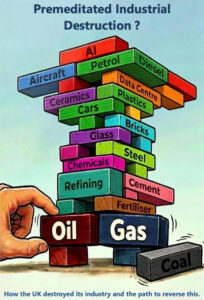
As explained in great detail by the Great British Business Council paper “Premeditated Industrial Suicide” the UK’s long journey into industrial darkness began in a tangible sense with that Act. It started the growth of restrictions and taxes that ended investment, erected domestic barriers and made overseas competition more attractive.
The reason I point to this is that more devolved power would have made no difference to preventing Aberdeen’s economic demise – as the SNP has shown. Having a Number Ten in the North is meaningless – especially if it is captured by the group think that afflicted Westminster. Which is, after all, what group think inevitably does even when politicians are opposed to Westminster, such as the SNP and Plaid.
The enveloping consensus – the group think – when the Climate Change Act was introduced included Conservative and Liberal Democrat opponents saying the Act did not go far enough. Everyone joined in, with the Scottish and Welsh politicians and local councils cheering it on, often then adding to the burden.
To prove their point the subsequent governments the Conservatives formed together, or alone from 2015, introduced more and more laws that accelerated the decline of businesses making or using hydrocarbons.
Let us remind ourselves that in 2021 the Johnson Government introduced an additional Energy Profits Levy of 25 per cent on the profits of oil and gas companies, intended to end in 2025, but Rishi Sunak increased it to 35 per cent and extended it to 2028. Rachel Reeves then pushed it to 78 per cent and extended it to 2030. What says Andy Burnham?
To change national decisions requires national assemblies – Westminster – to change their thinking and the consequences of group think.
What Aberdeen, Scotland and the whole of the UK needed to hear was a commitment to abolish the Energy Profits Levy. What the people of Aberdeen needed to hear was that Burnham would move immediately to authorise the Rosebank and Jackdaw fields to start pumping the hydrocarbons we need to reduce our costs across the UK aby Christmas nd give us better energy security than foreign powers allow.
What the people of Port Talbot, Scunthorpe – and Derbyshire, where Denby pottery closed this month – needed to hear was an end of the Climate Change Act and ending of the Net Zero goal. Bad laws cannot be overcome simply by transferring power to devolved mayors or assemblies if they have no authority to do so.
That’s why Andy Burnham, the new circus red-coated ring master, needs to start with getting his energy policy right. Only if he does that first will the local decision making – of businesses and investors be more responsive and grow the economy.
Where Burnham is wrong is to argue the UK’s real problem is too much centralised power and the answer must be to devolve more decision making across the country. It’s the sort of sloganeering that sounds warm and cozy but does not lead to better outcomes because it starts on a false premise.
The UK’s economic demise was not because of centralised Whitehall bureaucracy or Westminster political failure but because of group think that eliminated real debate. No amount of devolution will prevent the decline or halt an unjust transition from industrial success to jobless wasteland if local politicians and officials embrace the same group think falsehoods and enact their own bad laws. And that is what group think does – it spreads like a cancer and is as difficult to remove.
Burnham’s speech was all about how we emote, how we feel – it’s about the visible optics not the measurable outputs. There should be no doubt that the Labour Government will enjoy a Burnham bounce in the polls, in part, simply because “our Andy” is not Keir Starmer, but especially because Burnham’s tone is more a favourite woolly jumper than a hairshirt Nehru smock. It’s all vibes.
Burnham’s devolution schtick is an irrelevant feel good pitch about bringing decision making “closer”, more “local” – when competence and clear critical thinking is what we need. Transferring power from low-grade centralised politicians to even lower-grade regional or local politicians doesn’t achieve anything. The risk is it repeats the same mistakes at additional cost while making the outcomes more ingrained and difficult to remove. It’s the quality of analysis and decision making that matters.
Without a change in attitudes Burnham’s devo-max will simply bring group-think-max. It is the route to bad and damaging decisions – and will make the reversal of our foolish choices of the past far more difficult to deliver.
Established in 2006 and celebrating twenty years, ThinkScotland is not for profit relying on donations to publish our wide range of opinions. You can subscribe to our FREE newsletter here – share and follow us on ‘X’ here – like and comment on facebook here and make a donation here. Every contribution helps to meet our overheads.
Illustrations courtesy of GBBC, the Great British Business Council.