
The reality behind what really happened in Munich this time round.
THERE IS a particular theatre to Bavaria, Southern Germany in February: the snow, the solemnity, the discreet convoys, and the annual ritual in which the high priests of multilateralism announce either the end of the West or its imminent rebirth. This year, the script leaned decisively post-liberal. When U.S. Secretary of State Marco Rubio took the stage at the Munich Security Conference, he did not come to mourn the Atlantic alliance. He came to audit it.
Rubio’s speech was, on its face, a reassurance. The United States, he insisted, is not decamping from Europe; NATO is not a relic; the Atlantic is not widening into a moat. He invoked shared history and the blood price paid together in the last century. He dismissed the fashionable chatter about an “end of the transatlantic era” as a misreading of American politics and of President Donald Trump’s priorities. Washington, he said, remains committed to European security.
Yet reassurance was only the overture. The main movement was a rebuke, directed less at Moscow or Beijing than at Brussels and, by implication, at Washington’s own bipartisan complacency of the past three decades. The post-Cold War consensus, Rubio argued, rested on a fantasy: that liberal democracy, free trade, and global integration would smooth every geopolitical rough edge. Instead, he suggested, the West outsourced industry, hollowed out its middle class, grew dependent on strategic rivals, and mistook managerial governance for statecraft.
He took aim at European energy policy, at what he called self-imposed industrial decline in the name of climate virtue, and at migration systems that strain social cohesion.
He spoke of the need to rebuild productive capacity, to restore deterrence, and to reform international institutions, including the United Nations, that too often freeze paralysis into procedure.
The tone was firmer than diplomatic custom prefers, though less incendiary than the broadside delivered last year by Vice-President JD Vance.
The meaning for American foreign policy is not subtle. Rubio articulated the White House’s new doctrine of Atlantic realism: alliance without illusion. The United States will defend Europe, but it will no longer subsidise Europe’s delusions about green energy, defence spending, or economic strategy. The old formula – American security guarantees in exchange for European lectures on multilateralism – has expired. In its place Rubio proposes a compact of reciprocity. If the alliance is to endure, it must produce strength, not moral comfort.
In European circles still addicted to Wilsonian instincts, the reflex will be to brand this isolationism. That misses the point. The commitment remains; what has changed is the price.
In today’s America, engagement is conditional on delivery, mutual obligation and tangible strength. Rubio did not threaten withdrawal; he threatened impatience. His critique of globalisation was not a call to autarky but to strategic selectivity. Supply chains are geopolitical instruments; energy policy is national security; welfare states that crowd out defence budgets invite hard power from less restrained actors. The speech suggested that Washington will increasingly judge allies not by their rhetoric but by their capacity.
Rubio’s worldview has been forming for years. He is neither a nostalgic Cold Warrior nor a libertarian minimalist. He belongs to that faction of conservative thought that sees great-power competition as the organising fact of our era and domestic economic policy as inseparable from foreign policy. His emphasis on industrial renewal, border control, and cultural confidence reflects a belief that external power depends on internal cohesion. States that doubt themselves do not deter others.
He is also a politician who understands the mood of the American electorate. The voters who twice elected President Trump did not repudiate alliances; they repudiated arrangements that seemed to benefit everyone except them. Rubio’s Munich address translated that view into diplomatic language. It reassured allies while reminding them that American patience has limits. The subtext was unmistakable: if Europe wishes to be treated as a strategic equal, it must behave like one.
And there the domestic political dimension becomes impossible to ignore. Munich was not merely a policy speech; it was an audition. Rubio stood before the assembled guardians of the old order and informed them, politely, that the old order has conditions attached. He projected seriousness without bombast, resolve without theatrics. For a Republican Party that may soon look beyond Trump, he offered a template: nationalism with a suit and tie.
The road to 2028 runs through a crowded field, but Rubio has now staked his claim. He can speak fluent Atlanticism to foreign elites and fluent populism to American voters. He can criticise Europe without threatening abandonment, champion industry without renouncing markets, defend alliances without genuflecting to them. In Munich he appeared less the dutiful Secretary of State than a presidential candidate rehearsing a doctrine.
European reaction was mixed, which is to say revealing.
Some welcomed the reassurance. Others bristled at the scolding. Yet irritation is often the first sign that a message has landed. Rubio’s argument is uncomfortable precisely because it reframes the alliance as a partnership of responsibilities rather than a sanctuary of shared platitudes.
Whether this doctrine will endure depends on events: on Ukraine, on China, on the resilience of Western economies. But as a marker of intent, it was clear enough. Rubio believes the West can remain central to global order only if it rediscovers production, borders, and power. He is betting that American voters agree.
Munich has seen many speeches about the fate of the West. Rubio’s was different. It did not ask whether the West still believes in itself. It asked whether it is prepared to pay for itself.
Alliances, he implied, are not therapy sessions. They are contracts. And contracts, unlike affinities, come with signatures.
Established in 2006, ThinkScotland is not for profit and relies on donations to continue publishing our wide range of opinions – you can subscribe to our newsletter here, follow us on X here – like and comment on facebook here and support ThinkScotland by making a donation here.
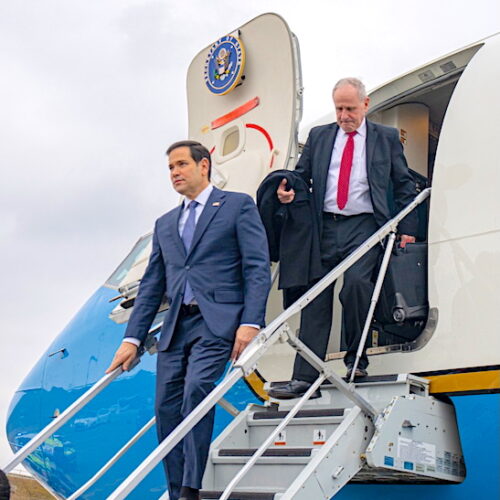
Photo by U.S. Department of State – https://www.flickr.com/photos/statephotos/54327138163/, Public Domain, https://commons.wikimedia.org/w/index.php?curid=159743600 and 54523529726/ index 165395858.