Burning Heresies: A Memoir of a Life in Conflict, 1979-2020, Dublin: Merrion Press, 2020, 320 pp, ISBN 9781785372612, £18.99
By Tom Gallagher
KEVIN MYERS has written a riveting account of his life in journalism in Ireland and some of the world’s trouble-spots over the last forty years. Qualities fast disappearing in a trade which recruits now join with an anaemic degree in media studies, rather than raw experience in pounding the mean streets of these islands, enable him to pull out the stops in what is often a tour de force of expressive writing and searing self-analysis. He shows himself to be an egocentric, fiercely independent, splenetic, rash but also highly moralistic commentator and reporter.
His career in the media spans a time-period in Irish society when a narrow form of group think – clerical and ultra-nationalist – has been superseded by another which is militantly secular, globalist and bound up with individual self-gratification. Myers sees today’s ‘cool, progressive’ Ireland as a faithful reincarnation of the Ireland of the 1950s. In both epochs, suppressing dissent and elevating orthodoxy are imperatives which are pursued amidst constant praise for a society burdened by a painfully disfunctional state.
A huge exodus of people keen to realise themselves in less capricious circumstances only really stopped during the fleeting years of the Celtic Tiger book at the turn-of- the- century. Myers the iconoclast points out that a flight of medical graduates means there are 261 doctors named Patrick in Ireland but another 791 named Mohammed (spelled different ways).
The talent and stubborn endurance of this awkward wordsmith enabled him to survive as the tight hold of Rome over Ireland’s political classes was replaced by an altogether more doctrinaire orthodoxy based around the dogma of equality. It was only in 2017 that Myers finally grasped how much of an outcast he had become in ‘Official Ireland’ when he found himself overnight turned into a pariah for reasons that still clearly puzzle him.
He had devoted numerous weekly columns at the Sunday Times Ireland to suggesting that the official celebrations of the 1916 Easter Rising were overly smug and certainly myopic. For decades he had fought to ensure that the Irish men and women who had participated in both world wars, received proper recognition from the state. Heroic figures such as Colonel Alfred Dunham Murphy, killed in 1917, still beloved by veterans of the conflict whom he sought out, were dragged from obscurity. It was thanks to the drive shown by Myers that the memorial to the fallen in the Great War ceased to be used as a rubbish tip by Dublin Corporation and instead was restored as a fitting place of remembrance for soldiers who had never returned from combat.
Myers was unsurprised not to be invited to the 2011 ceremony where Britain’s Queen Elizabeth II laid a wreath at what was now called the Irish National War Memorial. Thanks to a friend in the British Legion, he was still able to there. He recounts:
‘As the two heads of state sauntered towards the exit, Mary McAleese suddenly spotted me:
She said: “Kevin is that you?” She turned to the queen: “This is the journalist who kept the flame of this place alive for so many years. He fought the good fight, and like so many battles, it was worth fighting”’.
The queen nodded smilingly at me, and I, according to the account in the Irish Times…apparently blurted out “Your Majesty”’.
The bureaucratic impulse to cover up anything that offended nationalist pieties was slow to die and, in 2016, he kicked up a racket that, at a time when revolutionaries who had killed civilians and police were being honoured, there was no room for even an obscure ceremony to honour 513 members of the Royal Irish Constabulary murdered between 1916 and 1923.
Fatally, in 2017 Myers was talked into putting aside the customary Irish-themed article by his page editor in favour of doing a piece on the controversy raging over gender pay differentials at the BBC. A foolish mention of the Jewish identity of two women broadcasters (clumsily intended to be a compliment) resulted in a media lynching. He was dismissed from the Sunday Times within 24 hours as he was branded an anti-Semite and a Holocaust denier. The Jewish Representative Council of Ireland rallied to his defence, stating that he had played a vital role in educating people in Ireland about the true horror of the fate that had befallen most of Europe’s Jews after 1939:
‘More than any other Irish journalist, he has written facts about the Holocaust that would not otherwise have been known by an Irish audience.’
But it was to little avail. Taoiseach Leo Varadkar congratulated his employer for dropping him. The state broadcaster RTE was particularly vindictive. Several pages are also devoted to the glee with which star progressive pundit Fintan O’Toole sought to bury him with successive incendiary articles, long on supposition and flimsy on detail, about his alleged misdeeds. He thundered about Myers’s alleged misogyny in the strident tones familiar to a lot of British readers as he raged about the apparent backwardness of people supporting Brexit.
Myers hoped that the internet campaign would abate at least by the time of the centenary of the ending of the Great War. But he writes:
‘An internet lynching is not bound by the usual temporal limitations of human affairs but exists in another dimension that knows neither amnesia, kindness nor exhaustion. I was now almost totally excluded from all media discussions on Ireland and the Great War, especially on RTE, where there could be no doubt that I introduced the topic into Irish life.’
Ironically, Ireland’s most pro-Israeli journalist was being denounced as an anti-Semite by a progressive mob whose default position was fiercely anti-Israeli.
Myers chose to ignore all of his numerous detractors, hoping belated apologies might ensue, except for one, RTE. It doubled down on its claim ‘I am a Holocaust denier’, claiming erroneously that these were the journalist’s own words. The large settlement which he received was ignored by the media. A letter to the Irish Times from John Bruton, Taoiseach from 1994 to 1997, was even denied publication in a newspaper where Myers had worked for over thirty years.
A sentinel for transparency and ethical journalism during the first half-century of the Irish state’s existence, the Irish Times (IT) today is one of the West’s most zealous promoters of Woke leftism. In the process its circulation had crashed to 57,000 by 2016, most of the decline occurring during its switch from Presbyterian liberalism to pious leftist preaching. The rot had already set in when Myers joined the newspaper in 1979. Close-up he found Douglas Gageby not to be the legendary fearless editor who spoke truth to power. One unspoken rule was that the origins of the anti-British politician Charles Haughey vast and seemingly unearned wealth was never to be referred to. Gageby exploded when Myers mused about him enjoying the lifestyle of a Renaissance prince when his income was so modest.
He ‘soon erupted out of his office…my copy trembling in his hand. “Who the fuck do you think you are? You’re not one of our political staff…I pay you to write light chatty pieces on the lines that “An Irishman’s Diary’ has been written for about a hundred fucking years. Never ever stray into that territory again do you hear?”’
He soon learnt that ‘state-run, union-protected welfare and medical institutions’ which existed for the benefit of insiders and created huge distortions in the provision of medical and other services, were also off limits. The IT refused to touch any disclosures about the medical fundraising behind the Hospital Sweepstakes founded by the former gunman Joe McGrath and supervised by another former gunman Charlie Dalton who in 1922 seized three Dublin teenagers for posting anti-government posters and shot them dead with his revolver. In Scotland the public broadcaster is already far more cowed than the media in Ireland was when Haughey was in charge of the Irish Republic for much of the 1980s. It is not hard to imagine that if a post-British statelet emerged from a period of Scottish violence that the BBC (or whatever it ended up being called) would also ignore the misdeeds of warlords who had got rich in the turmoil.
With almost a decade of reporting strife-torn Belfast behind him, Myers found himself sent to various trouble spots during his first fifteen years at the IT. He described walking Beirut’s unfamiliar but bloody streets after nightfall in 1982 to get the story through to Dublin and going back to the city after surviving a mock execution. Later in Croatia and Bosnia he showed insane levels of courage in order to file his copy only to be told that his material was reaching the office at an inconvenient time. He displayed self-deprecation and black humour in the charnel house of the former Yugoslavia. He usually also managed to be even-handed in the contempt and disbelief he showed for the savage conduct of the main sides. While wary of many journalists at home, he saluted the ones he met in Bosnia who often went out of their way to help each other:
‘People are often critical of journalists, of the low standards that govern our trade…Much of this is justified. But Bosnia saw journalism at its best, for we all knew the perils there, and each of us privately had said goodbye to life.’
He also confesses that for a while he indulged in the ‘freebies’ which are dangled before obliging journalists by do-gooding organizations needing regular infusion of favourable publicity to replenish their coffers. Several of his more hair-raising trips involved joining aid missions in remote places such as the Darien rain forest of Panama; a death-defying flight to visit the remote Embará tribe was lightened by the self-indulgent behaviour of several of his Irish hosts.
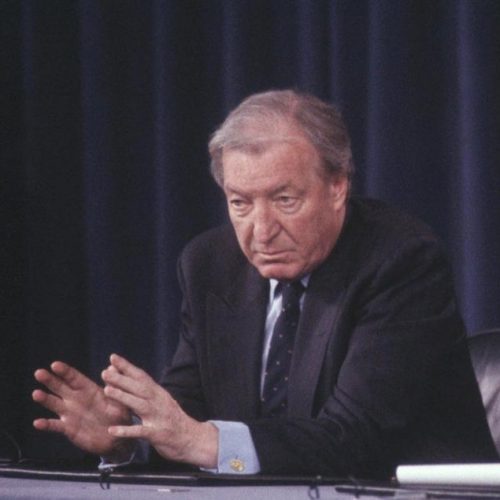
Except for his determination to see justice done to the memory and sacrifice of the Southern Irish Catholics who fought alongside the British in two world wars, Myers concedes that he was slow to denounce the hypocrisy and seedy corruption of Irish life. But watching how such a creature like Haughey (pictured) was untouchable, he was forced to conclude that:
‘Haughey understood the underside of Irish life perfectly. Contrary to the foreign perceptions of Ireland, it is not always a nice country. For all its outward charm and voluble gregariousness, there is too often a steady drip of poison in daily discourse, especially in relation to those who step out of line.’
Myers is convinced that Haughey’s outspoken hostility to Remembrance Sunday commemorations in Ireland provided ‘subconscious authorisation’ for the 1987 Enniskillen massacre which claimed eleven dead. In his last years working for the IT, he stood out on account of his bold criticism of Gerry Adams and Martin McGuiness, bathing in the glow of the peace process despite having so much blood on their hands. (But he was even-handed in his criticism, pointing out that actions by the Parachute Regiment were responsible for no less than 80% of the innocent civilians shot by the British Army).
No does Myers flinch from indicting the Celtic Revival of WB Yeats and JM Synge for preparing the ground in Ireland for decades of tribal violence which effectively destroyed the Old Ascendancy from which both sprang.
But he speaks warmly of the numerous Irish military and police personnel who publicly extended the hand of friendship his times of greatest adversity. Nor does he fault Irish people for emigrating rather than confronting those who mishandled the island’s affairs after 1922.
He wrote: ‘the greatest wealth the Irish possess is in that cliché social capital. The qualities that resource implies – a spontaneous affability, an uncanny ability to communicate with strangers and a thirst for gaiety – had enabled the Irish to prosper in exile.’
He retains some nostalgia for the Celtic Tiger years, a period of prosperity that ended with the EU imposing its imperial austerity in 2008. He extols the Gaelic Athletic Association for agreeing to host the England’s rugby international with Ireland at Dublin’s Croke Park (a place redolent with terrible memories) where God Save the Queen played to ‘a thunderously respectful silence.’
Myers is fearful of the future that may await Ireland because British and Irish foolishness have ensured that Sinn Fein now waits in the wings ready to grab power. Anyone interested in a beautifully related story of human vicissitudes told by a sometimes difficult but also brave and highly principled journalist, awaits a treat when picking up this book.
Photo of TD Charles Haughey, left with Spanish premier Felipe González by Ministry of the Presidency. Government of Spain, Attribution, https://commons.wikimedia.org/w/index.php?curid=65361296